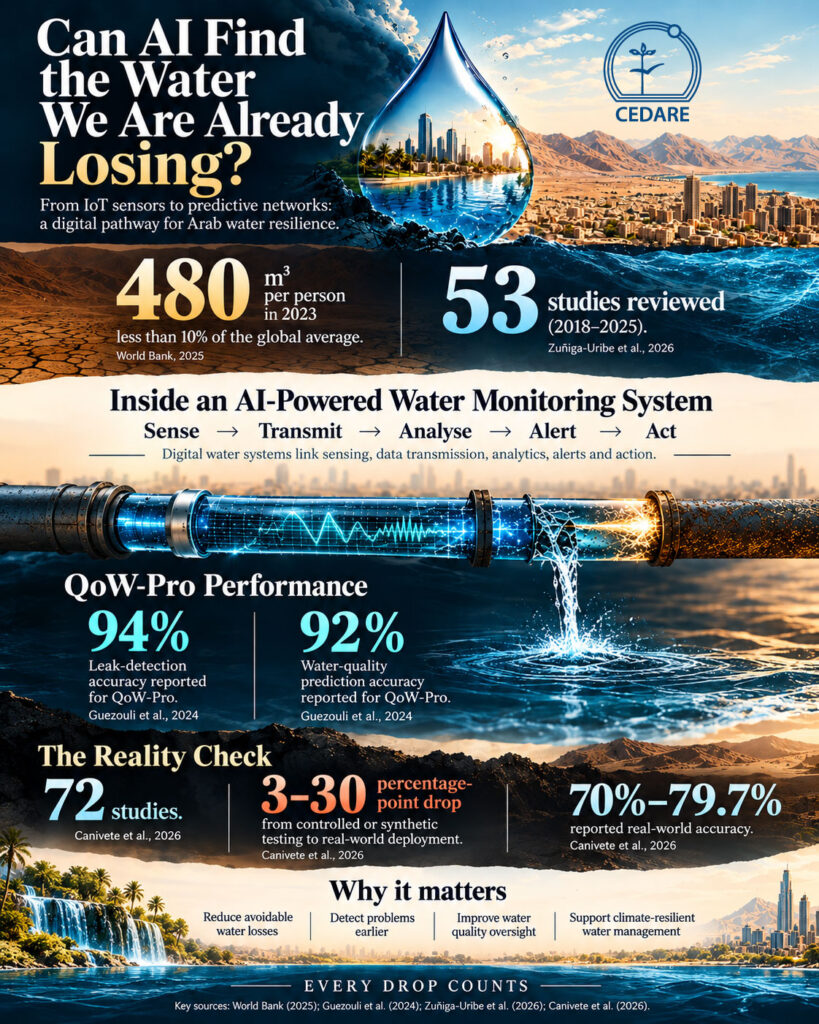
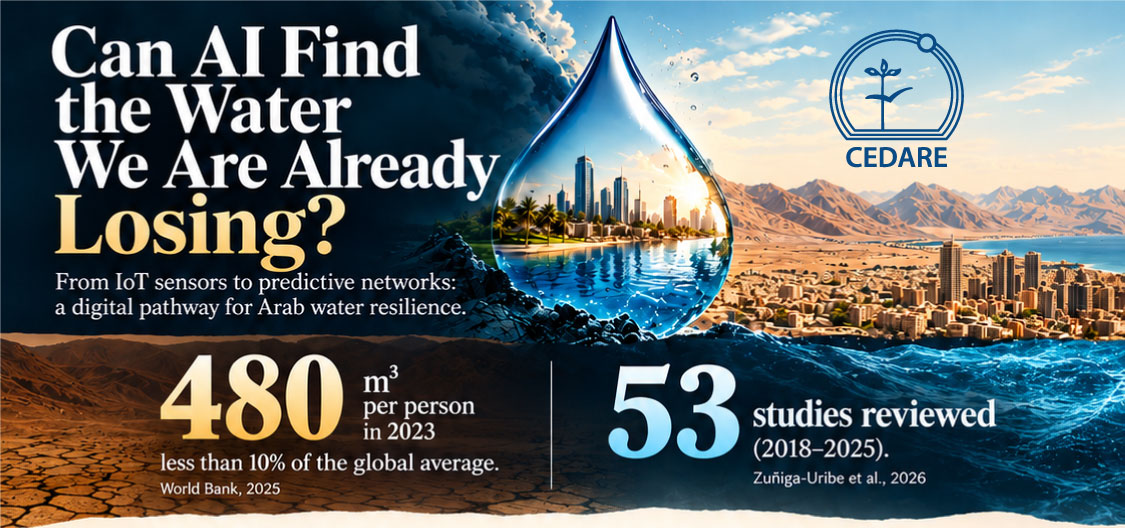
From IoT sensors to predictive networks: a digital pathway for Arab water resilience.
In one of the world’s most water-scarce regions, securing new water supplies is only part of the challenge. The other is protecting the water already produced and distributed. Average renewable water availability in the Middle East and North Africa fell to only 480 m³ per person in 2023, less than one-tenth of the global average. As climate change, population growth and urbanization intensify pressure on supplies, reducing avoidable losses could become an increasingly important source of water security (World Bank, 2025).
This is where the combination of the Internet of Things (IoT) and artificial intelligence (AI) could change conventional water management. Instead of relying mainly on periodic inspections or responding after a pipe failure becomes visible, connected sensors can continuously measure variables such as flow, pressure, pH, turbidity, temperature and dissolved solids. AI can then analyse these streams to identify abnormal patterns, predict water-quality problems and flag potential leaks almost immediately.
A 2024 study by Guezouli et al. demonstrates this concept through QoW-Pro, an integrated IoT-AI water-monitoring system. Its architecture connects field sensors to cloud platforms and applies machine-learning algorithms for anomaly detection and prediction, with alerts transmitted to users and the possibility of remotely controlling valves. The study reports 94% leak-detection accuracy and 92% water-quality prediction accuracy, compared with reported leak-detection ranges of approximately 70–80% for traditional approaches (Guezouli et al., 2024).
The potential extends beyond a single prototype. A 2026 systematic review examining 53 AI-based leak-detection studies published between 2018 and 2025 found that pressure is the most frequently used and sensitive hydraulic input. Machine-learning approaches such as support-vector machines reported accuracies of 94–100%, while CNN-based deep-learning approaches commonly achieved 95–99% in the studies reviewed. Hybrid AI approaches frequently exceeded 97%.
But high laboratory accuracy should not be confused with guaranteed performance in a real water network. Another 2026 systematic review of 72 studies found a substantial gap between controlled or synthetic testing and operational deployment: model performance could decline by roughly 3–30 percentage points. Sensor reliability, calibration, communications, representative training data and changing hydraulic conditions therefore remain critical.
This distinction matters for the Arab region. Digital water management should not mean simply installing sensors. It requires a connected chain: Sense → Transmit → Analyse → Predict → Alert → Act. A pressure or flow sensor identifies a change; IoT infrastructure transmits it; AI distinguishes routine variation from a possible anomaly; operators receive its probable location and severity; and maintenance or automated control can respond before a small leak develops into a major loss.
The opportunity is particularly relevant because the Arab region is entering a period in which water management must become increasingly proactive rather than reactive. ESCWA’s regional priorities for 2026–2030 emphasize innovation and digitization, stronger water-information systems and adaptive water governance (ESCWA, 2025). Egypt also provides a relevant context for combining flow and pressure measurement with GIS, hydraulic analysis, leak detection and utility databases to identify and reduce losses.
The next step could be more ambitious: connecting smart meters, IoT sensors, SCADA systems, GIS, hydraulic models, satellite observations and AI into digital water-management platforms. Rather than showing utilities only where the network failed, such systems could progressively help identify where failure is becoming likely.
Yet digitalization brings its own risks. Sensors require calibration and maintenance; communication networks can fail; AI models trained on one network may not perform equally well elsewhere; cybersecurity becomes increasingly important as operational infrastructure becomes connected; and utilities require personnel capable of interpreting and acting on digital information. Digital transformation therefore depends not only on technology but also on governance, skills, cybersecurity, integrated data systems and institutional capacity.
For the Arab region, this changes the water-security question. The future is not only about where the next cubic metre of water will come from, but also about how much of today’s water can be protected through better information.
As COP31 places greater emphasis on turning climate commitments into implementation, digital water systems offer a practical adaptation pathway: measure every drop, detect losses earlier, predict risks sooner and intervene faster.
The smartest new water source may be the water we stop losing.
References
Guezouli, L., Guezouli, L., Djeghaba, M.B.E. & Bentahrour, A. (2024). IoT and AI for Real-time Water Monitoring and Leak Detection. Journal of Renewable Energies, 27, 243–281. https://doi.org/10.54966/jreen.v27i2.1210
World Bank (2025). In MENA, Make Every Drop of Water Count. World Bank.
ESCWA (2025). Arab Region Priorities in the Field of Water Resources for the Period 2026–2030. United Nations Economic and Social Commission for Western Asia.
Recent 2026 systematic reviews on AI-based leak detection in water distribution systems, including reviews of 53 studies (2018–2025) and 72 studies assessing the gap between controlled testing and operational deployment.