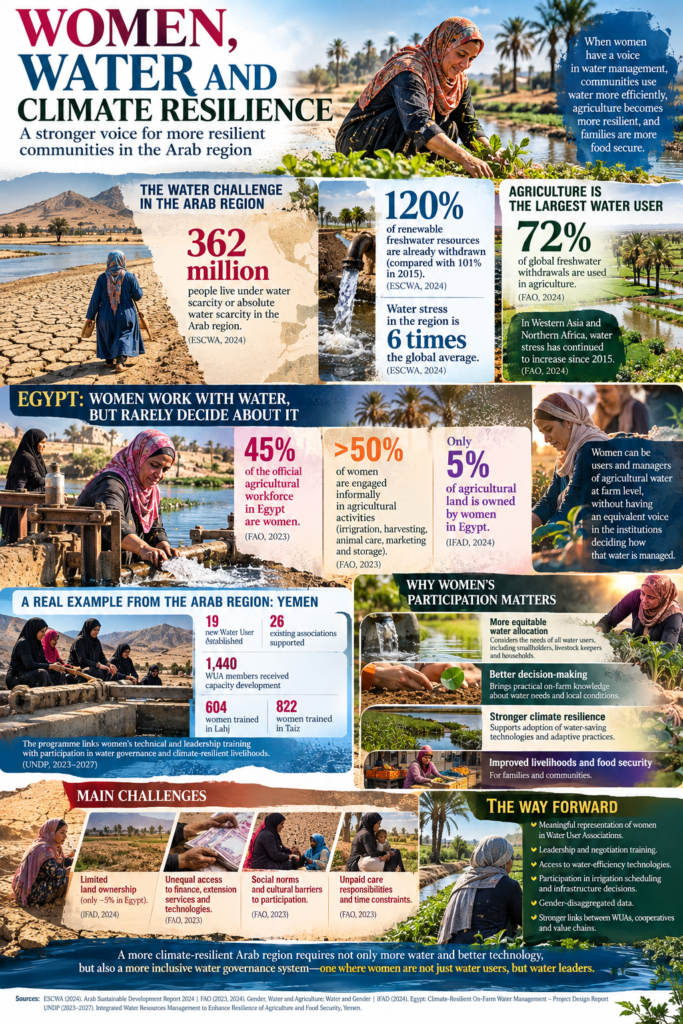
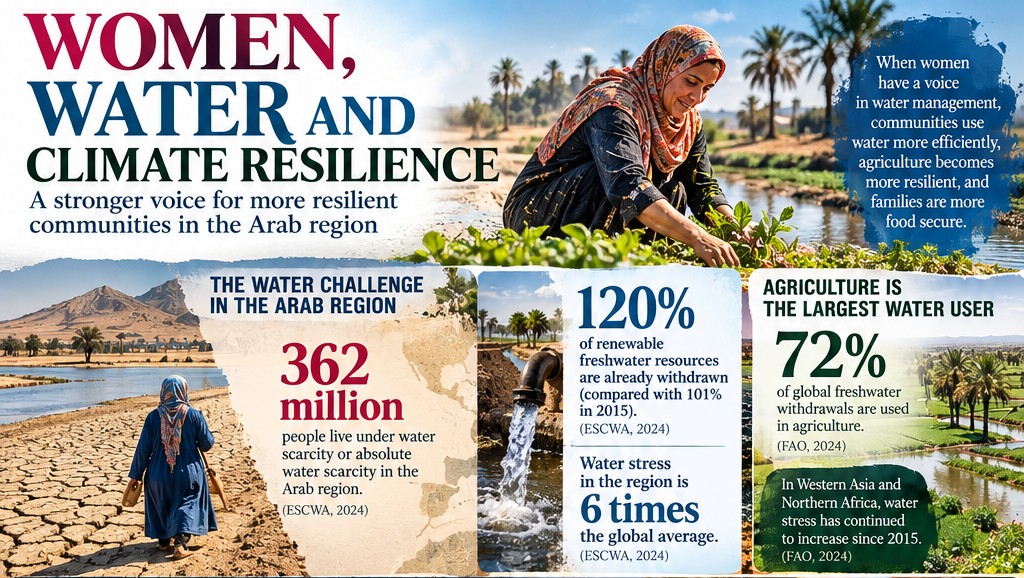
Water scarcity in the Arab region is no longer only a question of how much water is available. It is increasingly a question of how scarce water is managed—and who participates in those decisions. Nearly 362 million people in the Arab region live under conditions ranging from water scarcity to absolute water scarcity, while freshwater withdrawals have reached around 120% of available renewable freshwater resources, compared with 101% in 2015. Water stress in the region is approximately six times the global average (ESCWA, 2024).
For rural communities, the issue is particularly important because agriculture remains the dominant water user. Globally, agriculture accounts for approximately 72% of freshwater withdrawals, while pressures are particularly severe across Western Asia and Northern Africa, where water stress has continued to increase since 2015 (FAO, 2024).
Yet one group heavily involved in agricultural water use often has a limited voice in its formal management: rural women.
Egypt: Working with Water, but Not Always Deciding About It
Egypt provides a striking example. According to FAO’s Gender, Water and Agriculture: Assessing the Nexus in Egypt, women account for almost 45% of the official agricultural workforce, while more than 50% are engaged informally in activities that include irrigation, fertilization, harvesting, animal care, marketing and storage. Their contribution to agricultural production and water management is therefore substantial, but frequently informal and undervalued (FAO, 2023).
The gap becomes clearer when ownership and decision-making are considered. IFAD’s 2024 design report for Egypt’s Climate-Resilient On-Farm Water Management project estimates that women own only about 5% of agricultural land. It also describes membership of cooperatives, producer organizations and Water User Associations (WUAs) as predominantly male and notes that irrigation WUAs are “virtually devoid of women.” Yet women may still advise their families about crops and irrigation schedules and, in some areas, operate irrigation systems themselves (IFAD, 2024).
Women can be users and managers of agricultural water at farm level without having an equivalent voice in the institutions deciding how that water is managed.
FAO similarly identifies women’s under-representation in WUAs and irrigation committees as a continuing challenge because it restricts their ability to influence decisions concerning water allocation, irrigation infrastructure and resource management.
Would Greater Participation Make Water Management More Resilient?
The objective should not simply be to increase the number of women represented in committees. The more important issue is meaningful participation.
Women working in farming, livestock production, household food production and other rural activities can hold practical knowledge about when, where and for what purposes water is required. Bringing that knowledge into formal water governance can broaden the information available when communities determine irrigation priorities, maintain infrastructure, address water quality, introduce water-saving technologies or respond to shortages.
This is increasingly relevant under climate change. When water becomes less predictable, local institutions must make difficult decisions about allocation, timing, efficiency and competing uses. A Water User Association that represents only landowners may overlook the experience of people who use water for livestock, household production, food processing or agricultural activities without formally owning the land.
The potential contribution is therefore broader than “women’s empowerment.” It is about improving the information, representation and adaptive capacity of local water governance.
Evidence Is Emerging Across the Arab Region
Yemen offers an interesting current example. Under UNDP’s Integrated Water Resources Management to Enhance Resilience of Agriculture and Food Security project, 19 new Water User Associations have been established while another 26 existing associations have received support. More than 1,440 WUA members have received capacity development, alongside substantial participation by women in training activities—about 604 women in Lahj and 822 in Taiz. The programme explicitly links women’s technical and leadership training with participation in water governance, agricultural value chains and climate-resilient livelihoods (UNDP, 2023–2027).
Other initiatives demonstrate that participation can extend beyond consultation. In Yemen’s Al Maafer District, four women played leading roles in designing and implementing a community water initiative supported through a UNDP-led programme, illustrating how women’s participation can move from being beneficiaries of water projects to participating in their planning and implementation (UNDP, 2024).
But Participation Alone Is Not Enough
Simply reserving seats for women does not guarantee influence over water decisions. Limited land ownership, unequal access to finance and extension services, social norms, unpaid care responsibilities and restrictions on participation in local institutions can all affect women’s ability to participate effectively. FAO’s Egypt assessment specifically identifies economic empowerment, income, savings, credit, extension services and participation in household and community decision-making as factors affecting women’s access to land and water rights (FAO, 2023).
There is another risk: programmes can unintentionally add responsibilities without adding authority. Asking rural women to attend committees, monitor water, adopt new technologies and undertake community activities—while their existing agricultural and household workloads remain unchanged—does not necessarily constitute empowerment.
The goal therefore should not be participation for its own sake, but participation linked to knowledge, authority, resources and measurable influence over water decisions.
From Water Users to Water Leaders
As Arab countries invest in modern irrigation, treated-water reuse, digital agriculture, climate-smart farming and more efficient water allocation, institutional innovation should accompany technological innovation.
The next generation of Water User Associations could incorporate meaningful representation of women farmers and livestock keepers; leadership and negotiation training; access to agricultural extension and water-efficiency technologies; participation in irrigation scheduling and infrastructure decisions; gender-disaggregated data on agricultural water access and decision-making; and stronger links between WUAs, rural enterprises, cooperatives and agricultural value chains.
Climate resilience depends not only on finding additional water or using each cubic metre more efficiently, but also on ensuring that the people who work with water every day have a meaningful voice in deciding how it is managed.
References
FAO (2023). Gender, Water and Agriculture: Assessing the Nexus in Egypt. Food and Agriculture Organization of the United Nations.
FAO (2023). Methodological Guidance for Gender-Responsive Water Assessments. Food and Agriculture Organization of the United Nations.
FAO (2024). Water Scarcity and Agricultural Water Management resources. Food and Agriculture Organization of the United Nations.
IFAD (2024). Egypt: Climate-Resilient On-Farm Water Management – Project Design Report. International Fund for Agricultural Development.
UNDP (2023–2027). Integrated Water Resources Management to Enhance Resilience of Agriculture and Food Security, Yemen.
UNDP (2024). When Women Lead, Communities Thrive, Yemen.