
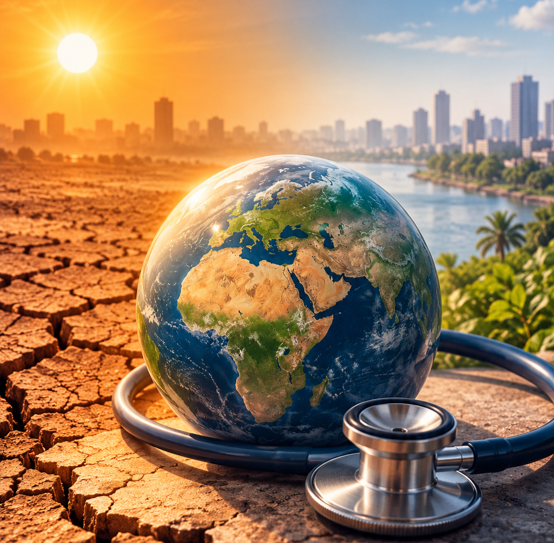
A decade after the Paris Agreement, climate change is no longer just an environmental threat; it has become an escalating global public health emergency. The Lancet Countdown Report (2026), developed in collaboration with the World Health Organization (WHO, 2026), reveals that climate-related health risks are increasing faster than global efforts to address them. Rising temperatures, extreme droughts, floods, and air pollution are claiming lives, undermining livelihoods, and placing growing pressure on health systems. Despite progress in renewable energy and climate policies, the human cost of delayed action continues to rise (ABC News, 2026). This alarming trend is evidenced by:
- Climate-related deaths are reaching unprecedented levels. Heat was associated with an estimated 710,000 deaths globally in 2023, with more than 70% attributable to human-induced climate change. Average annual heat-related deaths have increased by nearly 36% compared with the decade preceding the Paris Agreement, highlighting the growing gap between climate commitments and their impact on human health (Lancet Countdown , 2026).
- Extreme weather is threatening health, food security, and livelihoods. In 2025, more than half of the world’s land experienced extreme drought for at least one month, while increasingly severe rainfall and flooding heightened risks to water security, sanitation, and food production. Heat-related productivity losses also cost the global economy an estimated US$1.07 trillion in potential income in 2025, disproportionately affecting vulnerable workers and communities (Lancet Countdown , 2026).
- Clean energy progress is saving lives, but remains insufficient. Global clean energy investment reached US$2.1 trillion in 2025, contributing to improved air quality and preventing an estimated 323,000 premature deaths annually in countries where fossil fuel-related pollution declined. Nevertheless, fossil fuels still account for over 80% of global energy supply, and associated air pollution continues to cause approximately 2.7 million deaths annually worldwide (WHO, 2026).
Climate action must become a public health priority. As COP31 approaches, governments must recognize climate change as a global health emergency and move beyond emissions targets to integrate health into climate policies, financing, and adaptation planning. This requires stronger early warning systems, climate-resilient healthcare, accelerated emissions reductions, and greater support for vulnerable countries (ABC News, 2026).
For the Arab region, where extreme heat, water scarcity, and vulnerable livelihoods pose growing risks, linking climate resilience with public health, food security, and social protection is particularly urgent. Ultimately, climate action is not only about protecting the planet, but also about protecting human lives, and its success must be measured not only by emissions reduced, but by lives saved, health risks prevented, and communities protected.