
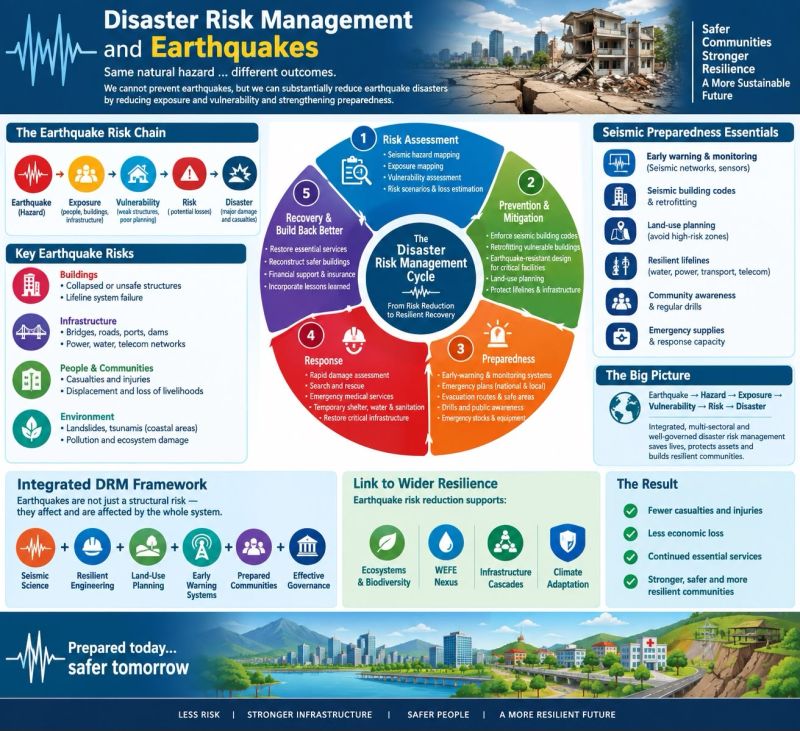
Earthquake risk management should follow a risk-reduction cycle rather than focusing only on emergency response:
1. Risk Assessment
* Seismic hazard mapping and fault identification
* Exposure mapping: population, buildings, infrastructure
* Vulnerability assessment of old and critical buildings
* Earthquake risk scenarios and loss estimation
2. Prevention & Mitigation
* Enforce seismic building codes
* Retrofitting vulnerable buildings
* Earthquake-resistant design for dams, bridges, hospitals and lifelines
* Land-use planning away from high-risk zones
* Protect water, electricity, transport and communication networks
3. Preparedness
* Earthquake early-warning and monitoring systems
* Emergency plans at national, city and institutional levels
* Evacuation routes and safe assembly areas
* Regular drills and public awareness
* Emergency stocks and response equipment
4. Response
* Rapid damage assessment
* Search and rescue
* Emergency medical services
* Temporary shelter, water and sanitation
* Restoration of critical infrastructure
5. Recovery & Build Back Better
* Restore essential services
* Reconstruct safer buildings
* Financial support and insurance mechanisms
* Incorporate lessons learned into future planning
The key concept
Earthquake → Hazard → Exposure → Vulnerability → Risk → Disaster
Therefore:
We cannot prevent earthquakes, but we can substantially reduce earthquake disasters by reducing exposure and vulnerability and strengthening preparedness.
Earthquake DRM = Seismic Science + Resilient Engineering + Land-Use Planning + Early Warning + Prepared Communities + Effective Governance
For broader Disaster Risk Management framework, earthquakes can be connected directly with engineering environmental control, ecosystem resilience, infrastructure cascades, WEFE Nexus, and early-warning systems.