The Arab region’s race for carbon-competitive industry | CEDARE COP31 Insight
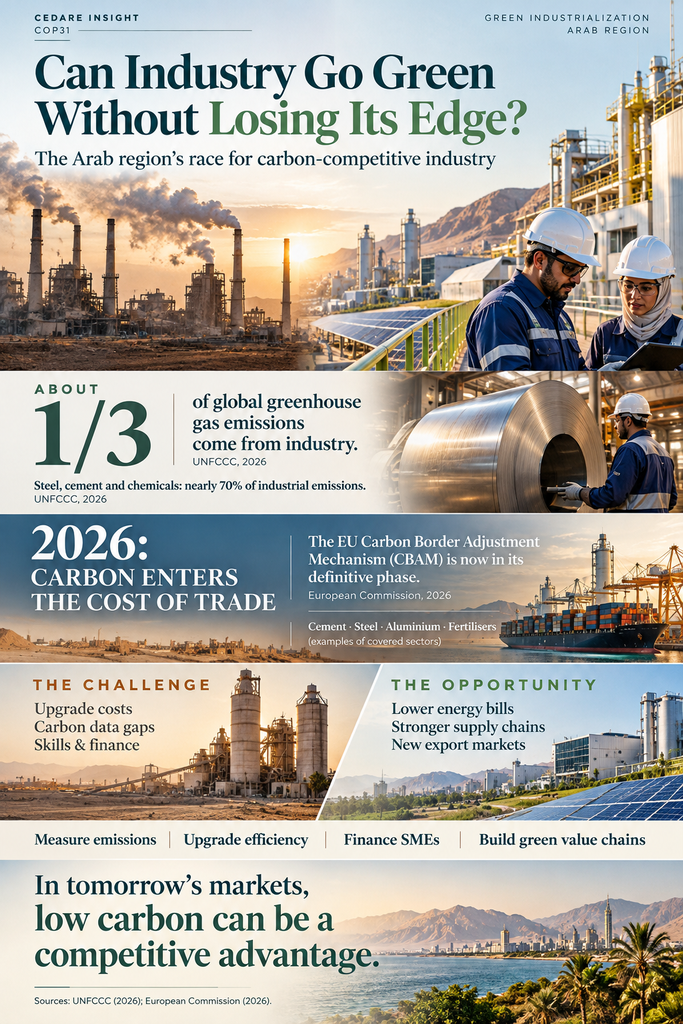
Industrial competitiveness is being redefined. Price, productivity and market access still matter, but the carbon footprint of a product is increasingly part of the commercial equation. Industry accounts for approximately one-third of global greenhouse-gas emissions, and steel, cement and chemicals contribute nearly 70% of industrial emissions (UNFCCC, 2026a). Green industrialization is consequently a COP31 priority, with a dedicated spotlight scheduled for 16 November 2026 (UNFCCC, 2026b).
Two routes to green industrialization
The transition has two complementary forms. Greening existing industries means making cement, steel, fertilizers, textiles and chemical production less energy- and resource-intensive through efficiency upgrades, cleaner electricity, waste-heat recovery, water and material reuse, and lower-carbon inputs. Creating new green industries means developing renewable-energy equipment, energy storage, recycled materials, low-carbon fuels and specialized environmental services. The first helps protect existing jobs and exports; the second can generate new industrial value chains and skills. For Arab economies, the strategic advantage lies in combining both rather than relying on imported technologies alone (UNIDO, 2025).
When carbon becomes a cost of trade
The European Union’s Carbon Border Adjustment Mechanism (CBAM) entered its definitive regime on 1 January 2026. It initially covers selected imports of cement, iron and steel, aluminium, fertilizers, electricity and hydrogen. Its objective is to align the carbon price of covered imports with that of comparable EU production; certificate purchases for emissions associated with 2026 imports begin in 2027 (European Commission, 2026a; 2026b). This does not affect every Arab export, but it makes credible emissions measurement and lower-carbon production increasingly relevant to exporters in the covered sectors.
For Morocco, UNIDO reported that 64% of exports go to the EU, making industrial decarbonization a practical competitiveness concern rather than only an environmental ambition (UNIDO, 2024). In Egypt, manufacturing contributes about 16% of GDP and 14% of employment, while UNIDO identifies dependence on fossil fuels, high resource intensity and slow progress in decoupling industrial output from emissions as continuing challenges (Brugger, 2026).
From international agreements to factory-level procedures
International frameworks do not impose identical obligations. Under the Paris Agreement, governments prepare and maintain Nationally Determined Contributions (NDCs) and pursue domestic policies to implement them; the Agreement does not directly impose a uniform emissions limit on every factory (UNFCCC, 2026c). The 2025 Belém Declaration on Global Green Industrialization is a voluntary cooperation framework for mobilizing finance, technology and new industrial capacity, rather than a binding trade requirement (UNIDO, 2025).
The EU’s CBAM has more direct commercial implications for covered exports. EU importers carry the legal responsibilities for authorization, declarations and certificates, while Arab producers wishing to supply actual emissions figures must calculate product-level embedded emissions and arrange verification by an accredited independent verifier (European Commission, 2026a; 2026c). A practical factory sequence is to identify covered products, audit energy and material inputs, quantify emissions, verify the results and share the required information with EU buyers. ISO 14001:2026 for environmental management and ISO 50001, with its 2024 climate-action amendment, can support continuous improvement, but certification is generally voluntary and does not replace CBAM obligations (ISO, 2026; ISO, 2024).
The challenge: paying for the transition without losing markets
Factory upgrades can require substantial upfront investment, reliable clean electricity, new production processes, verified emissions data and specialized skills. Small and medium-sized enterprises (SMEs) are especially exposed to financing and technical-capacity gaps. The challenge is not uniform: cement must address process emissions as well as fuel use, while fertilizers and steel face different choices involving electricity, hydrogen and feedstocks. A one-size-fits-all transition could raise costs without delivering sufficient reductions (UNIDO, 2024; Brugger, 2026).
Green hydrogen illustrates the risk of moving faster than markets. North Africa has promising opportunities for green ammonia, methanol and steel, but IRENA identifies uncertain buyers, infrastructure shortages, finance and skills as major barriers (IRENA, 2025). Globally, low-emissions hydrogen remained below 1% of hydrogen production in 2025, underscoring the distance between announcements and commercial deployment (IEA, 2026).
The impact: a compliance burden—or an industrial opportunity?
Delayed action can increase exposure to carbon-related trade requirements and reduce appeal to buyers seeking lower-emission supply chains. Well-sequenced action, however, can reduce energy and material bills, improve resource security, stimulate domestic services and create opportunities for higher-value low-carbon exports. Circular production—reusing materials, industrial by-products and waste heat—can strengthen competitiveness without relying on expensive frontier technology in every factory (Brugger, 2026; UNFCCC, 2026).
A practical Arab competitiveness agenda
First, measure before investing: establish plant-level energy, material and emissions baselines and credible monitoring, reporting and verification systems. Second, prioritize economically viable upgrades—energy efficiency, heat recovery, cleaner electricity and material efficiency—before committing to high-cost technologies. Third, develop shared green industrial infrastructure and bankable projects, while using blended finance and targeted technical support to prevent SMEs from being excluded. Finally, localize skills and supply chains so that Arab economies manufacture more green products rather than merely import green equipment (UNIDO, 2024; IRENA, 2025; Brugger, 2026).
What should COP31 deliver?
COP31’s green-industrialization discussions are expected to emphasize finance, competitiveness, investment conditions, international cooperation and scalable low-carbon technologies. The test will be whether these discussions help translate national pledges into credible industrial roadmaps, investable projects and fair access to technology—not just new targets (UNFCCC, 2026a).
The most competitive Arab factories of tomorrow may not be those with the cheapest energy today, but those that deliver more value with less carbon, fewer wasted resources and stronger market access.
References
UNFCCC (2026a). COP31 Presidency Event: Green Industrialization – Concept Note. Full text
UNFCCC (2026b). Global Climate Action at COP31: Event Programme. Full text
European Commission (2026a). Carbon Border Adjustment Mechanism (CBAM): Definitive Regime. Full text
European Commission (2026b). First CBAM Certificate Price Is Now Available (7 April). Full text
Brugger, F. (2026). Manufacturing and Environmental Performance in Egypt: Evidence and Policy Options. UNIDO, Working Paper 2/2026. Full text
UNIDO (2024). Morocco: Developing an Industrial Decarbonization Roadmap Framework (6 February). Full text
IRENA (2025). Enabling Green Hydrogen Development: North Africa. International Renewable Energy Agency. Full text
IEA (2026). Global Hydrogen Review 2026: Executive Summary. International Energy Agency. Full text
UNIDO (2025). Leaders Unite to Launch Belém Declaration on Global Green Industrialization at COP30 (14 November). Full text
UNFCCC (2026c). Nationally Determined Contributions (NDCs): The Paris Agreement and NDCs. Full text
European Commission (2026c). CBAM Verification: Rules and Accreditation Framework. Full text
ISO (2026). ISO 14001:2026: Environmental Management Systems — Requirements with Guidance for Use. Full text
ISO (2024). ISO 50001:2018/Amd 1:2024: Energy Management Systems — Climate Action Changes. Full text