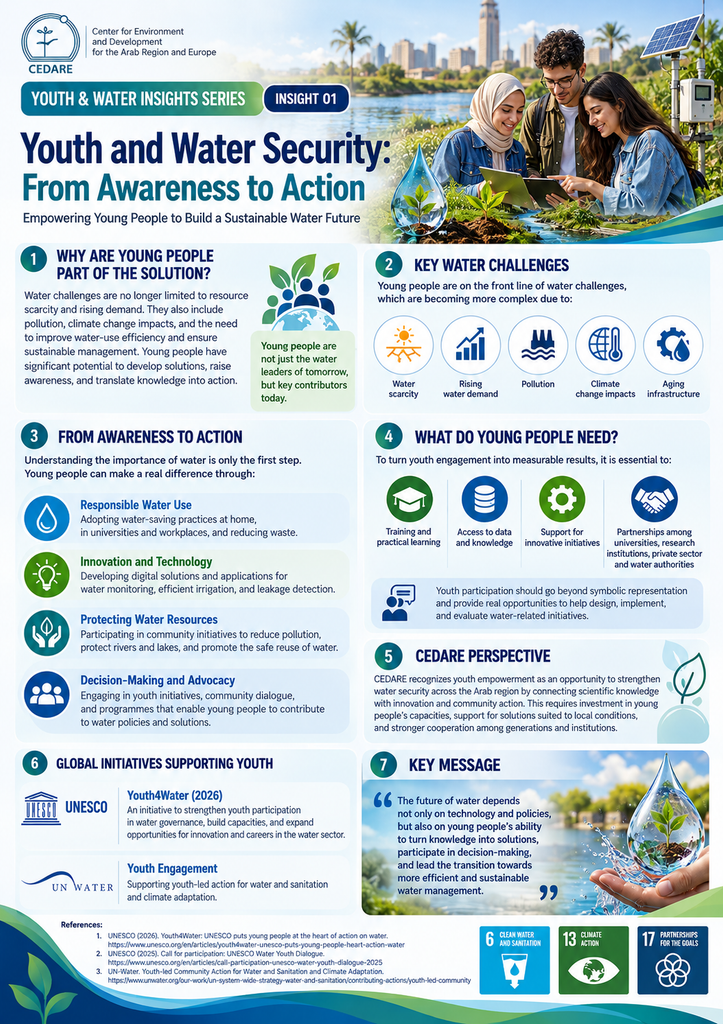
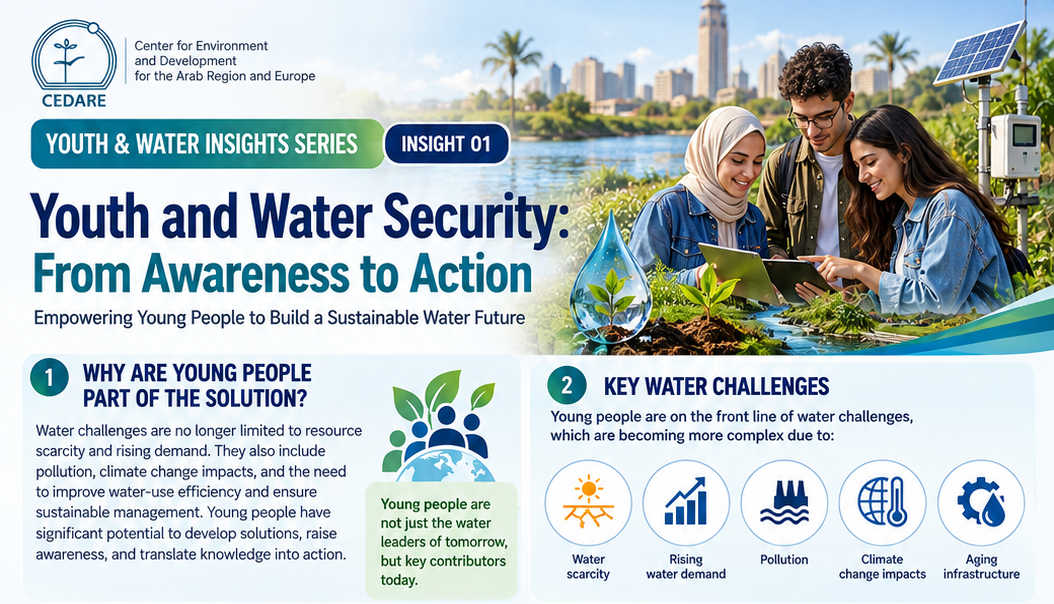
Youth & Water Insights Series | Insight 01
Empowering Young People to Build a Sustainable Water Future
Why Are Young People Part of the Solution?
Water challenges are no longer limited to resource scarcity and rising demand. They also include pollution, climate change impacts, the need to improve water-use efficiency, and the challenge of ensuring sustainable water management. In addressing these pressures, young people have significant potential to develop solutions, raise awareness, and translate knowledge into practical action.
In 2026, UNESCO’s Intergovernmental Hydrological Programme adopted Youth4Water, an initiative that aims to strengthen youth participation in water governance, build capacities, and expand opportunities for innovation and careers in the water sector (UNESCO, 2026).
From Awareness to Meaningful Participation
Understanding the importance of water is only the first step. Young people also need opportunities to contribute to its protection and sustainable management. This can be achieved through practical actions, including:
- Responsible Water Use: Promoting water-saving practices at home, in universities, and in workplaces while reducing unnecessary waste.
- Innovation and Technology: Developing digital solutions and applications that support water-consumption monitoring, efficient irrigation, and leakage detection.
- Water Resource Protection: Participating in community initiatives to reduce pollution, protect rivers and lakes, and promote the safe reuse of water.
- Decision-Making and Advocacy: Engaging in youth initiatives, community dialogue, and programmes that enable young people to contribute to water policies and solutions.
The UNESCO Water Youth Strategy, developed following the 2025 UNESCO Water Youth Dialogue, highlights capacity development, innovation, and meaningful youth participation in decision-making as important priorities (UNESCO, 2025).
What Do Young People Need to Make a Difference?
Turning youth engagement into measurable results requires access to training, practical learning opportunities, data and knowledge, and support for innovative initiatives and projects. Partnerships among universities, research institutions, the private sector, and water-management authorities can help young people turn ideas into scalable solutions.
Youth participation must also go beyond symbolic representation at events and consultations. Young people should have meaningful opportunities to help design, implement, and evaluate water-related initiatives.
CEDARE Perspective
The Center for Environment and Development for the Arab Region and Europe (CEDARE) recognizes youth empowerment as an opportunity to strengthen water security across the Arab region by connecting scientific knowledge with innovation and community action. This requires investment in young people’s capacities, support for solutions suited to local conditions, and stronger cooperation among generations and institutions.
Key Message: The future of water depends not only on technology and policies, but also on young people’s ability to turn knowledge into solutions, participate in decision-making, and lead the transition towards more efficient and sustainable water management.
References
- UNESCO (2026). Youth4Water: UNESCO Puts Young People at the Heart of Action on Water.
- UNESCO (2025). Call for Participation: UNESCO Water Youth Dialogue.
- UN-Water. Youth-led Community Action for Water and Sanitation and Climate Adaptation.