
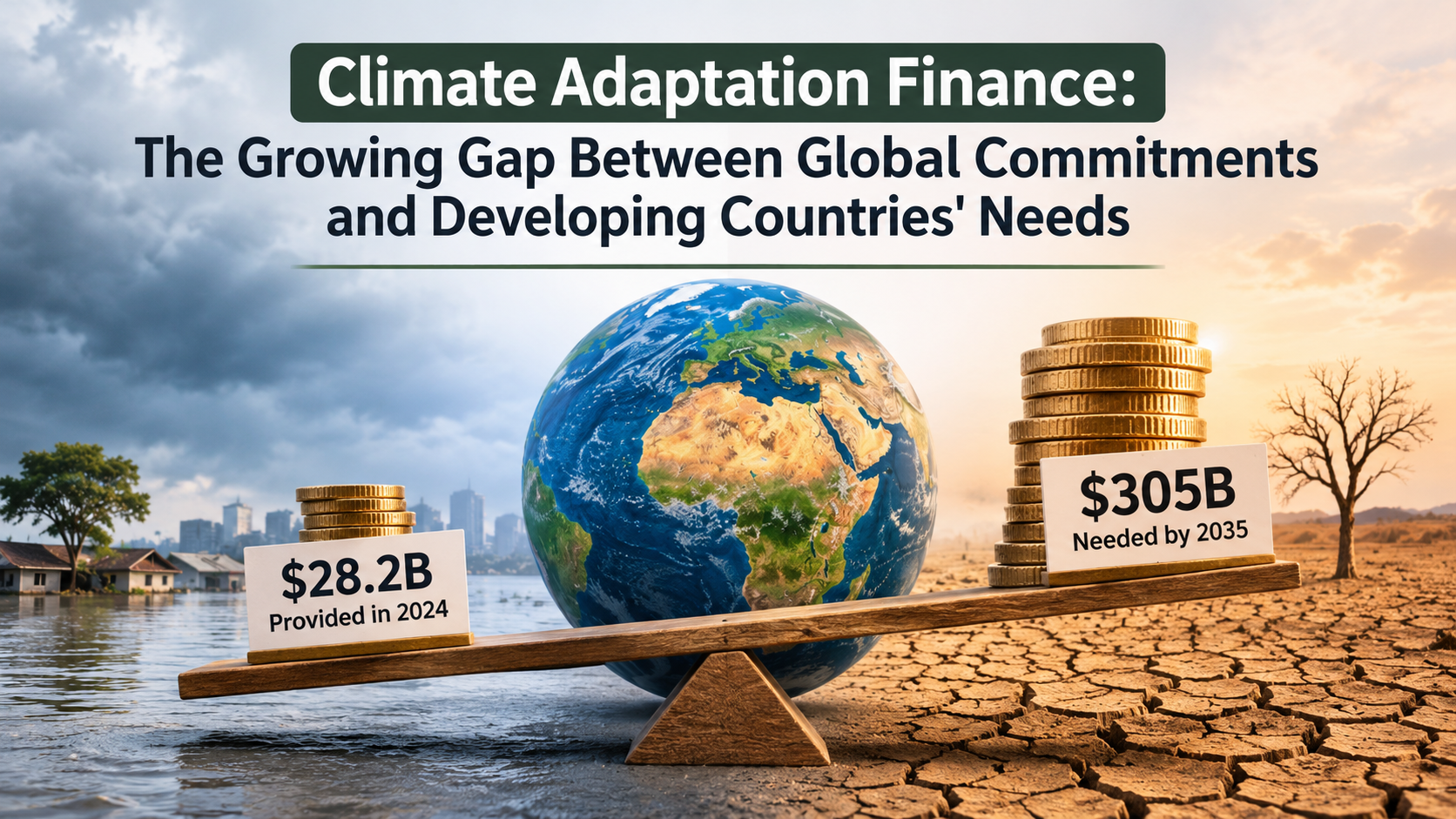
The widening gap between international climate adaptation commitments and actual financial support highlights a critical weakness in global climate governance: while developing countries face increasingly severe climate impacts, the financial resources required to strengthen their resilience remain significantly below what is needed. The latest United Nations Environment Programme (UNEP) 2026 Adaptation Gap Report illustrates that climate adaptation is no longer simply a matter of setting ambitious targets, but increasingly a question of whether international commitments translate into adequate, accessible and predictable financing (UNEP, 2026).
This raises concerns about the ability of vulnerable countries to protect their populations, infrastructure, ecosystems and economies, particularly as global temperatures approach and potentially exceed the 1.5°C threshold. This is evidenced by:
- The financing gap remains substantial:
According to Reuters, developed countries provided only $28.2 billion in adaptation finance in 2024, compared with an estimated annual requirement of $305 billion by 2035. This demonstrates the significant disparity between financial contributions and the actual needs of developing countries (Reuetrs, 2026). - Existing international commitments remain insufficient:
The Guardian reported that even tripling adaptation finance to between $85 billion and $120 billion annually by 2035 would cover only 20–29% of developing countries’ projected needs. Furthermore, least developed countries received 16% less adaptation support in 2024 than in 2022, highlighting the continued vulnerability of countries with limited financial capacity (The Guardian, 2026). - The consequences extend beyond financial shortages:
According to Agence France-Presse (AFP), developing countries currently receive approximately 10 cents for every dollar required to finance climate adaptation. The report also highlights the growing pressure on the Loss and Damage Fund, which received requests worth $2.8 billion against an initial funding allocation of just $342 million (AFP, 2026).
Ultimately, bridging the global adaptation finance gap requires translating international climate commitments into predictable and accessible funding, particularly for vulnerable Arab countries facing water scarcity, extreme heat, desertification and coastal risks. Arab countries should strengthen regional cooperation, improve climate project pipelines, and mobilize domestic and private-sector financing to complement international support and narrow the gap between adaptation needs and available resources.