
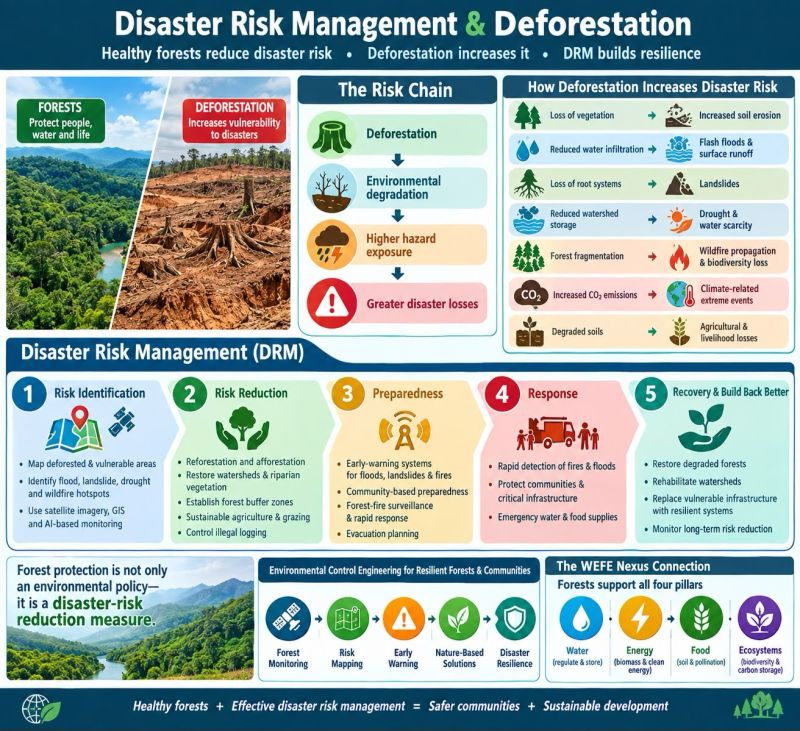
Deforestation is both a driver of disaster risk and a factor that increases the severity of disasters. Disaster Risk Management (DRM) can therefore be used to prevent, reduce, and manage the risks created by forest loss.
🌳 The Risk Chain
Deforestation → Environmental degradation → Higher hazard exposure → Greater disaster losses
Deforestation impact Disaster risk created
Loss of vegetation Increased soil erosion
Reduced water infiltration
Flash floods & surface runoff
Loss of root systems
Landslides
Reduced watershed storage Drought and water scarcity
Forest fragmentation
Wildfire propagation & biodiversity loss
Increased CO₂ emissions Climate-related extreme events
Degraded soils Agricultural and livelihood losses
🔄 DRM Approach
1. Risk Identification
* Map deforested and vulnerable areas.
* Identify flood, landslide, drought and wildfire hotspots.
* Use satellite imagery, GIS and AI-based monitoring.
2. Risk Reduction
* Reforestation and afforestation.
* Restore watersheds and riparian vegetation.
* Establish forest buffer zones.
* Apply sustainable agriculture and grazing.
* Control illegal logging.
3. Preparedness
* Early-warning systems for floods, landslides and fires.
* Community-based disaster preparedness.
* Forest-fire surveillance and rapid response.
* Emergency evacuation planning.
4. Response
* Rapid detection of fires and floods.
* Protect communities and critical infrastructure.
* Emergency water and food supplies.
5. Recovery & Build Back Better
* Restore degraded forests.
* Rehabilitate watersheds.
* Replace vulnerable infrastructure with resilient systems.
* Monitor whether restoration actually reduces future risk.
🎯 The key concept
Forest protection is not only an environmental policy—it is a disaster-risk reduction measure.
A useful Environmental Control Engineering framework would connect:
Forest Monitoring → Risk Mapping → Early Warning → Nature-Based Solutions → Disaster Resilience
This also fits strongly with the Water–Energy–Food–Ecosystem (WEFE) Nexus, because forests regulate water, protect soil, store carbon, support biodiversity, and protect agricultural systems.
9
previous post