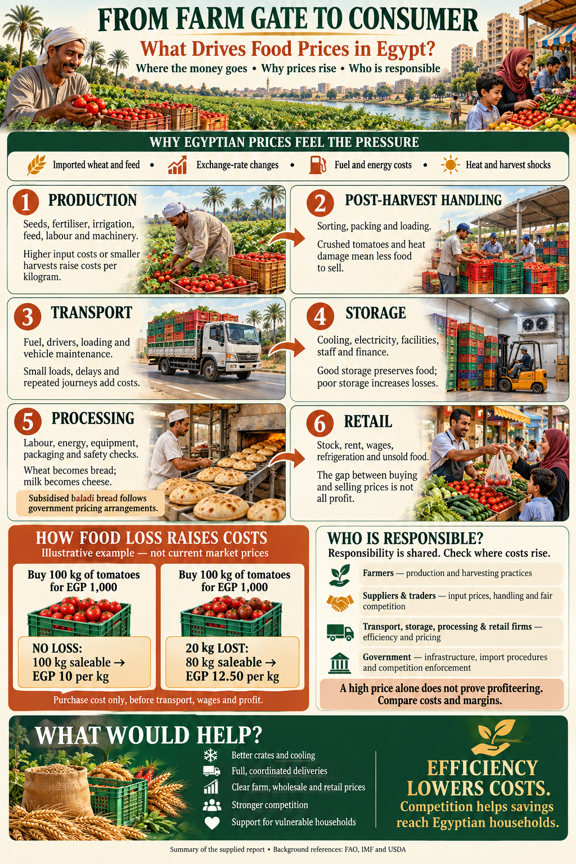
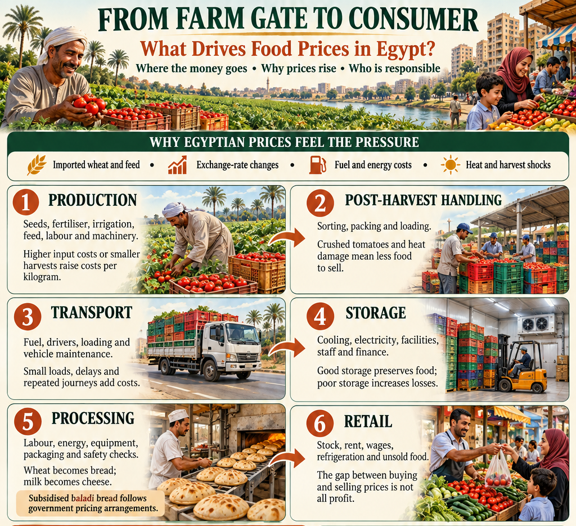
Where the money goes, why prices rise, and who is responsible
Anyone who regularly shops for food in Egypt knows the frustration: you buy roughly the same things, but the bill keeps changing. Tomatoes become expensive, chicken follows, and even a basic family meal starts putting pressure on the household budget.
The shopkeeper is the person we pay, so they are often the first person we blame. But the price on the shelf is the result of decisions, costs and losses that begin long before food reaches the shop.
A crop may leave a farm at one price and reach consumers at a much higher price. Part of that difference pays for necessary services. Part may reflect waste, poor organization or weak competition. Understanding which is which is essential if we want to make food more affordable.
1. Production: the farmer’s costs come first
Before a farmer sells a single kilogram, they have already paid for seeds, fertilizers, irrigation, labour and machinery. They may also be paying land rent and interest on borrowed money.
For poultry and livestock producers, feed is another major expense. This connects Egyptian food prices to international markets. Egypt imports wheat and maize, and imported maize helps supply its poultry and animal feed industries. A chicken raised in Egypt can therefore become more expensive because of costs originating outside Egypt.
The exchange rate matters too. When more Egyptian pounds are needed to buy the same dollar priced input, businesses face a higher cost even if the foreign supplier has not changed its price. The IMF’s analysis of Egypt’s inflation has identified currency depreciation, difficulties accessing foreign currency, weather conditions and supply chain disruptions as contributing factors.
Harvest size also affects prices. If heat or pests reduce the crop, the farmer has fewer kilograms over which to spread their expenses. Less food reaching the market can then push selling prices higher.
This is why a higher farm-gate price does not necessarily mean a better income for the farmer. Their costs may have increased even more.
2. Post-harvest handling: damaged food makes the remaining food more costly
Once vegetables are harvested, they need to be sorted, packed and loaded. This sounds straightforward, but what happens during these few hours can affect both quality and price.
Think of tomatoes packed into unsuitable containers, stacked too heavily or left in the sun. Some will arrive damaged. Others will spoil before they can be sold. The money spent growing and buying that food has already been paid, even though the food itself has been lost.
FAO’s work on food losses in Egypt identifies poor harvesting, packing, storage and transport, along with exposure to heat and sunlight, as causes of loss.
Here is a simple illustration, rather than an actual market quotation. A trader buys 100 kilograms of tomatoes for EGP 1,000. If all of them can be sold, the purchase cost is EGP 10 per kilogram. If 20 kilograms spoil, the purchase cost rises to EGP 12.50 for each remaining kilogram—before transport, wages or profit.
Someone must absorb that loss. It may reduce the trader’s earnings, lead to lower offers to farmers, or contribute to higher consumer prices.
3. Transport: we pay for the journey as well as the food
Food needs to move from farms to collection points, wholesale markets and neighborhood shops. Every journey involves fuel, drivers, loading and vehicle maintenance.
For example, vegetables travelling from a farm in the Delta to a shop in Cairo may pass through several businesses. Each transfer can involve additional handling, waiting and payment.
Distance matters, but organization matters just as much. A full truck making a direct journey is generally cheaper per kilogram than several small deliveries. Delays can also damage perishable produce, especially when it is not kept at a suitable temperature.
When fuel becomes more expensive, the effect can spread across the chain: farm machinery, collection vehicles and shop deliveries all become more costly. Egypt’s IMF reports document fuel-price adjustments alongside wider inflation pressures.
Removing a middleman only saves money if their work can be done more cheaply by someone else. Farmers still need a way to collect, transport and sell their produce.
4. Storage: preserving food costs money, but losing it costs money too
Food is not always consumed immediately after harvesting. Grain needs protection from moisture and pests. Milk, meat and many fresh products need appropriate cooling.
Storage businesses pay for facilities, electricity, maintenance and staff. They also have money tied up in stock until it is sold.
In Egypt’s hot conditions, suitable handling and storage are particularly important for perishable food. Inadequate facilities can shorten the time available to sell it. Better storage can preserve supply and give farmers and traders more flexibility over when they sell.
Storage should not automatically be treated as evidence of hoarding. Keeping food available between harvests serves a useful purpose. Deliberately restricting supply to manipulate prices is a separate issue that needs evidence.
5. Processing: wheat and bread are not the same product
A bakery does more than buy flour. It pays for workers, energy, equipment and deliveries. A dairy processor turning milk into yoghurt or cheese also pays for packaging, cooling and food-safety checks.
Processing changes the product and sometimes the amount available for sale. A kilogram of raw material does not always produce a kilogram of finished food. This means that a fall in wheat prices will not necessarily produce an equal fall in bread prices. Other expenses may remain high.
Egypt also has an important distinction between subsidized baladi bread and bread sold at market prices. Subsidized bread follows government pricing and support arrangements, so its consumer price cannot be understood in the same way as an ordinary commercial product. Egypt’s reliance on imported wheat makes procurement costs relevant to both public spending and commercial milling.
6. Retail: the selling price must cover the shop’s expenses
The neighborhood vegetable seller, grocery shop and supermarket all pay for the food they sell. They also face expenses such as rent, wages, electricity, refrigeration and unsold stock. The difference between a shop’s buying and selling prices is therefore not all profit. Those operating expenses have to be deducted first. But consumers are right to question increases. If a seller says prices have risen because of costs, those costs should help explain the increase. A widening gap between wholesale and retail prices deserves closer examination, especially if it persists after supply conditions improve. Comparisons also need to be fair: the same product, quality, unit and date. Comparing a farm price from one week with a supermarket price from another can give a misleading picture.
Who is responsible for the problem?
In Egypt, responsibility is shared, but it is not identical at every stage.
Farmers are responsible for production and harvesting practices, but they cannot individually control exchange rates, international feed prices or extreme weather. Small farmers may also have limited bargaining power when their crops need to be sold quickly.
Input suppliers, traders and wholesalers influence the prices farmers pay and receive. They provide necessary services, but inefficient handling, collusion or abuse of market power can add avoidable costs.
Transporters, storage operators, processors and retailers are responsible for how efficiently they operate and how they set prices. Higher expenses can explain an increase; they should not become a blanket excuse for every increase.
The government and public authorities influence the conditions in which the whole chain operates. Infrastructure, import procedures, fuel and electricity pricing, agricultural support and competition enforcement all matter. The IMF has identified stronger competition institutions and easier trade procedures as priorities for Egypt’s reforms.
There is also a difference between causing a shock and being responsible for the response. Egypt cannot control world grain prices, but public policy and business preparedness can affect how severely a global shock reaches Egyptian households.
Where efficiency makes a difference
Efficiency means getting more usable food to consumers with fewer wasted resources. Better crates can prevent damage. Coordinated deliveries can reduce empty journeys. Suitable storage can keep food saleable for longer. Better market information can help farmers find buyers before their crops deteriorate. These improvements create room for lower costs without forcing farmers or workers to accept less income. However, savings do not automatically reach consumers. Businesses may keep them as profit, particularly where competition is weak. That is why Egypt needs both a more efficient food chain and markets that give buyers and sellers real alternatives.
What would help Egyptian households?
A practical starting point is clearer price information: what farmers receive, what wholesalers charge and what consumers pay for comparable products. Investment should also target the points where food is being lost or journeys are being duplicated. Farmer groups could share collection, transport and storage services where these arrangements genuinely reduce costs. Competition authorities should investigate suspected collusion using evidence about prices, costs and business behavior.
Support for vulnerable households remains important because improvements to the supply chain take time. Families still need to eat while those changes are being made. The question is not simply, “Who raised the price?” It is, “What changed between the farm and the shop, was that increase necessary, and who benefited?” Answering that carefully gives Egypt a better chance of protecting both the people who produce food and the people who buy it.