
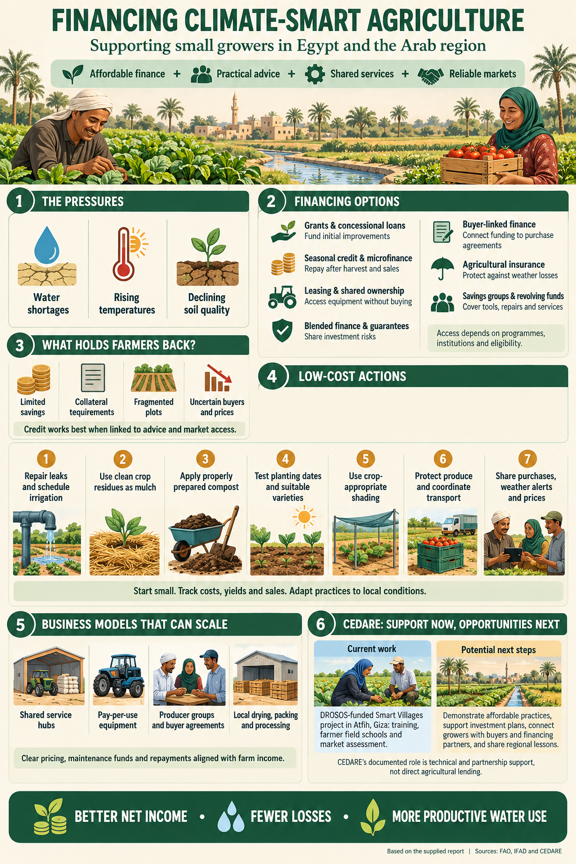
For small growers in Egypt and the Arab region, climate change is already a challenge to earning a dependable living. Water shortages, rising temperatures and deteriorating soil quality put pressure on yields and household incomes. Climate Smart Agriculture can help farmers improve productivity, adapt to changing conditions and reduce emissions where possible. However, farmers need solutions they can afford, maintain and trust to deliver a reasonable production.
Available financing instruments
Different forms of finance can support different stages of adaptation. Grants and concessional loans can help cover the initial costs of irrigation improvements, suitable crop varieties, protected cultivation and training. Microfinance can pay for seeds and other inputs, with repayments scheduled after harvest and sales. Equipment leasing and shared ownership allow farmers to access machinery, pumps and cooling facilities without paying the full purchase price.
Blended finance combines public or donor funding with commercial investment, while credit guarantees help reduce lenders’ risks. Buyer-linked finance connects input advances or working capital with purchase agreements from processors, retailers or exporters. Agricultural insurance can help manage weather related losses where affordable policies and reliable claims systems exist. Access to these instruments depends on national program, participating institutions and farmer eligibility.
For smaller investments, well managed community savings groups or revolving funds could help farmers pay for repairs, tools and shared services. Such arrangements need transparent records, affordable terms and clear responsibilities.
Why investment remains difficult
Many small growers have limited savings and little capacity to absorb a failed harvest or an unsuccessful investment. Their earnings fluctuate, while lenders may require collateral or formal records they cannot provide. Small, fragmented holdings also make individual equipment purchases expensive. Uncertain markets add another risk: producing more does not necessarily mean earning more if buyers are unavailable or prices fall.
Egypt’s experience shows why finance must be linked to market support. IFAD’s evaluation of the PRIME project found that lending and marketing activities often operated in different locations, limiting their benefits for participating farmers. Weak producer associations and insufficient business and financial training also controlled results. Credit therefore needs to come with practical support and a realistic route to sales. ioe.ifad.org
Low cost solutions farmers can start with
Adaptation does not always require expensive equipment. FAO, IFAD and the Islamic Development Bank have identified affordable climate-smart technologies for smallholders, including farmers in Egypt, Jordan, Morocco, Palestine and Tunisia. Their work covers water management, crop protection, post-harvest handling and market access. fao.org
Practical options to assess locally include:
- Improve irrigation management. Check soil moisture before watering, repair leaking pipes and valves, and adjust irrigation to crop needs and weather conditions. Better management of existing systems can be a useful first step before purchasing new equipment.
- Cover exposed soil. Appropriate, clean crop residues can be used as mulch to reduce evaporation and protect the soil. Farmers should consider competing uses for residues, such as animal feed, and avoid material carrying pests or disease.
- Use locally available organic matter carefully. Properly prepared compost can improve soil structure and moisture retention. Application should reflect crop needs and soil conditions.
- Adjust planting dates and test suitable varieties. Local extension advice can help farmers choose planting periods and varieties suited to heat, water availability and market demand. Small trial plots can limit the cost of testing a change.
- Provide simple crop protection. Where appropriate, shade nets or locally available shading materials can protect nurseries and sensitive crops. Shading levels need to match the crop.
- Reduce losses after harvest. Keep produce shaded, handle it gently, use suitable reusable crates and coordinate transport to shorten delays before sale.
- Share purchases and information. Joint input orders, phone based groups for weather alerts, extension advice and market prices can reduce costs and improve coordination.
FAO guidance supports soil cover, organic matter management, locally appropriate planting calendars and low-cost protected cultivation. Their suitability and savings will vary by crop and location. fao.org
Low cost measures still require labor, materials and upkeep. Farmers should start with the problems causing their largest losses, test changes on a manageable scale and keep simple records of costs, yields and sales.
Business models that can help growers survive
Collective investment can make services affordable for farms that are too small to justify owning equipment. Farmer-owned service hubs could offer machinery, irrigation maintenance, grading, storage and transport for a fee. Local enterprises could provide equipment services, allowing growers to pay when needed.
Producer groups can combine harvests, negotiate clearer purchase agreements and share the cost of meeting buyers’ quality requirements. Small drying, packing and processing businesses facilities can also reduce losses and create income opportunities for women and young people. These approaches align with FAO’s emphasis on inclusive value chains, finance and market partnerships. www.fao.org
To remain viable, shared businesses need enough customers, transparent pricing. Loans should follow the timing of farm income. In conflict affected areas, livelihood grants and restored basic services may be more appropriate than additional borrowing.
CEDARE’s role
The Centre for Environment and Development for the Arab Region and Europe (CEDARE) already supports farmers through its DROSOS-funded Smart Villages project in Atfih, Giza. Activities include training, awareness sessions and farmer field schools, delivered with agricultural authorities and community partners. CEDARE has also commissioned a market assessment and private sector engagement study to connect agricultural development with local economic opportunities. CEDARE advances climate-smart agriculture through the UK FCDO-funded Al Murunah project, implemented with the International Water Management Institute (IWMI) in Egypt’s Beheira Governorate. The project promotes affordable solutions, including solar-powered irrigation, laser land leveling, and improved soil and water management, to enhance water efficiency, productivity, and smallholder resilience. Complemented by Al Murunah+, which supports women’s economic empowerment and inclusive livelihoods, the initiative strengthens local cooperatives and service providers to scale sustainable, cost-effective agricultural practices through community partnerships. cedare.org
Building on this work, CEDARE could demonstrate low cost practices on farmers’ fields and help participants compare their costs and benefits over a season. It could also support producer groups in preparing investment plans, identifying buyers and approaching financing partners. Its regional water management programme offers a basis for sharing lessons across Arab countries while adapting them to local conditions. These are proposed extensions of its support role, rather than evidence of direct agricultural lending. cedare.org
The priority is to help farmers make affordable improvements that protect income today and strengthen resilience over time. Finance should support that process alongside practical advice, shared services and reliable markets. Progress should be measured through farmers’ net earnings, reduced losses and better use of scarce water.