Insight at a glance
Egypt’s reliance on imported food, particularly wheat, maize, vegetable oils, and animal-feed inputs, creates a direct link between national food security and the availability of foreign exchange. The country imports approximately 50% of its wheat, 55% of its maize, and around 70%–90% of both its vegetable-oil requirements and principal concentrated feed inputs. Using 2024 UN Comtrade data, Egypt spent approximately US$9.3 billion importing wheat, maize, vegetable oils, and prepared animal-feed products, excluding almost US$2 billion in imported soybeans, which are used primarily for oil extraction and animal feed. Consequently, increases in global commodity prices, freight costs, or the value of the US dollar requires Egypt to allocate more foreign exchange simply to maintain the same volume of essential food imports.
Although Egypt’s external position improved during 2025, its structural exposure remains. The IMF reported that gross international reserves increased from US$54.9 billion in December 2024 to approximately US$59.2 billion in December 2025. However, the country still recorded a current-account deficit of 4.2% of GDP in FY2024/25, according to IMF Country Report No. 26/69. Regional instability has also reduced Egypt’s Suez Canal revenues by billions of dollars. The US$10 billion (EGP 500 billion) decline in cumulative Suez Canal receipts since the start of the decade, along with global supply-chain disruptions and rising energy costs, has placed Egypt at a “historic crossroads”, Arabian Gulf Business Insights, March 2026. The central challenge is not simply Egypt’s dependence on food imports, but the inflexible nature of demand for essential commodities. These imports must continue even when foreign-exchange earnings decline or the Egyptian pound depreciates. The core insight is that Egypt’s food-import dependence acts as a structural claim on foreign currency, transmitting global commodity and exchange-rate shocks into inflation, fiscal pressure and household vulnerability.
Why this matters now
Egypt’s exposure has become more significant as several pressures converge. A large and growing population keeps demand for basic food commodities high, while limited agricultural land and severe water constraints restrict the extent to which domestic production can expand. At the same time, the country remains heavily dependent on imported cereals and agricultural inputs, even as foreign exchange earnings fluctuate in response to global and regional conflicts and shocks.
Egypt remains one of the world’s largest wheat importers. The US Department of Agriculture forecasts wheat imports of approximately 12.5 million tons in marketing year 2026/27, despite expectations of higher domestic production, according to the USDA Foreign Agricultural Service, Egypt Grain and Feed Annual 2026.
Egypt’s wheat production is forecast to reach approximately 10 million tons in 2026, nearly 7% above the average primarily because of an expansion in the cultivated area. By mid-June 2026, the government had procured approximately 4.7 million tons from domestic farmers, around 20% more than during the corresponding period in 2025, according to FAO, GIEWS – Global Information and Early Warning System.
While this increase strengthens domestic supply, Egypt’s capacity to expand wheat production remains constrained by limited agricultural land, water scarcity and competing cropping priorities. Wheat competes for winter-season land with strategically and economically important crops such as berseem, sugar beet, broad beans and winter vegetables. Allocating more land to wheat may therefore reduce the production of other crops, creating difficult trade-offs involving food security, livestock-feed availability, farmers’ profitability and water use.
Higher domestic production and procurement can reduce Egypt’s reliance on imported wheat, but they cannot eliminate the need for large-scale imports. Consequently, even during periods of macroeconomic stabilization, Egypt must continue allocating a substantial share of its foreign-exchange resources to securing essential food supplies, as noted in the FAO GIEWS Country Brief: Egypt.
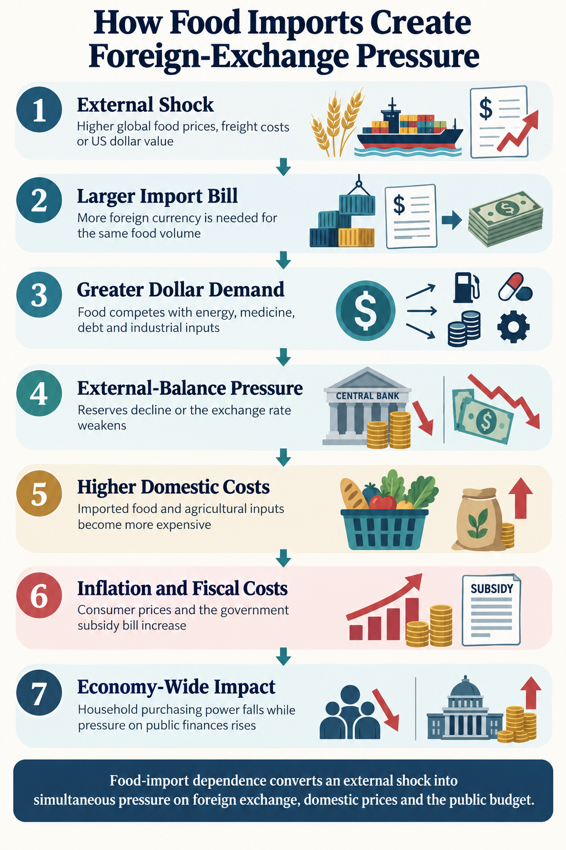
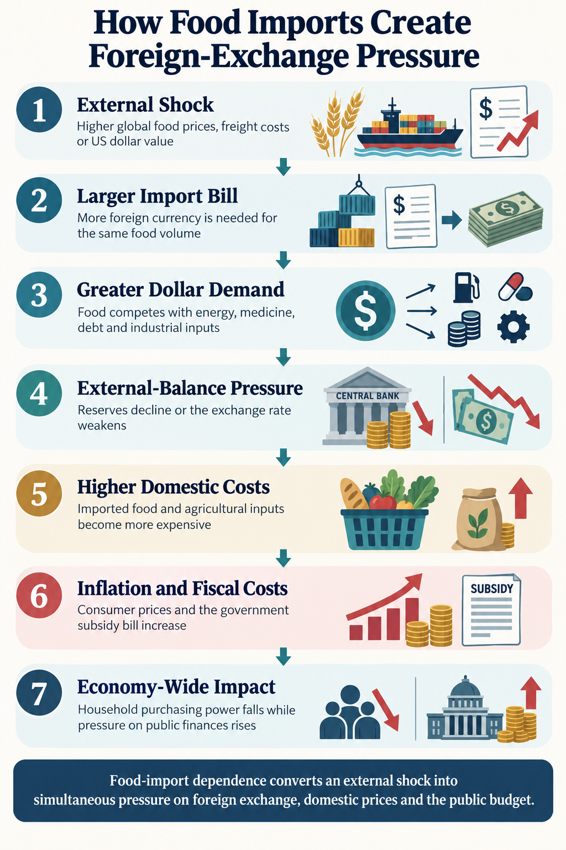
How food imports create foreign-exchange pressure
The economic transmission mechanism operates through several connected pathways. The first pathway begins with the import bill. Food imports are generally priced in US dollars or other foreign currencies. Even when Egypt buys the same physical quantity, higher international commodity prices or shipping costs increase the foreign-currency bill. Food imports must then compete for scarce foreign exchange with energy, medicine, industrial inputs and external debt payments.
The pressure then moves through the exchange rate. When the Egyptian pound depreciates, the domestic-currency cost of imported food rises. The effect reaches beyond finished products because imported seeds, fertilizers, feed, machinery and fuel also raise the cost of domestic agricultural production. Currency depreciation can therefore make both imported and locally produced food more expensive.
From there, the shock reaches households through inflation. Food accounts for a significant share of household expenditure, particularly among lower-income families, so rising prices quickly weaken purchasing power and living standards. Food and beverages account for approximately 39% of household expenditure in Egypt, rising to around 44% among the poorest households, which makes lower-income families particularly vulnerable to food-price increases. The effect can spread through the wider economy as households seek higher wages and businesses face higher transport, energy and input costs.
The same shock also reaches the public budget. Bread and food subsidies protect household access to essential commodities, but maintaining that protection becomes more expensive when import prices rise or the pound depreciates. Egypt spends approximately US$3.5 billion annually on bread and food subsidies, of which around US$2.5–2.6 billion is directed to bread. The government must then decide whether to absorb the additional cost, allow consumer prices to rise, reduce the coverage or value of subsidies, or redirect expenditure from other development priorities. Each choice carries economic and social consequences.
A final pathway concerns continuity of supply. Foreign-exchange shortages may delay letters of credit, import payments or the release of goods from ports. Food security can therefore deteriorate even when commodities remain available in global markets, showing that physical availability and financial access are equally important dimensions of national food security.
The main economic insight
Egypt’s vulnerability is created not only by the volume of its food imports, but by the interaction of three structural conditions. Demand for wheat and other staples is essential and cannot be reduced quickly without social consequences. Those imports must be financed in foreign currency regardless of domestic fiscal conditions, while the earnings that provide that currency including tourism, remittances, exports, investment and Suez Canal receipts, remain exposed to global and regional developments.
This means that a shock can affect both sides of Egypt’s external balance at the same time. Regional conflict, for example, may increase shipping and import costs while simultaneously reducing Suez Canal receipts and weakening tourism or investment flows. The resulting pressure is therefore larger than the food-import bill alone suggests.
Outlook and risk scenarios
Baseline scenario: gradual stabilization. In the baseline, foreign-exchange availability continues to improve, inflation remains below previous peaks and international food prices remain broadly stable. Egypt can maintain food imports without severe shortages, but the import bill continues to represent a large and inflexible demand for foreign currency. The immediate pressure eases, while the underlying structural vulnerability remains.
Adverse scenario: a combined commodity and currency shock. A more difficult story emerges if global grain prices or freight costs rise while regional instability reduces Suez Canal, tourism or investment receipts. A weaker exchange rate would further increase the local cost of imports. Together, these forces would raise the food-import bill, renew food inflation, increase subsidy expenditure, weaken household purchasing power and intensify competition for foreign exchange among essential sectors.
Resilience scenario: coordinated risk reduction. In a more resilient future, Egypt would not aim for complete food self-sufficiency, which would place even greater pressure on its limited land and water resources. Instead, it would increase productivity and produce more value from each unit of water through modern irrigation, climate-resilient crops, and precision-farming technologies. Better storage, cold chains, and transport would reduce losses before food reaches consumers. Egypt would also diversify suppliers and import routes, maintain well-managed strategic reserves, and use financial tools such as agricultural insurance and price hedging to limit exposure to climate shocks and global price increases. Exporting high-value, water-efficient agricultural products would generate foreign currency to help finance essential food imports; Egypt’s fresh agricultural exports roughly doubled over the previous five years, reaching approximately US$4.5 billion. Together, these measures would create a more productive, flexible, and secure food system. They would not eliminate imports, but they would reduce volatility and strengthen the country’s capacity to absorb external shocks.
Policy options and trade-offs
Increasing domestic production selectively is one part of the response. Egypt can raise output of wheat, pulses, oilseeds and feed crops through better seeds, stronger agricultural extension, precision irrigation and more effective incentives for farmers. Yet every production target must be tested against water use, land productivity, energy requirements and fiscal cost. Attempting to produce every imported commodity domestically would be economically inefficient and environmentally unsustainable.
Diversification provides a second layer of protection. A wider network of suppliers, ports, shipping routes and contractual arrangements would reduce exposure to disruptions affecting a particular country or region. This insurance may sometimes carry a higher immediate procurement cost, but it can protect the country against export restrictions, conflict and logistical interruption.
Strategic reserves provide another buffer, but only when they are governed carefully. Transparent rules should define target stock levels, procurement timing, stock rotation, acceptable storage losses, emergency-release conditions and coordination between domestic procurement and imports. The goal is to protect the country against temporary disruption without carrying unnecessarily expensive stocks.
Reducing food loss and supply-chain inefficiency
Investment in storage, transport, cold chains and processing can increase the effective food supply without requiring equivalent increases in production or imports. Reducing post-harvest losses may deliver foreign-exchange savings at a lower water and fiscal cost than expanding the cultivation of water-intensive crops.
Reforming subsidies while protecting vulnerable households
A gradual shift toward more accurately targeted assistance could reduce leakage and improve the fiscal sustainability of food protection. Reform must be carefully sequenced. Rapid price adjustments without adequate compensation could intensify poverty and food insecurity. Reliable household data, transparent communication and effective cash or food-support mechanisms are essential.
Linking food planning to foreign-exchange management
Food-security planning should become part of national foreign-exchange stress testing. Authorities need to model how changes in commodity prices, freight and insurance costs, exchange rates, Suez Canal and tourism receipts, domestic harvests, interest rates and trade-financing costs could interact. This would reveal financing gaps before they develop into delays, shortages or broader price pressure.
Priority recommendations
The first priority is an integrated food and foreign-exchange risk dashboard. It should bring together import requirements, international prices, exchange rates, available reserves, strategic stocks, domestic harvests and shipping risks. The central bank and the ministries responsible for finance, planning, agriculture, supply, trade and social protection would share responsibility, giving decision-makers a common view of emerging pressure.
The second priority is a crop-specific resilience framework. Rather than applying a single policy to every commodity, the framework would assess each strategic crop according to the cost per calorie secured, water consumption, foreign exchange required or saved, concentration of import sources, storage potential and exposure to climate and logistical shocks. These measures would support evidence-based choices about whether to produce, import, store or substitute each commodity.
The third priority is to improve efficiency before pursuing broad import substitution. The first line of action should be to increase yields, reduce post-harvest losses, improve irrigation efficiency, and strengthen storage and logistics. Import substitution should be pursued only where the foreign-exchange and resilience benefits exceed the associated water, energy, fiscal, and opportunity costs.
Potential role for CEDARE
The Centre for Environment and Development for the Arab Region and Europe could support Egypt by integrating agricultural, water, climate, trade and macroeconomic data into a unified decision framework.
CEDARE can contribute by developing a food-water-foreign-exchange risk dashboard that shows how these three interconnected pressures affect national food security. It can model price, exchange-rate, drought, and logistics scenarios; compare domestic-production and import-diversification options; and assess the water and climate implications of import substitution. It can also strengthen strategic-reserve governance, facilitate coordination among national institutions and development partners, and translate Egypt’s experience into lessons for other import-dependent Arab countries.
CEDARE’s added value would be its ability to connect macroeconomic resilience with the water–energy–food nexus, ensuring that policies designed to save foreign exchange do not unintentionally deepen water scarcity or create unsustainable fiscal costs.
Conclusion
Egypt’s improving reserves and declining inflation provide a stronger short-term buffer, but they do not remove the structural risks associated with food-import dependence.
The appropriate objective is not complete food self-sufficiency. It is to ensure reliable and affordable access to essential food while minimizing exposure to foreign-exchange, climate and supply-chain shocks.
A resilient strategy should combine selective domestic production, efficient water use, diversified imports, well-governed strategic reserves, lower food losses and targeted social protection. The success of this strategy should ultimately be measured by four outcomes: food secured, water conserved, foreign exchange protected and resilience gained.