Executive Summary
Water resources worldwide are facing increasing pressures driven by climate change, population growth, urbanization, rising water demand, and deteriorating infrastructure. At the same time, investment in the water sector remains significantly below the levels required to achieve water security and strengthen climate resilience.
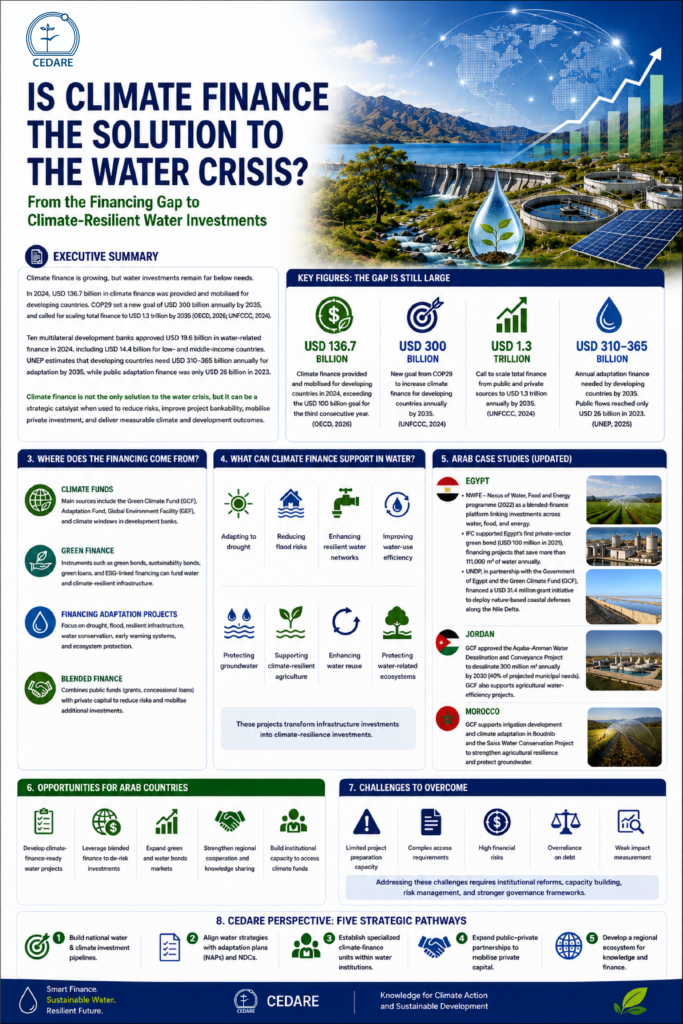
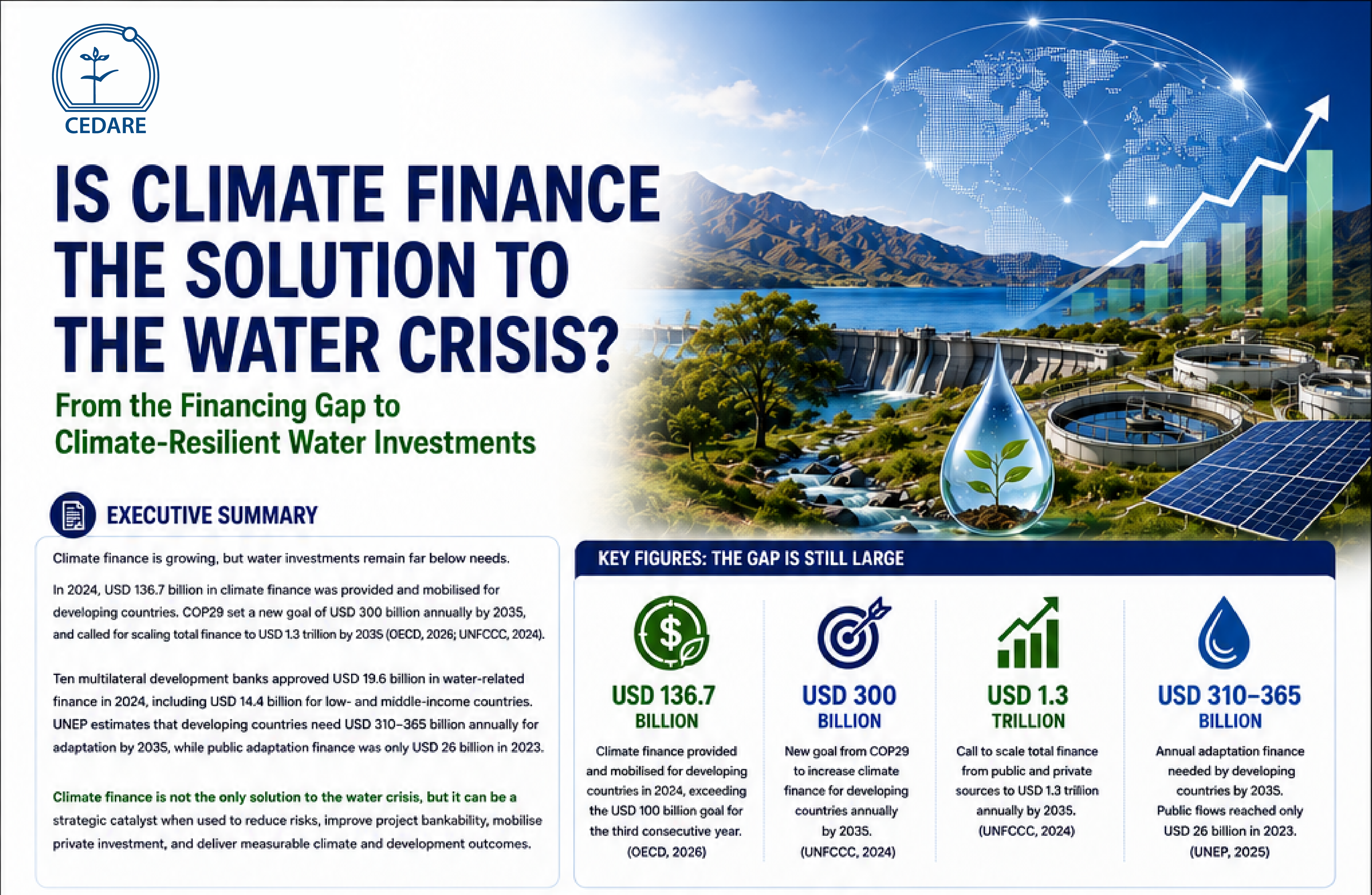
Climate finance has expanded considerably in recent years. Climate finance provided and mobilised by developed countries for developing countries reached USD 136.7 billion in 2024, exceeding the annual USD 100 billion goal for the third consecutive year. Meanwhile, COP29 established a new goal to increase climate finance for developing countries to USD 300 billion annually by 2035, while calling for efforts to scale total finance from public and private sources to USD 1.3 trillion annually by the same year (OECD, 2026; UNFCCC, 2024).
But the most important question for the water sector is not only: How much climate finance is available? It is also: How much of this finance actually reaches water projects, and how is it allocated?
In 2024, ten multilateral development banks approved approximately USD 19.6 billion in water-related finance, of which USD 14.4 billion was directed to low- and middle-income countries. Nevertheless, international institutions continue to emphasize that the water-financing gap remains substantial, and that increasing finance alone will not be sufficient without institutional reforms, improved project quality, and financing models capable of attracting private capital.
This challenge comes at a time when UNEP estimates that developing countries will require USD 310–365 billion annually for adaptation finance by 2035, while international public adaptation-finance flows amounted to only USD 26 billion in 2023. Water is one of the key sectors where adaptation needs intersect with development, infrastructure, food security, and health.
Climate finance, therefore, is not the only solution to the water crisis. However, it can become a strategic catalyst when it is used to reduce risks, improve project bankability, mobilise private investment, and direct resources toward water projects that deliver measurable climate and development outcomes.
- Introduction
The water crisis is no longer solely a question of how much water is available. It is also increasingly a question of countries’ capacity to finance infrastructure, manage risks, invest in adaptation, and translate national plans into implementable projects.
Dams, reservoirs, water and wastewater networks, desalination plants, water-reuse systems, irrigation schemes, and flood-protection projects all require substantial investment, while climate change is increasing uncertainty about how these assets will perform over the coming decades.
The Organisation for Economic Co-operation and Development (OECD) notes that water remains one of the sectors facing the greatest financing constraints, and that addressing the financing gap requires not only additional resources, but also better use of existing finance, a stronger investment environment, strategic investment planning, and the mobilisation of diverse public and private sources of finance (OECD, 2026).
Climate finance has consequently become one of the main channels through which water investments can be supported, particularly when a project is clearly linked to climate adaptation or emissions reduction.
However, the relationship between water, climate, and finance is more complex than it may initially appear.
Is it enough to label a water project as a “climate adaptation” project in order to obtain financing?
The answer is: No.
Financing institutions are increasingly looking for projects with a clear investment rationale, measurable outcomes, strong institutional frameworks, risk-management capacity, and, in some cases, the ability to attract additional private-sector finance.
This is precisely where an important opportunity lies for Arab countries.
- Why Has Climate Finance Become Important for the Water Sector?
Climate change is one of the major multipliers of water-related risks. Rising temperatures, changing rainfall patterns, and increasing drought and flood intensity directly affect water availability, agricultural production, infrastructure operations, and ecosystem stability.
The Green Climate Fund (GCF) indicates that the impacts of climate change are increasingly manifested through water-related risks, including droughts, floods, and storms, making water security an essential component of the adaptation agenda. The GCF framework explicitly includes water, food, and health security among its key areas of action.
Consequently, a wide range of water projects can become eligible for climate finance when they are designed to demonstrate their contribution to:
- Adapting to drought.
- Reducing flood risks.
- Strengthening the resilience of water networks.
- Improving water-use efficiency.
- Protecting groundwater.
- Supporting climate-resilient agriculture.
- Enhancing water reuse.
- Protecting water-related ecosystems.
This opens the door to redefining water projects not merely as infrastructure projects, but as investments in climate resilience.
- Where Does the Finance Come From? A Map of Available Instruments
Climate Funds
Multilateral climate funds represent one of the most important direct sources of finance for adaptation projects.
Green Climate Fund (GCF)
The GCF is the largest climate fund dedicated to developing countries. It provides grants, concessional finance, guarantees, and equity investments, while also working to mobilize private capital. Its scope includes projects related to water security, infrastructure, and resilience. As of July 2026, committed project finance through the Fund amounted to approximately USD 20.4 billion.
Adaptation Fund
The Adaptation Fund focuses directly on financing adaptation projects and programmes in developing countries that are particularly vulnerable to climate change. It is also distinguished by its Direct Access mechanism, which enables accredited national entities to access funding and manage projects locally. Since 2010, the Fund has committed more than USD 1.39 billion to adaptation and resilience projects and programmes.
Global Environment Facility (GEF)
The GEF provides an additional source of climate and environmental finance through its mechanisms and adaptation-related funds, including support for natural-resource management, ecosystems, and adaptation in developing countries.
- Green Finance: Can Water Become an Investable Asset?
Water has traditionally been regarded as a public-service sector that relies heavily on government budgets and development finance. Recent developments, however, indicate that the role of capital markets can be expanded.
The OECD notes that green, social, sustainable, and sustainability-linked bonds (GSSS) have become important instruments for mobilizing long-term capital, although the share of freshwater investments remains extremely limited. According to the OECD, the water sector accounts for only around 1%–4% of global GSSS bond issuance.
This creates a clear paradox: water is among the sectors most exposed to climate risks, yet it remains among those benefiting least from green-finance markets.
The OECD’s 2026 report highlights significant potential for green bonds, sustainability bonds, and water-related bonds to finance water-security investments, while stressing the need for investable projects and clear impact-measurement frameworks.
The IFC also notes that green-bond frameworks can include projects related to adaptation, resilience, and the protection of water and natural resources. IFC’s cumulative green-bond issuance reached approximately USD 14.9 billion by June 2025.
- Financing Adaptation Projects: From Expenditure to Investment
The importance of adaptation finance lies in its ability to help countries invest before losses occur, rather than paying the costs of disaster response after events have taken place.
UNEP data indicate that developing countries will require USD 310–365 billion annually in adaptation finance by 2035, while international public adaptation-finance flows amounted to only USD 26 billion in 2023. This reflects a substantial gap between needs and available resources.
In the water sector, adaptation finance can support projects such as:
- Developing drought-resilient water networks.
- Modernising irrigation systems.
- Protecting cities from floods and flash floods.
- Rainwater harvesting.
- Wastewater reuse.
- Protecting and restoring water basins.
- Strengthening early-warning systems.
- Improving desalination-plant efficiency.
- Protecting groundwater from depletion.
- Developing water infrastructure capable of withstanding future climate risks.
The challenge, however, is to demonstrate that these investments generate clear climate benefits, rather than only broader development benefits.
- Blended Finance: The Bridge Between Climate Finance and the Private Sector
One of the most important developments in climate finance is the use of blended finance, in which public resources or concessional finance are combined with private capital to reduce risks and improve project investability.
Blended finance can be used for water projects that have strong public value but cannot, on their own, generate the returns or achieve the risk profile required by commercial investors.
GCF instruments, for example, demonstrate how grants, concessional finance, guarantees, and equity investments can be combined within different financing structures to reduce risks and attract private capital.
Experience from international financial institutions also shows that blended finance can support infrastructure, water, and climate-related sectors, particularly in markets facing high investment risks.
- The Arab Region: Where Are the Opportunities?
The Arab region presents a distinctive context. Water scarcity, rising temperatures, increasing drought risks, and reliance on groundwater and desalination make the water sector particularly closely linked to climate adaptation.
At the same time, these challenges can be transformed into investment opportunities when projects are prepared in ways that connect water security with climate and development objectives.
7.1. Jordan: Climate Finance for Improving Water-Use Efficiency
Jordan represents a clear example of how climate finance can be used in the water sector.
The Green Climate Fund approved a project with a total value of USD 33.3 million to improve climate resilience by increasing water-use efficiency in agriculture, including USD 25 million in GCF financing. The project includes wastewater reuse, rainwater harvesting, improved agricultural water efficiency, and reduced pressure on groundwater.
In 2025, the GCF also approved the Aqaba–Amman Water Desalination and Conveyance Project, which targets the desalination of approximately 300 million cubic metres of water annually, strengthening water security in Jordan and responding directly to water scarcity and climate risks.
Significance: Climate finance can move beyond financing “environmental projects” to financing strategic assets for water security.
7.2. Morocco: Adaptation Finance and Agricultural Water Management
Morocco provides another example through the Saïss Water Conservation Project, which aims to strengthen agricultural resilience in the Saïss region in response to declining and increasingly irregular rainfall and unsustainable groundwater abstraction.
The GCF contributed a grant of approximately USD 37.6 million to the project, within a total investment of around USD 243.1 million. This illustrates how climate finance can function as part of a larger financing structure rather than bearing the full cost of a project.
The GCF has also supported Morocco’s efforts to strengthen institutional capacity, adaptation planning, and the development of sustainable adaptation-financing strategies.
Significance: Climate finance can serve as a risk-reduction and capital-mobilisation instrument, rather than merely as a standalone source of funding.
7.3. Egypt: Climate Finance for Water Security, Coastal Resilience, and the Water–Food–Energy Nexus
The United Nations Development Programme (UNDP), in partnership with the Government of Egypt and the Green Climate Fund (GCF), has supported a USD 31.4 million grant initiative—Enhancing Climate Change Adaptation in the North Coast of Egypt—to deploy nature-based coastal defenses along the Nile Delta. The initiative demonstrates how climate finance can help address water-related climate risks while strengthening the resilience of vulnerable coastal communities and ecosystems.
Egypt has also developed the NWFE – Nexus of Water, Food and Energy programme, launched in 2022 as a platform for linking investments in water, food, and energy within an integrated financing and development framework. The OECD describes NWFE as a national blended-finance platform that seeks to align international finance with Egypt’s national priorities and climate commitments, while using different financial instruments to mobilise additional investment.
Egypt’s financial sector has also witnessed important developments in green finance. In 2021, the International Finance Corporation (IFC) supported the country’s first private-sector green bond with USD 100 million, financing projects that included water-efficiency measures. According to IFC, the supported projects contributed to saving more than 111,000 cubic metres of water annually.
Significance: Egypt’s experience demonstrates that climate finance can support water security through multiple pathways—from nature-based coastal adaptation and resilience to integrated water–food–energy investments and green finance. Rather than treating water as a standalone sector, integrating it into broader climate and development frameworks can help mobilise diverse sources of finance and generate wider environmental, economic, and social benefits.
- Opportunities and Challenges for Arab Countries
- Key Opportunities
Turning Adaptation Plans into Bankable Projects
Having NDCs and NAPs is not enough. The priority is to translate them into project pipelines that include feasibility studies, cost estimates, climate-impact indicators, and clear financing structures..
Leveraging Climate Funds
Arab countries can expand their use of the GCF, Adaptation Fund, GEF, and other mechanisms by strengthening the capacity of national entities responsible for project preparation and access to finance. The GCF already provides readiness and project-preparation support before projects reach large-scale financing.
Developing Green and Sustainable Bond Markets
Water can become a major sector in Arab green and sustainable bond markets, particularly in desalination, water reuse, non-revenue-water reduction, irrigation efficiency, and flood protection.
Scaling Up Blended Finance
Concessional climate finance can be used to provide guarantees or reduce the risks of water projects, followed by mobilisation of banks, investors, and institutional capital.
Leveraging Islamic Finance
This opportunity is particularly relevant to the Arab region. The OECD’s 2026 analysis points to the potential of Islamic finance, alongside bonds, results-based financing, and public–private partnerships, to support water security.
- Major Challenges
Despite these opportunities, Arab countries face several challenges:
- Limited readiness of some water projects to access international finance.
- Insufficient climate and water data needed to demonstrate risks and impacts.
- Difficulty translating climate benefits into measurable indicators.
- Lengthy and complex financing-access procedures.
- Limited national capacity to prepare investment proposals.
- High political and economic risks in some markets.
- Limited private-sector participation in adaptation projects.
- Overreliance on loans instead of grants and concessional finance in some cases.
This issue becomes increasingly important in light of UNEP’s warning that increasing adaptation finance should not lead to higher debt burdens for the most vulnerable countries.
Conclusions
Climate finance is not a magic solution to the water crisis, nor can it by itself close the growing investment gap in the water sector.
Its importance, however, lies in its ability to change the nature of investment itself.
Rather than financing infrastructure solely to meet today’s needs, climate finance can help countries build water systems capable of operating under more severe climatic conditions and greater uncertainty.
Current trends indicate that global climate finance is increasing, yet the adaptation gap remains substantial, while the water sector continues to receive only a limited share of green-finance markets.
Therefore, the real challenge for Arab countries is not simply to obtain more finance, but to improve their capacity to transform finance into water investments that are implementable, measurable, and capable of attracting private capital.
CEDARE believes that the future of water security in the Arab region requires a transition from:
“Financing Water Projects” to a more integrated model:
“Financing Water Security and Climate Resilience”
Within this transition, climate finance can play a critical role—not as the only solution to the water crisis, but as a catalyst for turning climate risks into long-term investment and development opportunities.
References
- OECD. (2026). Financing Water Security: Models and Approaches for Investments that Last. OECD Publishing. DOI: 10.1787/7cf3f5bd-en.
- OECD. (2026). Climate Finance Provided and Mobilized by Developed Countries in 2013–2024. OECD Publishing. DOI: 10.1787/ab5eb9ad-en.
- UNEP. (2025). Adaptation Gap Report 2025: Running on Empty. United Nations Environment Programme.
- UNFCCC. (2024). COP29: New Collective Quantified Goal on Climate Finance. United Nations Framework Convention on Climate Change.
- World Bank & Multilateral Development Banks. (2025). Joint MDB Water Security Financing Report 2024.
- Green Climate Fund. (2026). The Green Climate Fund: About and Portfolio Dashboard.
- Adaptation Fund. (2026). About the Adaptation Fund.
- Green Climate Fund. (2021). Building Resilience to Cope with Climate Change in Jordan through Improving Water Use Efficiency in the Agriculture Sector (FP155).
- Green Climate Fund. (2017). The Saïss Water Conservation Project (FP043).
- OECD. (2025). Egypt’s Country Platform – Nexus of Water, Food and Energy (NWFE) Program.
- International Finance Corporation. (2026). Egypt 30by30: A Financial System Learning to Breathe for the Future.
- International Finance Corporation. (2026). Green Bonds.
- OECD. (2025). Mind the Gap—but Don’t Stop There: Rethinking Water Finance.