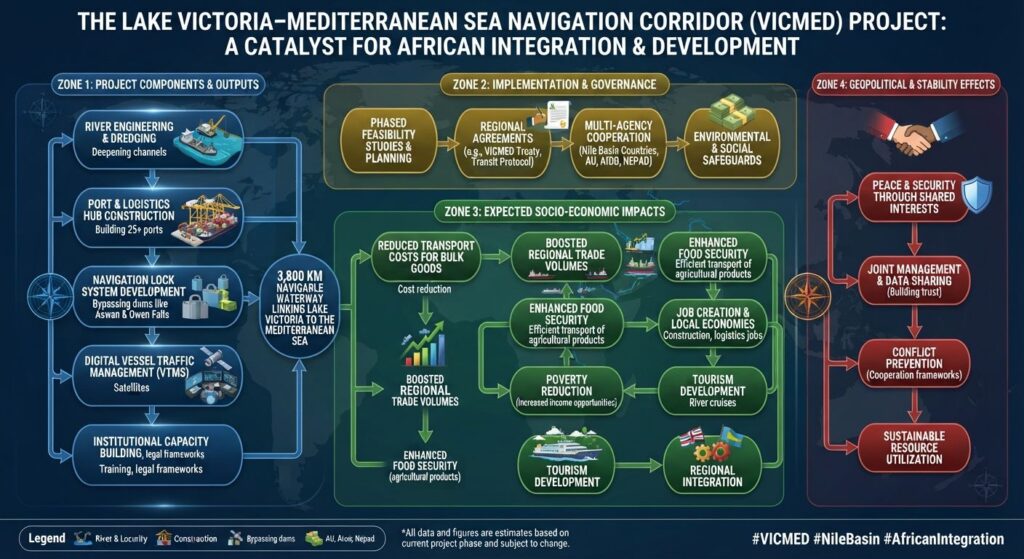
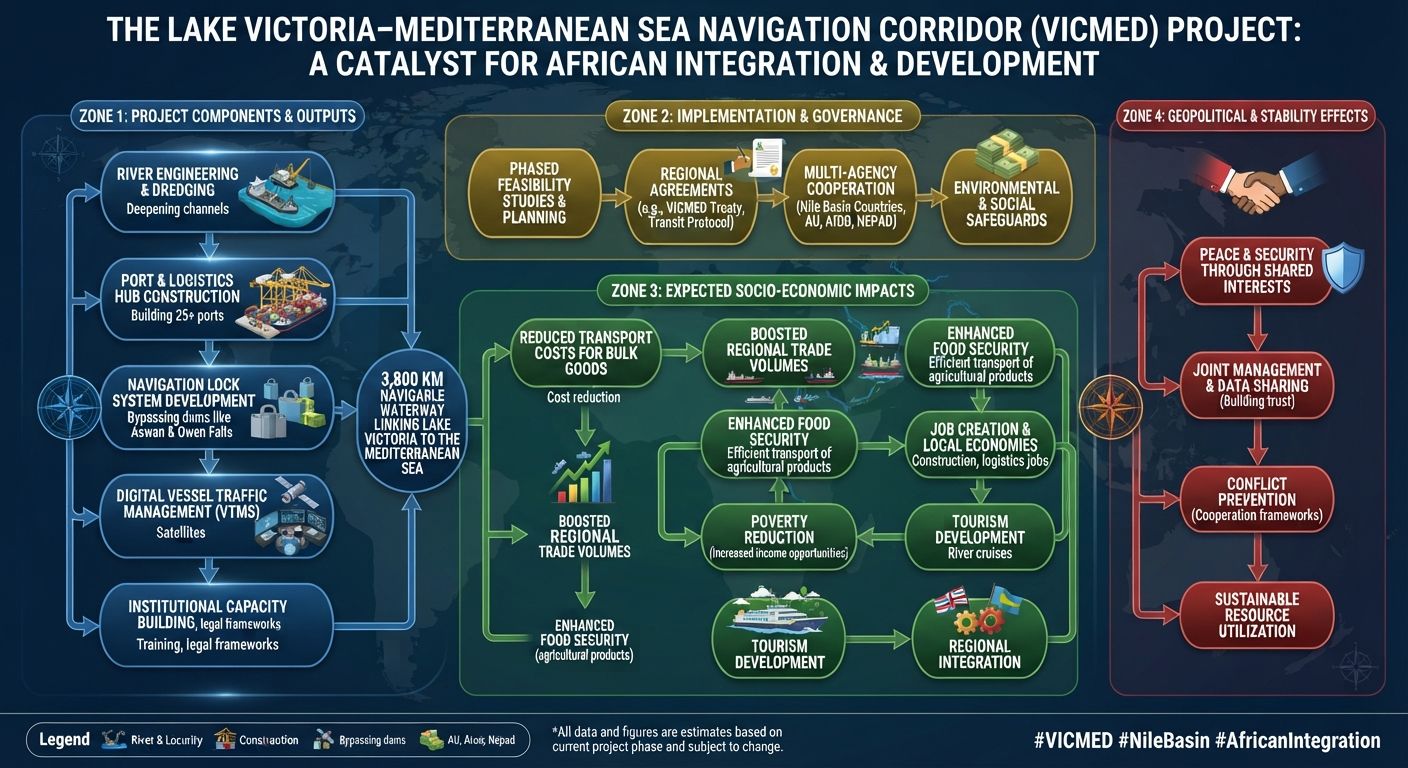
The Lake Victoria–Mediterranean Sea Navigation Corridor (VICMED) is a flagship multinational infrastructure initiative championed under the African Union’s Presidential Infrastructure Championing Initiative (PICI). The project establishes a 3,800-kilometer continuous navigable waterway linking Lake Victoria.
Key Project Components:
Civil & River Engineering: Large-scale dredging, channel deepening, and river training to maintain a minimum channel depth of 2.5 meters and width of 70 meters in critical sections.
Infrastructure Hubs: Construction of over 25 major river ports and multi-modal logistics centers equipped with container-handling facilities.
Bypassing Systems: Development of roughly 15 fish-friendly navigation locks (minimum dimensions of 150m x 17m) allowing commercial vessels of up to 1,500 tons to safely bypass natural barriers and mega-dams like The High Dam Of Aswan Click to open side panel for more information and Owen Falls.
Digital Management: Implementation of satellite-backed Digital Vessel Traffic Management Systems (VTMS) and synchronized regional coordination structures.
Implementation Costs & Financing
Capital Cost: The total full-scale infrastructure construction is estimated between $10 billion and $12 billion.
Preparatory Funding: Phase 2 feasibility and strategic environmental studies are supported by specialized grants—including a $2 million contribution from the African Development Bank’s NEPAD Infrastructure Project Preparation Facility (NEPAD-IPPF)—with total preparatory study funding valued around $9.7 million.
Governance, Treaties, and Legal Frameworks To avoid historical regulatory gridlock in transboundary water management, implementation relies on:
Multinational Transit Protocols: Intergovernmental shipping agreements establishing unified regional navigation rules, open-access commercial transport, and streamlined customs clearance.
Environmental & Data-Sharing Accords: Comprehensive Strategic Environmental and Social Assessments (SESA) and joint hydrological data-transparency protocols to balance commercial marine transport with water security.
Socio-Economic & Geopolitical Impacts
Trade & Cost Reductions: By offering a cleaner, more economical transport alternative for bulk goods, VICMED cuts logistics costs by an estimated 30–40% compared to road transport, boosting regional trade volumes and food security.
Poverty Reduction & Regional Cohesion: Stimulates local job creation in construction and logistics, while unlocking long-haul river cruise tourism across East and North Africa.
Peace & Security: Institutionalizing shared infrastructure, joint operations, and cooperative data-sharing transforms historical Nile Basin bilateral tensions into platforms for mutual economic dependency and long-term regional stability.