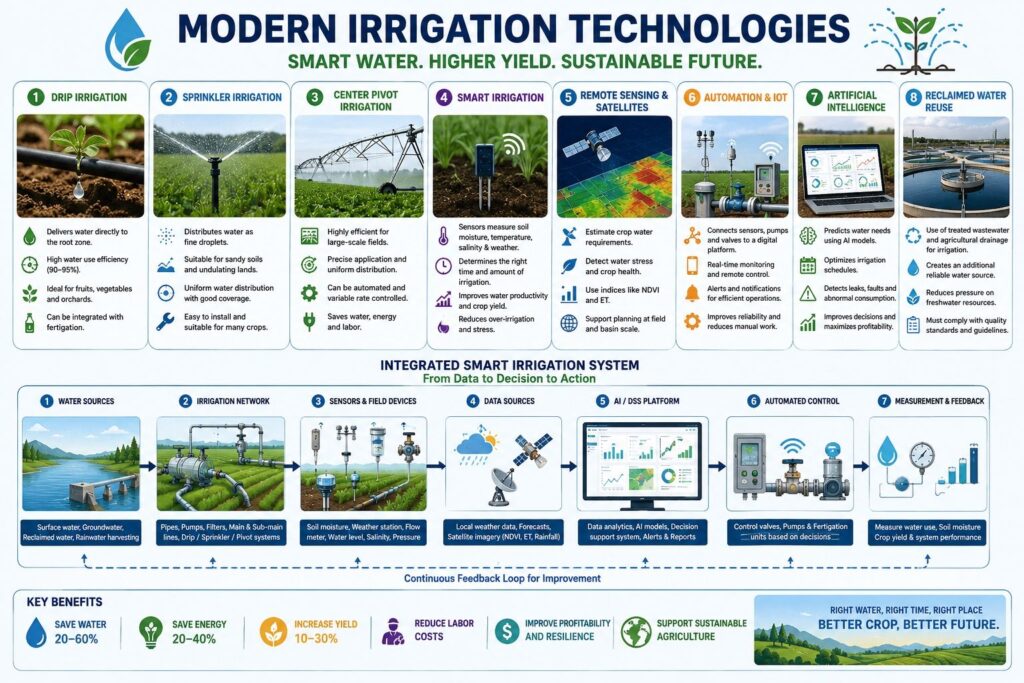
The future of water management increasingly relies on the use of modern irrigation technologies to manage and distribute water to crops in the right quantity, at the right time, and in the right place, with the aim of increasing agricultural productivity while reducing water and energy losses.
Key Modern Irrigation Technologies
1. Drip Irrigation
- Delivers water directly to the root zone.
- Suitable for a wide range of crops, particularly orchards and horticultural crops.
- Can be integrated with fertigation, allowing fertilizers to be applied through the irrigation system.
2. Sprinkler Irrigation
- Distributes water in the form of fine sprays or droplets.
- Suitable for sandy soils and areas with varying terrain and topography.
3. Center Pivot Irrigation
- Highly effective for large-scale agricultural areas.
- Allows irrigation rates to be adjusted according to the water requirements of different sections of the field.
4. Smart Irrigation
- Uses sensors to monitor soil moisture, temperature, salinity, and weather conditions.
- Enables the automatic determination of irrigation timing and water quantities based on actual crop requirements.
5. Remote Sensing and Satellite Technology
- Enables the estimation of crop water requirements and the identification and mapping of areas experiencing water stress.
- Can utilize indicators such as NDVI (Normalized Difference Vegetation Index) and ET (Evapotranspiration).
6. Automation and the Internet of Things (IoT)
- Connects sensors, pumps, and valves to a digital platform.
- Enables real-time monitoring and remote control of irrigation systems through smartphones and other digital devices.
7. Artificial Intelligence (AI)
- Predicts crop water requirements.
- Optimizes irrigation schedules based on weather conditions, soil characteristics, and crop requirements.
- Detects leaks, equipment failures, and abnormal water consumption patterns.
8. Water Reuse
- Utilizes treated wastewater and appropriately treated agricultural drainage water as additional sources for irrigation, in accordance with applicable quality and safety standards.
The Future Direction
The optimal future model is not simply about changing the irrigation method; rather, it involves establishing an integrated smart irrigation system that connects all key components:
Water Source → Irrigation Network → Sensors → Weather & Satellite Data → AI/DSS → Automated Control of Valves & Pumps → Measurement of Water Use & Agricultural Productivity
The ultimate goal is to shift from “irrigation according to a fixed schedule” to “irrigation based on the plant’s actual water requirements.”