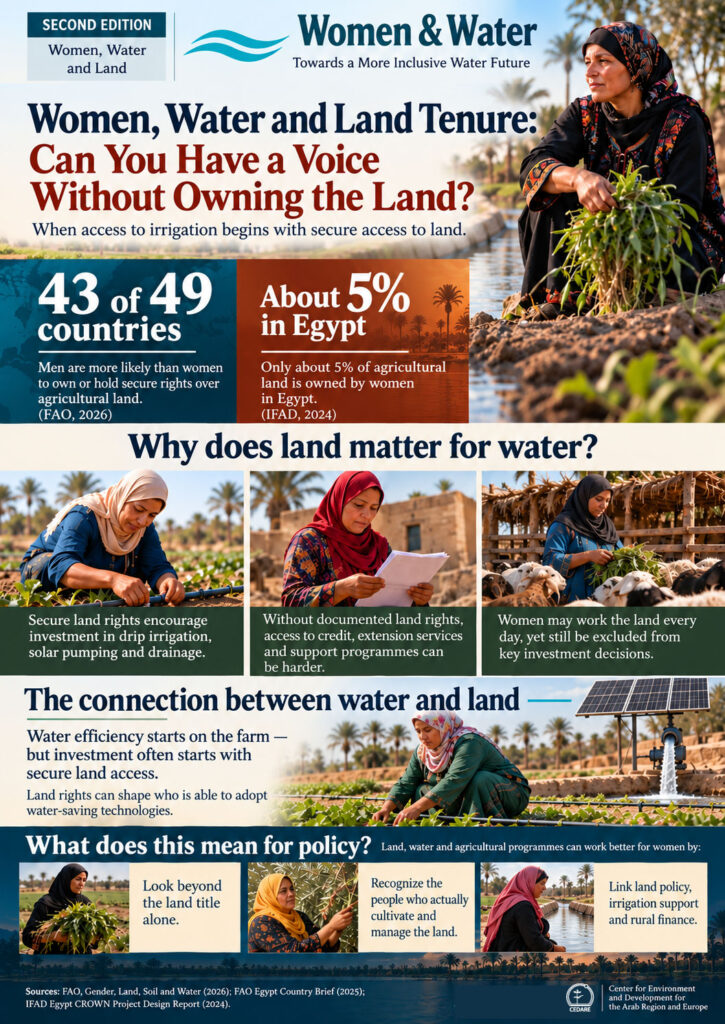
For rural farmers, land and water are closely connected—but ownership, access and control are not the same thing. A woman may cultivate family land, rent a plot, work under a sharecropping arrangement or manage agricultural production without appearing on the land title. The key question is therefore not simply who owns the land? It is also whether the person actually farming it has enough recognition and security to access water-related opportunities.
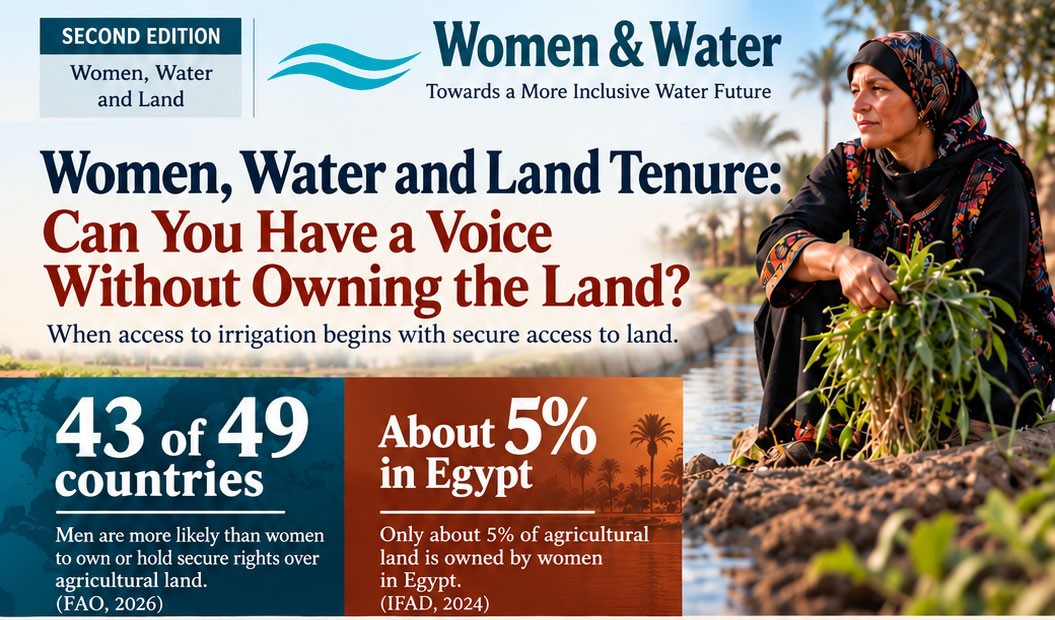
The gap is substantial. In 43 out of 49 countries with comparable data, men are more likely than women to own agricultural land or hold secure rights over it (FAO, 2026). FAOHome In Egypt, only about 5% of agricultural land is owned by women (IFAD, 2024). IFAD
1. The missing distinction: owning land is not the same as farming it
Land statistics can obscure an important reality. Women who do not own land may still be actively cultivating it and making day-to-day agricultural decisions.
IFAD’s CROWN assessment for Egypt notes that poor landless women working under sharecropping arrangements can lack access to services and agricultural organisations because they do not have legal ownership, despite their involvement in agricultural production (IFAD, 2024). IFAD
This creates a recognition gap: the person cultivating the land may not be the person formally recognised by institutions.
That distinction matters for water because irrigation support is rarely just about receiving water. Farmers increasingly need access to technology, technical advice, finance, equipment and programmes to improve how that water is used.
2. A land title can become a gateway to other resources
The effect of insecure tenure extends beyond the land itself.
FAO’s Egypt assessment shows that women’s ability to exercise land and water rights is connected to their access to credit, extension services, income and savings, as well as their economic position and participation in decision-making (FAO, 2023). FAOHome
Recent regional evidence points to the same problem. ICARDA reports that women without recognised land titles can face barriers to credit, extension and training, meaning that lack of formal recognition can affect access to the wider agricultural support system (ICARDA, 2025). ICARDA
The issue, therefore, is not just land ownership. It is what land ownership can unlock.
Land → recognition → services → finance → water investment.
3. Irrigation modernisation can expose this hidden gap
This becomes particularly important as agriculture moves toward drip irrigation, solar pumping, precision technologies and other forms of water-saving investment.
FAO’s current work on gender and water notes that women farmers continue to face barriers in accessing irrigation equipment, technology, finance and extension services (FAO, 2026). FAOHome Recent work under FAO’s Water Scarcity Initiative in the Near East and North Africa is also examining gender disparities in access to irrigation technologies and their effects on rural livelihoods in Egypt (FAO, 2026). FAOHome
This raises a different question from whether technology saves water:
Who is positioned to adopt the technology in the first place?
If irrigation modernisation is designed around the formally registered owner, women farming through family arrangements, tenancy or sharecropping can become harder to identify and reach.
That does not mean modern irrigation programmes necessarily exclude women without titles. It means tenure status should be considered when programmes decide who qualifies for support and how beneficiaries are identified.
The impacts: four ways the land gap can become a water gap
The first impact is investment capacity. FAO finds that stronger land and water rights are associated with greater uptake of technologies and investment in natural-resource management (FAO, 2026). FAOHome
The second is access to finance. Property rights can affect the ability to access credit and other economic opportunities, while women frequently face greater restrictions in financing agricultural investment (World Bank, 2024). World Bank
The third is access to knowledge and services. When women are not formally recognised as farmers or landholders, they can become less visible to extension systems, training opportunities and agricultural programmes (ICARDA, 2025). ICARDA
The fourth is unequal readiness for water modernisation. Two farmers may cultivate neighbouring plots supplied by the same irrigation system, yet their ability to adopt a new technology can differ greatly if one has secure tenure, financing and formal access to services while the other does not.
This is where a land issue becomes a water-efficiency issue.
What should water programmes do differently?
The objective should not be to replace ownership rights or disregard legitimate land titles. It is to make sure that formal ownership is not the only doorway to water-efficiency support.
A more inclusive approach could recognise alternative evidence of cultivation or legitimate land use when appropriate, so that tenants, sharecroppers and women farming family land are visible to programmes. Financing mechanisms can also be designed so that access to irrigation technologies does not depend entirely on land being available as collateral. FAO recommends strengthening women’s land and water rights while expanding access to services, institutions and water-saving technologies (FAO, 2026). FAOHome
Programmes should also record not only sex, but tenure status. Asking whether a beneficiary is an owner, tenant, sharecropper or other legitimate user can reveal inequalities that a simple count of male and female beneficiaries may miss. FAO specifically recommends sex-disaggregated and gender-sensitive data on access to and control over land and water resources (FAO, 2026). FAOHome
Before launching an irrigation-modernisation programme, four questions can reveal whether its design is genuinely inclusive:
- Can a woman who cultivates family land but is not named on the title apply?
- Can a tenant or sharecropper access irrigation support?
- Can a farmer without land collateral obtain finance for a water-saving technology?
- Does the monitoring system distinguish between ownership and actual land use?
These questions shift the discussion from “How many women own land?” to the more practical question:
Can the women actually farming the land access the resources needed to manage its water efficiently?
You do not need to own land to depend on its water. Water modernisation becomes more inclusive when the people who actually cultivate the land are visible, recognised and able to invest.
References
FAO (2023). Gender, Water and Agriculture: Assessing the Nexus in Egypt. Food and Agriculture Organization of the United Nations. FAOHome
FAO (2026). Gender, Land, Soil and Water. Food and Agriculture Organization of the United Nations. FAOHome
FAO (2026). Water and Gender. Land, Soil and Water Division, Food and Agriculture Organization of the United Nations. FAOHome
FAO (2026). Water Scarcity Initiative in the Near East and North Africa – Water Governance: Gender Impacts of Irrigation Modernization. FAOHome
IFAD (2024). Egypt: Climate-Resilient On-Farm Water Management in the Nile Valley (CROWN) – Project Design Report. International Fund for Agricultural Development. IFAD
ICARDA (2025). Women and Smallholder Farming in MENA. International Center for Agricultural Research in the Dry Areas. ICARDA
World Bank (2024). Four Priorities for Increasing Women’s Access to Farmland; and World Bank Group Gender Strategy 2024–2030.