
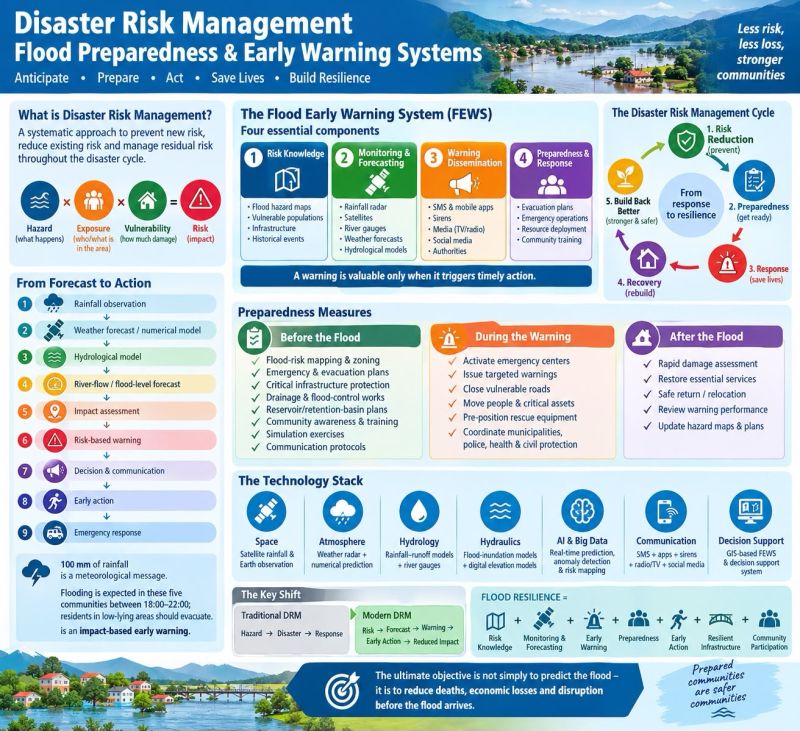
1. The integrated concept
Flood Risk = Hazard × Exposure × Vulnerability
An effective Disaster Risk Management (DRM) approach moves from reactive disaster response to anticipation, preparedness and risk reduction.
Monitoring → Forecasting → Early Warning → Early Action → Response → Recovery → Build Back Better
2. Flood Early Warning System
The key principle:
A warning is valuable only when it triggers timely action.
3. From forecast to action
Rainfall observation
↓
Weather forecast / numerical model
↓
Hydrological model
↓
River-flow / flood-level forecast
↓
Impact assessment
↓
Risk-based warning
↓
Decision & communication
↓
Early action
↓
Emergency response
For example:
“100 mm of rainfall” is a meteorological message.
But:
“Flooding is expected in these five communities between 18:00–22:00; residents in low-lying areas should evacuate.”
4. Preparedness measures
Before the flood
* Flood-risk mapping and zoning
* Emergency and evacuation plans
* Critical infrastructure protection
* Drainage and flood-control works
* Reservoir and retention-basin operation plans
* Community awareness and training
* Regular simulation exercises
* Emergency communication protocols
During the warning
* Activate emergency operations centers
* Issue targeted warnings
* Close vulnerable roads
* Move people and critical assets
* Pre-position rescue equipment
* Coordinate municipalities, police, health and civil protection
After the flood
* Rapid damage assessment
* Restore essential services
* Safe return/relocation
* Review the warning performance
* Update hazard maps and emergency plans
5. Technology stack
Space
🛰️ Satellite rainfall & Earth observation
Atmosphere
🌧️ Weather radar + numerical weather prediction
Hydrology
💧 Rainfall–runoff models + river gauges
Hydraulics
🌊 Flood-inundation models + digital elevation models
AI & Big Data
🤖 Real-time prediction, anomaly detection and risk mapping
Communication
📱 SMS + mobile apps + sirens + radio/TV + social media
Decision support
🖥️ GIS-based Flood Early Warning & Decision Support System
6. The most important shift
Traditional DRM
Hazard → Disaster → Response
Modern DRM
Risk → Forecast → Warning → Early Action → Reduced Impact
FLOOD RESILIENCE = Risk Knowledge
* Monitoring & Forecasting
* Early Warning
* Preparedness
* Early Action
* Resilient Infrastructure
* Community Participation