
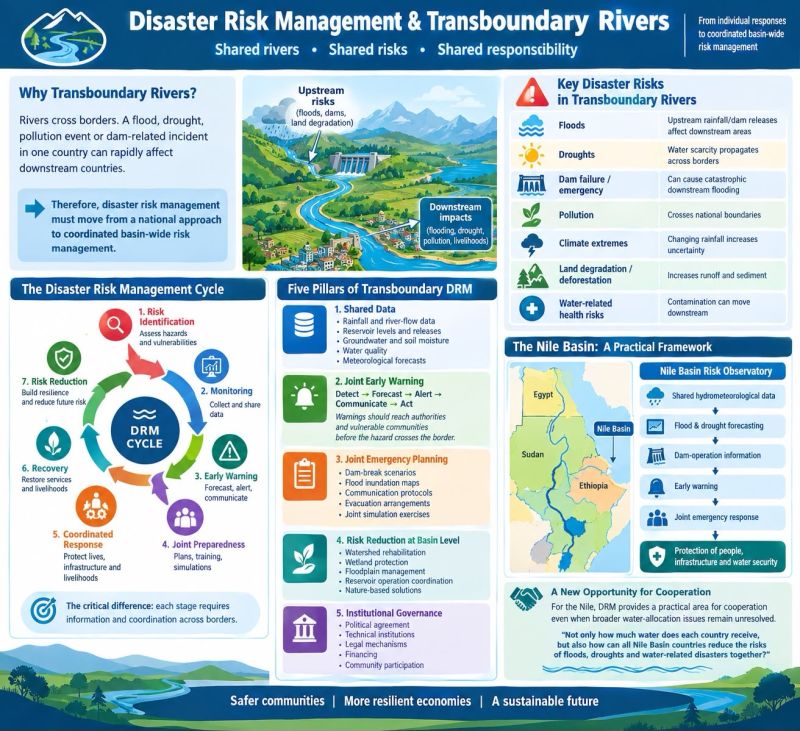
Transboundary rivers create a shared disaster-risk environment: a flood, drought, pollution event, or dam-related incident in one country can rapidly affect downstream countries. Therefore, disaster risk management (DRM) must move from a national approach to coordinated basin-wide risk management.
1. Main disaster risks
Risk Transboundary dimension DRM response
🌊 Floods Upstream rainfall/dam releases affect downstream areas Joint forecasting + Early Warning Systems
☀️ Droughts Water scarcity propagates across borders Joint drought monitoring + coordinated allocation
🏗️ Dam failure/emergency Failure can cause catastrophic downstream flooding Emergency Action Plans + real-time data exchange
🧪 Pollution Pollution crosses national boundaries Joint water-quality monitoring
🌧️ Climate extremes Changing rainfall increases uncertainty Basin-wide climate-risk assessment
🌱 Land degradation/deforestation Upstream changes increase runoff and sediment Watershed restoration + erosion control
🦠 Water-related health risks Contamination can move downstream Joint surveillance and rapid response
2. The DRM cycle for transboundary rivers
Risk Identification → Monitoring → Early Warning → Joint Preparedness → Coordinated Response → Recovery → Risk Reduction
The critical difference is that each stage requires information and coordination across borders.
3. Five pillars of cooperation
1. Shared Data
* Rainfall and river-flow data
* Reservoir levels and releases
* Groundwater and soil moisture
* Water quality
* Meteorological forecasts
2. Joint Early Warning
Detect → Forecast → Alert → Communicate → Act
Warnings should reach authorities and vulnerable communities before the hazard crosses the border.
3. Joint Emergency Planning
Countries can develop:
* Dam-break scenarios
* Flood inundation maps
* Emergency communication protocols
* Evacuation arrangements
* Joint simulation exercises
4. Risk Reduction at Basin Level
* Watershed rehabilitation
* Wetland protection
* Floodplain management
* Reservoir operation coordination
* Nature-based solutions
5. Institutional Governance
A strong transboundary DRM system needs:
Political agreement + technical institutions + legal mechanisms + financing + community participation.
4. Particularly important for the Nile Basin
For the Nile, DRM can provide a practical area for cooperation even when broader water-allocation issues remain unresolved.
A possible framework is:
Nile Basin Risk Observatory
⬇
Shared hydrometeorological data
⬇
Flood & drought forecasting
⬇
Dam-operation information
⬇
Early warning
⬇
Joint emergency response
⬇
Protection of people, infrastructure and water security
This reframes cooperation from “How much water does each country receive?” toward an additional shared
3