
Introduction
Europe’s summer of 2026 provides a stark illustration of how extreme heat and drought are increasingly translating climate risks into direct agricultural and economic losses. Across the continent, prolonged dry conditions, record-breaking heatwaves and wildfires affected crop yields and production, with impacts ranging from smaller potatoes in the Netherlands and reduced carrot harvests in France to dried rice fields in Italy and damaged olive groves across parts of the Mediterranean. Human-induced climate change is increasing the severity and likelihood of many extreme weather events, adding greater volatility to agricultural production and food systems.
The impacts are occurring at a time when global food prices are already under pressure from extreme weather, energy prices, fuel costs and disruptions to fertiliser supplies. The 2026 European experience therefore demonstrates that climate change is no longer only a long-term agricultural risk; it is increasingly affecting present-day production, food security, farm incomes, food prices and wider economic performance.
1. Cereal production and agricultural declined across most of Europe
Cereal production is expected to decline across almost all EU countries in 2026 compared with 2025 (Carbon Brief, 2026). France faces the largest absolute reduction, with cereal production projected to fall by approximately 7.7 million tonnes (Mt). Germany follows with a decline of around 3.5Mt, while Poland, Spain and Hungary are also expected to record substantial reductions.
The widespread nature of these declines is particularly important. Rather than reflecting an isolated crop failure in one agricultural region, the figures demonstrate how simultaneous heat and water stress can affect agricultural production across multiple countries (Figure 1).
The impact is evident not only in total production, but also in yield per hectare. Heat and insufficient water substantially worsened crop prospects across western and much of central Europe during summer 2026. This highlights the importance of water availability and effective water management as climate risks intensify.
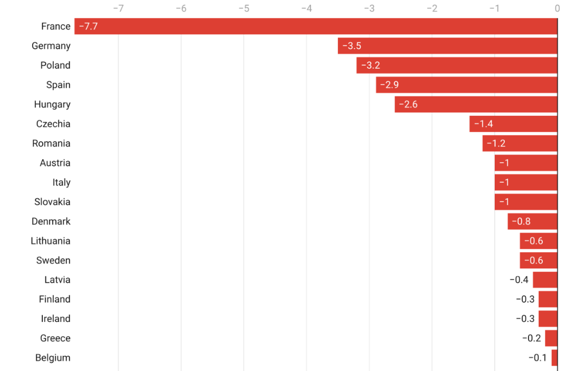
Figure 1: Change in cereal production in 26 EU countries between 2025 and 2026 (Mt).
Source: European Commission, 2026.
2. Climate impacts are becoming direct economic losses
The agricultural consequences of the June 2026 heatwave can also be measured financially. Changes in European grain-production forecasts between June and July were estimated to represent approximately €2–2.3 billion in lost production value. France alone accounted for an estimated €891 million, followed by Hungary at around €444 million and Spain at approximately €276 million. France, Germany, Hungary and Spain together represented 86% of the estimated lost revenue (Figure 2).
This demonstrates an important shift in the climate-risk discussion: declining agricultural productivity is simultaneously becoming an economic and fiscal issue. Carbon Brief (2026) also cites analysis suggesting that the broader extreme-weather events of summer 2026 could reduce EU GDP by around 1%, equivalent to approximately €180 billion.
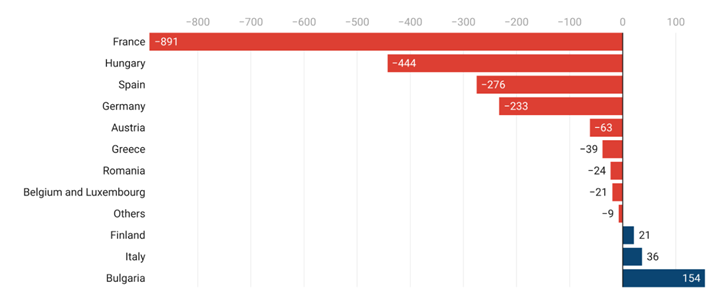
Figure 2: Estimated revenue losses associated with changes in European grain-production forecasts between June and July 2026.
Source: Energy & Climate Intelligence Unit (ECIU)
3. Historically Low Harvests Highlight Growing Adaptation and Food-Security Risks
The impacts of the 2026 heat and drought are particularly evident in major European agricultural producers, with both the United Kingdom and France approaching historically low production levels.
In the United Kingdom, repeated climate stresses are increasingly visible in long-term agricultural records. If current trends continue, average cereal and oilseed yields could result in the country’s poorest harvest since detailed records began in 1984. Compared with 2025, barley yields could decline by 15%, oats by 14% and wheat by 6%. Even if conditions improve, 2026 is expected to remain among the five poorest UK harvest years on record (Carbon Brief, 2026). Significantly, four of these five poor harvests have occurred within the past decade, highlighting the increasing pressure facing agricultural systems.
France, the EU’s largest agricultural producer, has also been severely affected. Maize production is projected to decline by approximately 35% compared with 2025, potentially reaching its lowest level since 1980 (Carbon Brief, 2026). The impacts extend beyond staple crops: extreme heat has contributed to unusually early grape harvesting in several regions, while smaller and less juicy grapes could reduce wine output.
Taken together, the national impacts translate into a significant reduction in European agricultural output. EU cereal production is projected to fall by approximately 9% in 2026 compared with 2025. Only 2024 recorded lower cereal production during the past decade.
These experiences demonstrate that extreme heat and drought are affecting both staple and high-value crops, with historically poor harvests becoming increasingly concentrated in recent years. This raises wider food-security concerns, as simultaneous production losses across major agricultural regions can constrain food supplies, increase price volatility and place additional pressure on farmers and consumers.
Implications: Agricultural Adaptation is Essential to Food Security and Can No Longer Be Incremental
Europe’s 2026 heat and drought demonstrate that climate extremes can no longer be treated as temporary agricultural shocks. Extreme heat, water scarcity and declining crop productivity are increasingly interconnected with food availability, farm incomes, prices and wider economic resilience, particularly when several major food-producing regions are affected simultaneously.
The experience reinforces the urgency of long-term agricultural adaptation. Irrigation can reduce losses, but growing water scarcity means that irrigation alone is not a sustainable solution. Resilience will increasingly depend on integrated approaches combining efficient water management, drought- and heat-resilient crops, improved soil and land management, diversified farming systems, climate information and early-warning systems, and stronger financial and institutional support for farmers.
These lessons are particularly important for the Mediterranean and Arab region, where water scarcity is already more acute and many countries depend heavily on food imports. Climate-related production losses in Europe can therefore extend beyond European borders through food prices, trade and supply chains, compounding domestic climate pressures. Investing in climate-resilient agriculture and nature-based water solutions is consequently not only an adaptation priority, but increasingly a food-security imperative. Protecting food security requires agricultural systems designed to withstand recurrent heat, drought and water scarcity, rather than treating climate extremes as exceptional events.