
What the August 2026 Nepal disaster reveals about climate risk, adaptation and the Arab region’s development choices
Nepal’s loss is first and foremost a human tragedy. It is also a warning: when climate stress, exposed infrastructure, fragile terrain and incomplete preparedness interact, a local hazard can become a national development crisis within minutes.
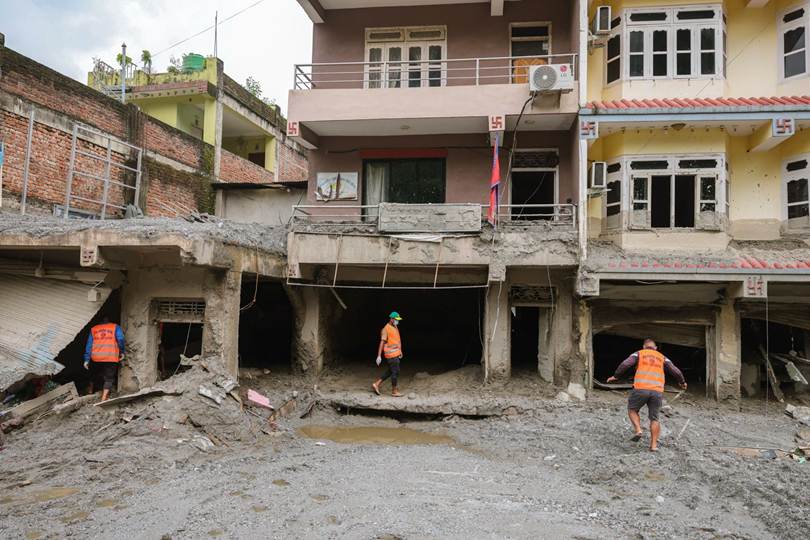
Response workers navigate the mud and debris of a flooded area in Nepal. Photo credit: World Central Kitchen 2026
When a Mountain Became a Wall of Water
On 26 August 2026, a violent flash flood tore through Nepal’s Rasuwa district and the Bhote Koshi river corridor near the border with China. Water, mud, rock and ice swept through settlements and strategic infrastructure, destroying homes, roads and bridges and isolating communities at the very moment when access was most urgently needed.
The scale of loss is still being established. According to a preliminary UNDP update issued on 1 September, Nepal had reported more than 1,000 deaths and more than 4,000 people missing. Government figures cited by UNDP indicated that 84,270 people had been affected across 17 municipalities in six districts. Satellite-based analysis estimated at least 2.2 million tonnes of debris in the areas assessed. These figures remain provisional and should be treated with the restraint owed to an unfolding emergency.
| 26 August 2026 Flash flood struck northern Nepal | 84,270 People reported affected across six districts in Nepal | 2.2 Million Tonnes Preliminary estimate of debris in analysed areas |
Figures are provisional; data cut-off: 11:30 PM, 2 September 2026. Source: UNDP 2026
The disaster did not stop at the riverbank. UNDP reported that 11 hydropower stations and one solar facility, representing 431.1 megawatts, had stopped operating, while a further 15 power projects under construction were damaged. Agricultural communities were struck during the main monsoon planting season. Roads, communications and electricity failures complicated rescue and delayed the restoration of basic services.
The defining feature of modern climate risk is not the hazard alone. It is the cascade.
The Climate Link: Urgent, but Not Simplistic
Early scientific assessments indicate that the flood was triggered by an ice-and-rock avalanche high in the mountains. Experts of the International Centre for Integrated Mountain Development (ICIMOD) reported that the avalanche temporarily blocked the Lende River, creating a natural dam whose failure released a destructive surge downstream. This matters because the event has sometimes been described as a glacial lake outburst flood; the emerging evidence points instead to a different but equally dangerous cascading mountain process.
It would be scientifically careless to state that climate change alone caused this specific disaster before a full attribution assessment is completed. ICIMOD has cautioned that direct attribution is not yet possible. Yet it would be equally careless to remove the event from its climate context. Warming is rapidly reshaping the Hindu Kush Himalaya, changing ice, snow, water and slope stability and increasing the range of hazards that governments must monitor.
This distinction is essential for sound policy. Event attribution asks how much climate change influenced one disaster. Risk management asks whether a changing climate is altering the baseline against which infrastructure, settlements and emergency systems were designed. Governments cannot wait for perfect attribution before managing an already shifting risk environment.
A Disaster Is Built Before It Happens
Nature provided the trigger in Rasuwa, but the scale of the tragedy emerged from the interaction between the trigger and pre-existing exposure. Communities and energy assets occupied a narrow river corridor. Access depended on roads and bridges that were themselves exposed to the same hazard. The event crossed an international border, while monitoring and warning responsibilities did not necessarily cross with it. Once electricity, transport and communications were disrupted, one emergency multiplied into several.
This is why the phrase ‘natural disaster’ can be misleading. Hazards may be natural; disasters are shaped by where people build, which standards are enforced, what information is shared, whether warnings reach the last mile, and how much time is left to act before and after impact.
The lesson is not that every extreme event can be prevented. It is that catastrophic consequences are rarely produced by the hazard alone. Exposure, vulnerability and institutional readiness are development choices, accumulated over years.
Why the Arab Region Should Recognise the Warning
The Arab region does not share Nepal’s Himalayan geography, but it shares the same governance test. Across the region, climate risk is expressed through extreme heat, prolonged drought, flash floods, coastal hazards, water scarcity and sand and dust storms. In fragile and conflict-affected settings, weak infrastructure and constrained public institutions can magnify each shock. In fast-growing cities, expansion into floodplains or poorly drained areas can convert short-duration rainfall into a major urban emergency.
The 2023 Derna disaster in Libya offers the clearest regional parallel: extreme rainfall associated with Storm Daniel caused two dams upstream of the city to collapse, releasing a devastating flood. The tragedy demonstrated how an extreme weather event can become a catastrophe when ageing infrastructure, inadequate maintenance, settlement exposure, limited warning capacity and fragmented risk governance converge.
A severe heatwave can raise electricity demand, interrupt water supply, reduce labour productivity and strain hospitals at the same time. A flood can close a transport corridor, interrupt food markets, contaminate water and cut communications. Drought can move from the farm to food prices, household incomes, public budgets and displacement. These are not separate sectoral problems. They are linked failures across the water-energy-food-ecosystem nexus.
Regional readiness remains uneven. WMO reported in 2025 that 59 per cent of Arab States had reported multi-hazard early warning system coverage, while only 23 per cent of Arab WMO members operated climate services at a Full or Advanced capacity. Coverage on paper is also not the same as protection in practice: a forecast saves lives only when it triggers an understood, funded and locally executable action.
Knowledge management is not a supporting activity in climate resilience. It is operational infrastructure.
From Forecasts to Decisions: What Must Change
The Arab region already has climate strategies, disaster-risk frameworks and growing technical capacity. The priority now is to close the implementation gap between information, investment and action. Seven practical shifts stand out.
- Treat risk intelligence as critical public infrastructure. National environmental information systems should integrate hazard, exposure, vulnerability and infrastructure data rather than store them in separate institutional silos. Risk maps must be updated, interoperable and usable by municipalities, civil-protection agencies, utilities and project planners.
- Connect early warning to early action. The communications trail must be tested from the forecasting centre to the last household, including people without reliable internet access or adequate means of communications.
- Stress-test infrastructure for cascading failure. Roads, dams, power systems, desalination plants, hospitals, ports, and most recently AI data centres, should be assessed not only for the hazard they face directly, but also for the services that fail when they stop operating. Climate-risk screening should become a mandatory gate in public planning, investment and procurement.
- Finance preparedness before financing recovery. Dedicated adaptation budgets, anticipatory financing, reserve mechanisms and risk-transfer instruments should be established before the emergency. The public-finance case is strong: UNDRR estimates that the true global cost of disasters exceeds USD 2.3 trillion annually once indirect and ecosystem losses are included.
- Protect the most exposed first. Risk is distributed unequally. Informal settlements, remote communities, small farmers, displaced people, older persons, women, children and persons with disabilities often receive warnings later and recover more slowly. Local institutions and trusted community networks must therefore be part of system design, not added during crisis response.
- Build regional and transboundary warning arrangements. Weather systems, dust, rivers, fires, food markets and displacement do not respect administrative borders. Arab cooperation should cover real-time data exchange, common standards, shared modelling, mutual assistance and protocols for communicating risk across borders.
- Institutionalise learning after every event. Each disaster should generate a transparent loss-and-damage record, an independent after-action review, updated risk assumptions and funded corrective actions. Lessons that remain in reports but do not change budgets, standards or operating procedures are not lessons learned.
From Nepal to Antalya: An Arab Agenda for COP31
COP31 will take place in Antalya, Türkiye, from 9 to 20 November 2026. The official preparatory process has framed 2026 around a practical question: after COP30’s shift towards implementation, how can the Paris Agreement’s policy cycle produce climate action on the ground? Nepal has given that question a human face.
For Arab countries, the value of COP31 will not be measured by the number of references to vulnerability in negotiating text. It will be measured by whether global decisions expand the region’s ability to protect people, infrastructure and development gains. Arab delegations and institutions should therefore arrive in Antalya with a focused implementation package built around five priorities:
- Adaptation finance that matches risk: UNEP estimates that developing-country adaptation needs in 2035 will reach USD 310-365 billion annually, while international public adaptation finance was only USD 26 billion in 2023. COP31 should advance finance that is accessible, predictable and appropriate to vulnerability, with greater use of grants and highly concessional instruments for countries already constrained by debt and conflict.
- Measurable implementation of the Global Goal on Adaptation: Global indicators must translate into national delivery: people covered by effective warnings, critical assets screened for future risk, water and food systems made more resilient, and local institutions equipped to act. Reporting should reward reduced vulnerability, not merely the existence of another strategy.
- Faster arrangements for loss and damage:When impacts exceed adaptation limits, finance should move quickly enough to support recovery, protect livelihoods and prevent temporary shocks from becoming long-term development reversals. Access procedures must be workable for least developed and fragile states.
- Technology and data as public goods: Observation networks, climate services, interoperable data platforms, satellite analysis, and forecasting should be treated as a connected capability. Technology transfer must include maintenance, training, institutional ownership and long-term operating finance.
- Regional investment pipelines, not isolated project lists: Arab countries can strengthen their negotiating position by presenting coordinated programmes for early warning, heat-health action, resilient water systems, drought management, coastal protection and climate-risk information. A credible pipeline with common standards and measurable outcomes is more likely to mobilise finance than fragmented requests prepared after each emergency.
This is the strategic connection between Rasuwa and Antalya: climate negotiations matter only when their outcomes alter the conditions on the ground before the next shock arrives.
Will the Arab Region Learn?
The honest answer is that the Arab region will learn from Nepal only if the tragedy changes decisions made before its own next emergency: where infrastructure is built, how it is designed, which data are shared, who receives the warning, when finance is released and which institution is accountable for acting.
The region does not lack evidence. It lacks time. Climate change is increasing the pressure on already stressed water systems, cities, coasts, food supply chains and public budgets. At the same time, tested solutions already exist: risk-informed planning, impact-based forecasts, anticipatory action, resilient infrastructure, locally led adaptation and regional data cooperation.
Nepal’s tragedy should therefore be met with solidarity, scientific humility and institutional resolve. The purpose of learning is not to claim that every disaster can be stopped. It is to ensure that foreseeable risk is no longer treated as an unforeseen emergency.
Learning will not be measured by the statements issued after a disaster. It will be measured by the lives and development gains protected before the next one.
Resources & Further Reading
The report draws principally on the following sources:
- UNDP. Nepal Floods: Preliminary Impact and Debris Assessment (1 September 2026).
- ICIMOD. Kyirong-Rasuwa Flood 2026 (updated 2026).
- IFRC. Nepal Flash Floods Emergency Appeal (27 August 2026).
- World Meteorological Organization. Arab Regional Platform for Disaster Risk Reduction (17 February 2025).
- United Nations Environment Programme. Adaptation Gap Report 2025: Running on Empty (29 October 2025).
- United Nations Office for Disaster Risk Reduction. Global Assessment Report 2025: Resilience Pays (2025).
- UN Climate Change. The Road to Antalya (2026).
- Intergovernmental Panel on Climate Change. Mediterranean Region – AR6 Impacts, Adaptation and Vulnerability (2022)