
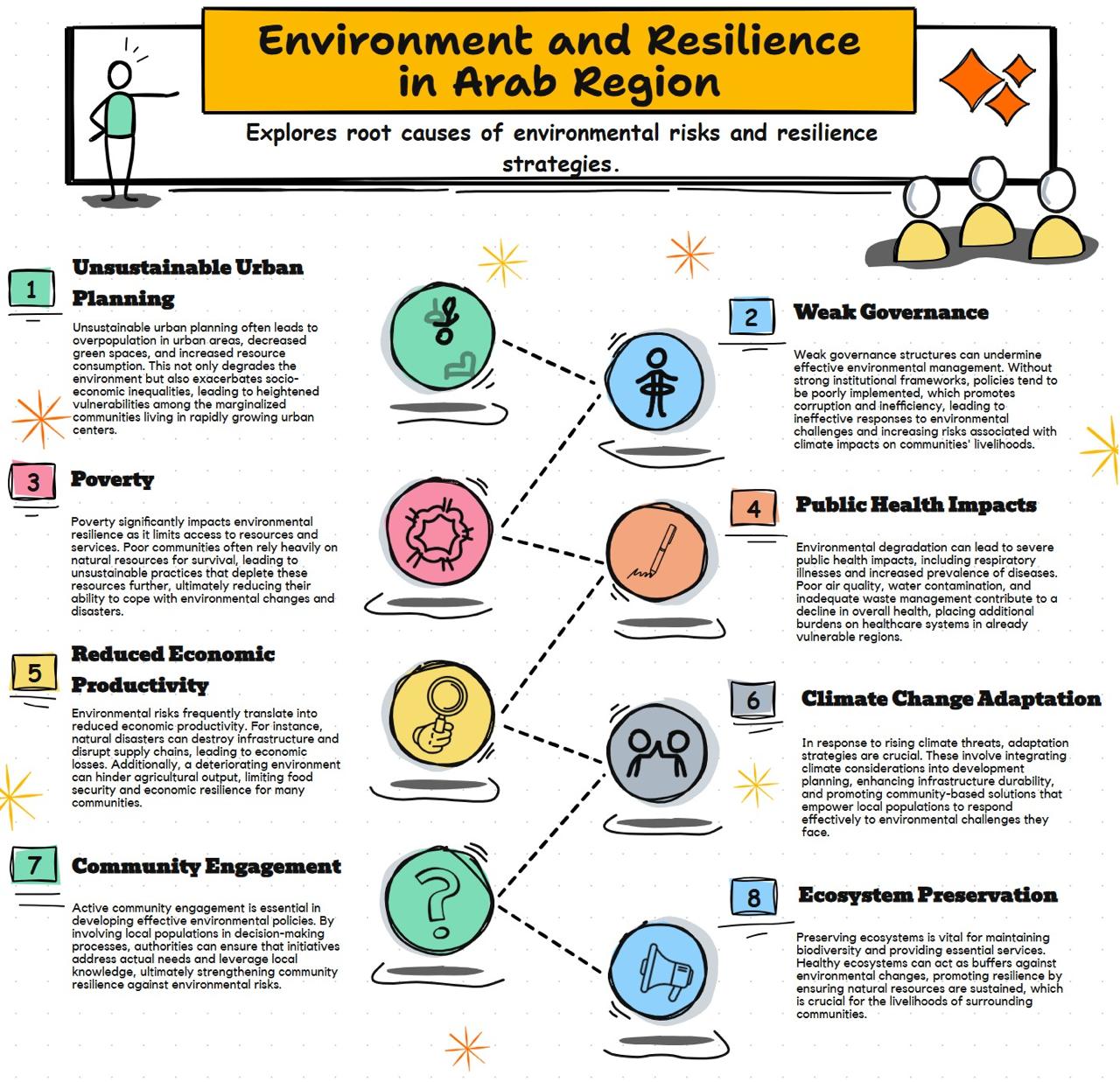
The 2024 Regional Disaster Risk Reduction Assessment confirms that the Arab region faces a new phase of intertwined risks, where environmental, climate, economic, and social challenges no longer occur separately but interact to produce more complex and broader impacts. Climate change, rapid urbanization, growing inequalities, and ongoing conflicts in some Arab countries together form an interconnected system of risks that multiplies losses and tests the resilience of societies and institutions.
The seriousness of complex environmental risks lies in the fact that they do not occur alone; a severe heat wave may coincide with a power outage, drought may be accompanied by rising food prices and declining livelihoods, or urban floods may cause greater damage when they coincide with weak infrastructure or population displacement. In such cases, traditional sectoral dealing becomes insufficient. It may even transfer risks from one sector to another instead of addressing them radically.
In the Arab context, these challenges are evident in floods in cities in the Nile Valley and the Maghreb, disruptions to basic services because of conflicts in the Levant, Yemen, and Sudan, and rising risks of extreme heat in Gulf cities. However, the climate event itself is not always the primary cause of losses; deeper drivers often include unsustainable urban planning, weak governance, ecosystem degradation, poverty, and institutional fragility.
The true cost of these risks exceeds direct material losses. They include invisible public health impacts from heat stress, air and water pollution, reduced economic productivity, increased public budget burdens, and the depletion of natural capital and services that ecosystems provide to communities and local economies.
Therefore, an effective response requires a shift from post-disaster management to pre-disaster management through integrated policies based on three main axes: building national systems to understand and periodically update interconnected risks, integrating climate and disaster considerations into public planning and investment, and expanding early warning coverage and multi-risk response. The success of this transformation also depends on a broad partnership that includes governments, municipalities, universities, the private sector and civil society, while providing the necessary data, financing and capacity building.
In this context, indicators such as the existence of a national registry of interconnected risks that is updated annually, the percentage of public investments subject to climate and disaster risk screening, and the extent to which early warning plans and multi-risk response cover the population represent practical tools for measuring real progress on the ground, far from being satisfied with theoretical commitments.
Strengthening resilience is no longer a development option, but a strategic necessity to achieve the Sustainable Development Goals and implement the commitments of the Paris Agreement, the Sendai Framework, and the 2030 Agenda. Every dollar invested in prevention, early planning, and resilience helps avoid larger future losses, strengthens community security, and stabilizes economies in a region where risks are increasingly complex and interconnected.