
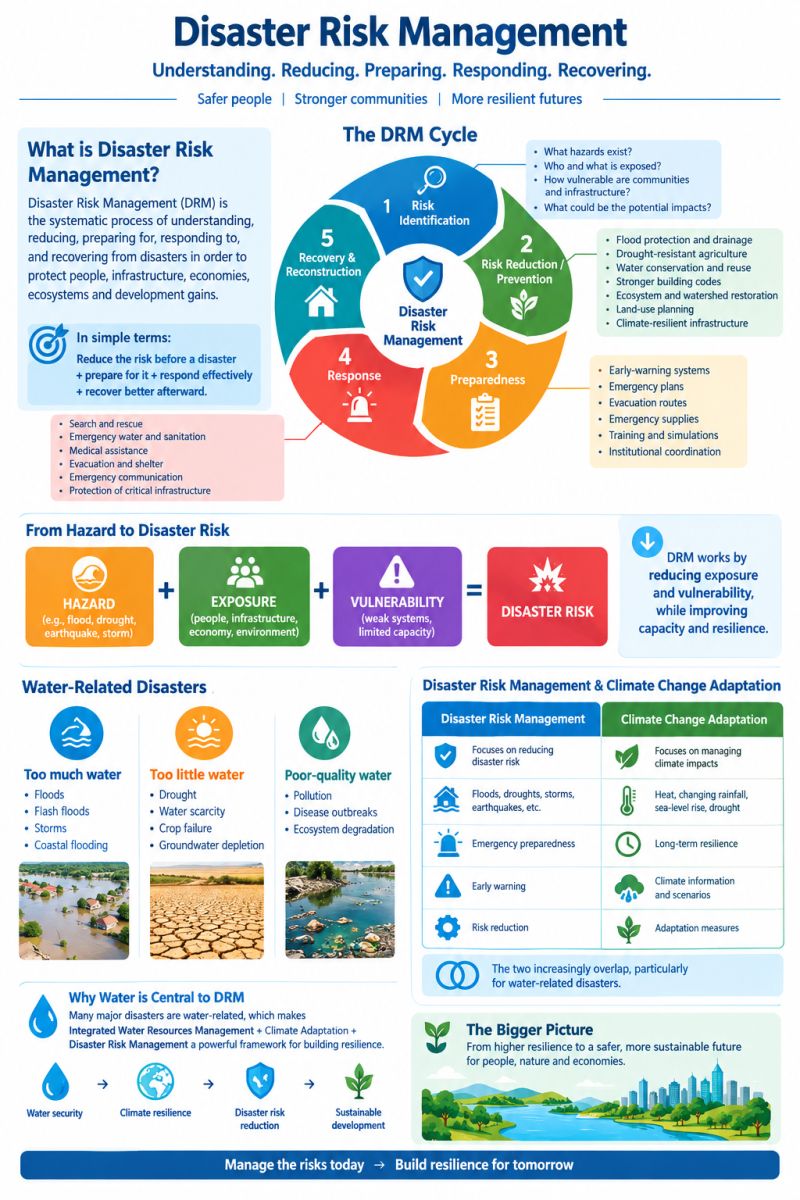
A systematic process of understanding, reducing, preparing for, responding to, and recovering from disasters in order to protect people, infrastructure, economies, ecosystems, and development gains.
Disaster Risk Management = Reduce the risk before a disaster + prepare for it + respond effectively + recover
The DRM cycle
1. Risk Identification
What hazards exist? — floods, droughts, earthquakes, storms, wildfires, epidemics, etc.
Who and what is exposed?
How vulnerable are communities and infrastructure?
What could be the potential impacts?
2. Risk Reduction / Prevention
Actions that reduce the likelihood or impact of disasters:
Flood protection and drainage
Drought-resistant agriculture
Water conservation and reuse
Stronger building codes
Ecosystem and watershed restoration
Land-use planning
Climate-resilient infrastructure
3. Preparedness
Getting ready before an event:
Early-warning systems
Emergency plans
Evacuation routes
Emergency water and food supplies
Training and simulations
Institutional coordination
4. Response
Actions during and immediately after a disaster:
Search and rescue
Emergency water and sanitation
Medical assistance
Evacuation and shelter
Emergency communication
Protection of critical infrastructure
5. Recovery and Reconstruction
Restoring communities and economies while reducing future risk:
Rebuilding infrastructure
Restoring water systems
Supporting livelihoods
Rehabilitating ecosystems
“Build Back Better”
Why water is central to DRM
For water professionals, DRM is particularly important because many major disasters are water-related:
Too much water
→ Floods • Flash floods • Storms • Coastal flooding
Too little water
→ Drought • Water scarcity • Crop failure • Groundwater depletion
Poor-quality water
→ Pollution • Disease outbreaks • Ecosystem degradation
This makes Integrated Water Resources Management + Climate Adaptation + Disaster Risk Management a powerful framework for building resilience.
A useful overarching concept would therefore be:
Water Security → Climate Resilience → Disaster Risk Reduction → Sustainable Development
5