
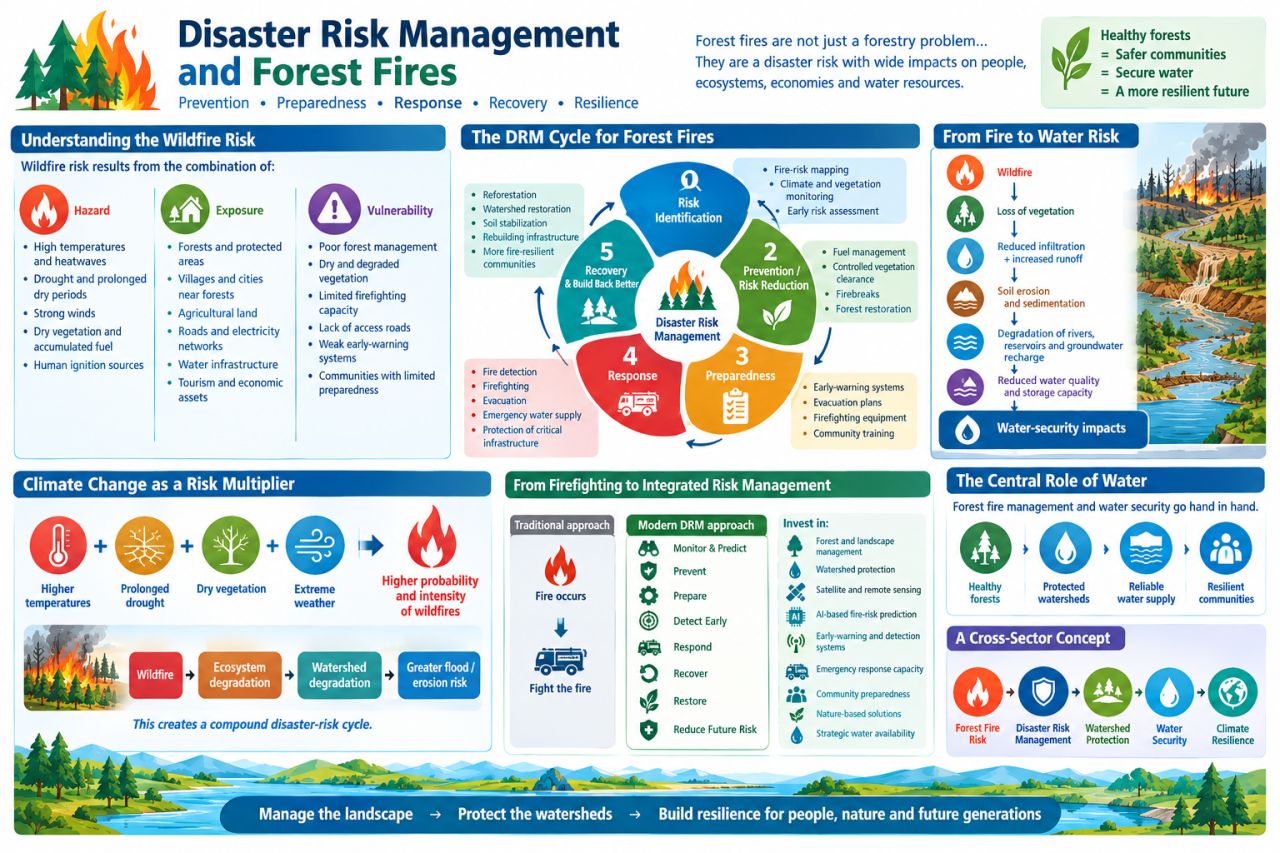
Forest fires (wildfires) are a clear example of how Disaster Risk Management (DRM) can be applied to prevent, prepare for, respond to, and recover from a disaster.
A useful framework is:
Climate & vegetation conditions → Fire hazard → Exposure & vulnerability → Wildfire risk → DRM → Resilience
1. Understanding the wildfire risk
Wildfire risk is influenced by three main elements:
🔥 Hazard
High temperature and heatwaves
Drought and prolonged dry periods
Strong winds
Dry vegetation and accumulated fuel
Human ignition sources
🏘️ Exposure
Forests and protected areas
Villages and cities near forests
Agricultural land
Roads and electricity networks
Water infrastructure
Tourism and economic assets
⚠️ Vulnerability
Poor forest management
Dry and degraded vegetation
Limited firefighting capacity
Lack of access roads
Weak early-warning systems
Communities with limited preparedness
2. The important role of water
Forest fires are not only a forestry problem—they can become a water-security problem.
Wildfire
↓
Loss of vegetation
↓
Reduced infiltration + increased runoff
↓
Soil erosion and sedimentation
↓
Degradation of rivers, reservoirs and groundwater recharge
↓
Reduced water quality and storage capacity
↓
Water-security impacts
After a fire, intense rainfall can also produce flash floods and debris flows because vegetation that previously protected the soil has been removed.
3. Climate change creates a risk multiplier
A useful conceptual relationship is:
Higher temperatures + prolonged drought + dry vegetation + extreme weather
→ higher probability and intensity of wildfires
Wildfire → ecosystem degradation → watershed degradation → greater flood/erosion risk
4. From firefighting to integrated risk management
Traditional approach: 🔥 Fire occurs → 🚒 Fight the fire
Modern DRM approach:
Monitor → Predict → Prevent → Prepare → Detect Early → Respond → Recover → Restore → Reduce Future Risk
This means investing not only in firefighting, but also in:
🌲 Forest and landscape management
💧 Watershed protection
🛰️ Satellite and remote sensing
🤖 AI-based fire-risk prediction
📡 Early-warning and detection systems
🚒 Emergency response capacity
🏘️ Community preparedness
🌱 Nature-based solutions
💦 Strategic water availability for emergency response
Forest fires can be presented as:
FOREST FIRE RISK → DISASTER RISK MANAGEMENT → WATERSHED PROTECTION → WATER SECURITY → CLIMATE RESILIENCE
5
previous post