CEDARE – COP31 STRATEGIC INTELLIGENCE
THE IMPLEMENTATION TEST
Week-one executive assessment, Antalya, Türkiye, 9–14 November 2026
THE BIG QUESTION: Who pays, who implements, and who decides?
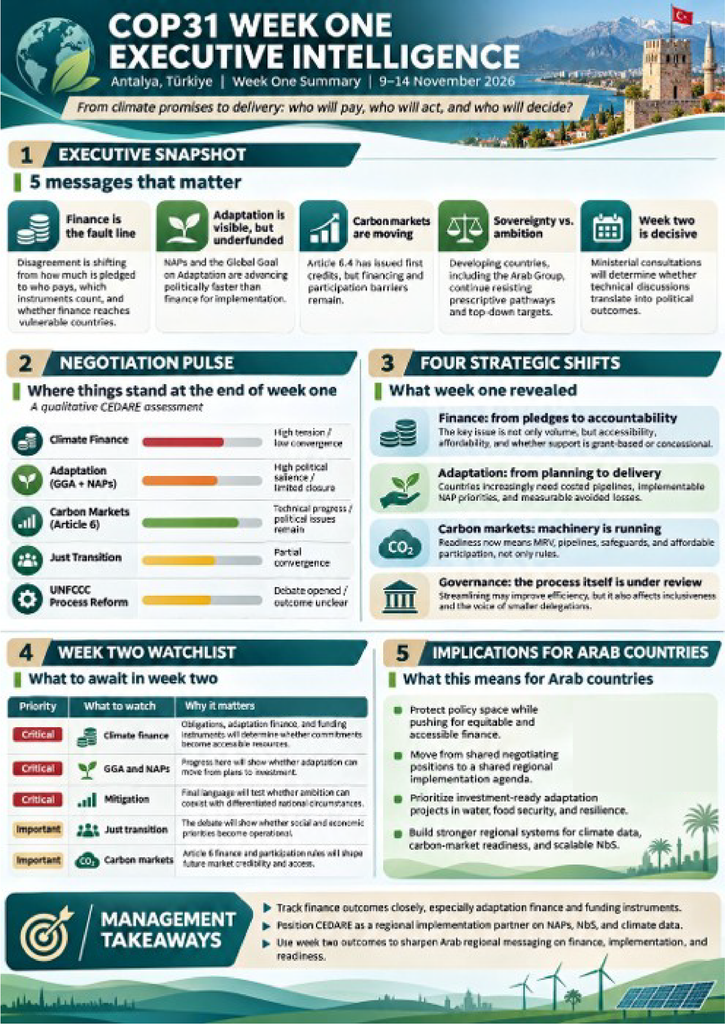
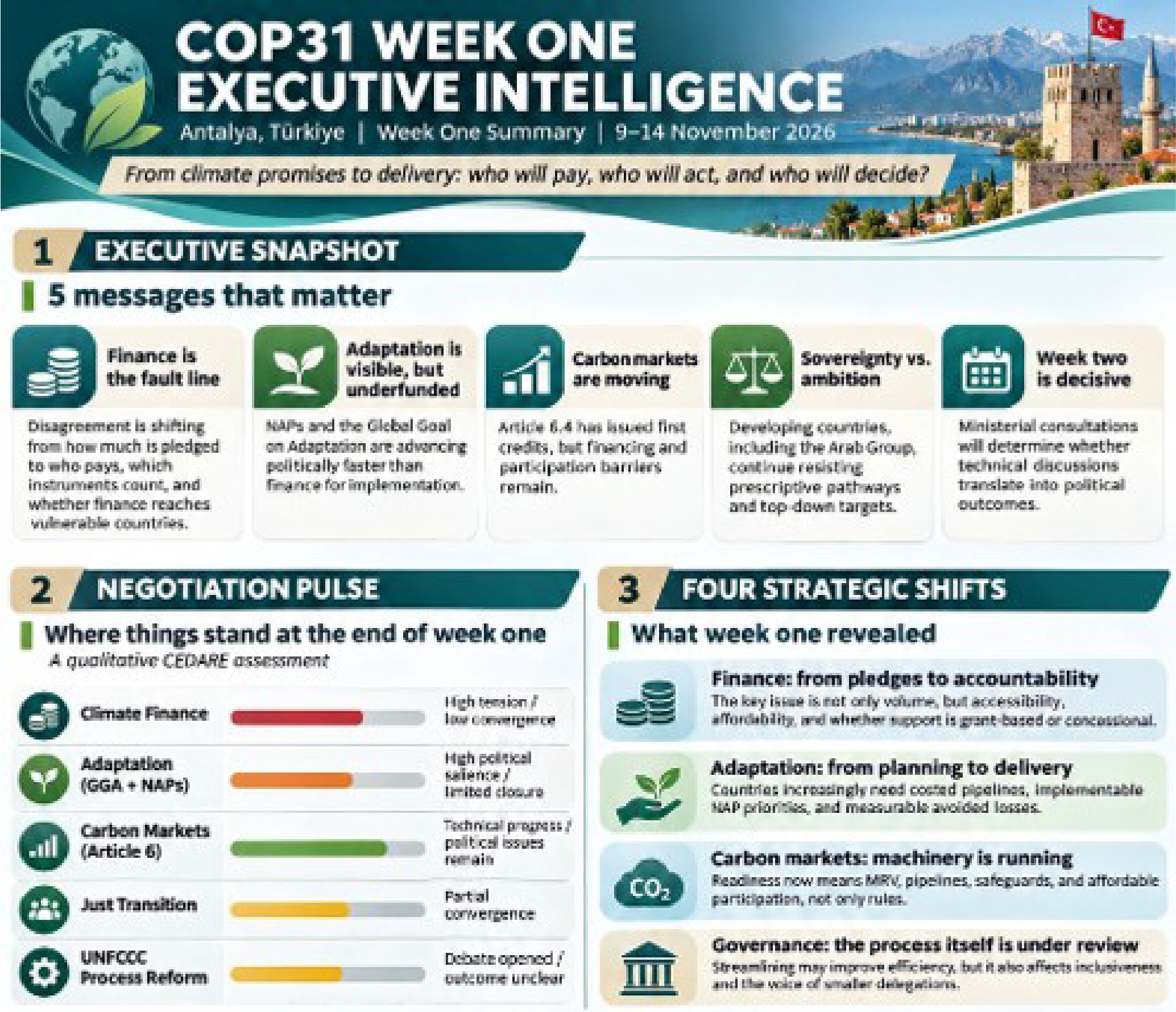
COP31 entered its second week with the negotiating machinery moving, but the political bargain still missing. Technical conclusions were adopted and carbon-market infrastructure advanced; however, adaptation finance, mitigation pathways, the Global Goal on Adaptation (GGA) and just transition remain politically contested. The defining divide is no longer whether implementation matters, but who carries its costs and who controls its rules.
AT A GLANCE: Five signals for leadership
| SIGNAL | WEEK-ONE READING | MANAGEMENT IMPLICATION |
| FINANCE | High friction: obligations, donor base and instruments contested | Prioritize grant/concessional access and project readiness |
| ADAPTATION | NAP implementation recognized; finance and GGA indicators unresolved | Convert plans into costed investment pipelines |
| CARBON MARKETS | Article 6.4 issued first credits; operating finance uncertain | Invest in MRV, safeguards and viable project preparation |
| JUST TRANSITION | Broad support to continue work; scope and modalities disputed | Connect jobs, diversification and food security |
| PROCESS | Debate over streamlining COP versus equity and consensus | Protect regional voice and negotiating capacity |
Source: IISD Earth Negotiations Bulletin, COP31 daily issues 9–14 November.
1. THE REAL STORY: THREE NEGOTIATING FAULT LINES
Finance: bigger numbers are not the same as usable money
Negotiations over the Climate Finance Work Programme exposed a fundamental disagreement: developing countries foreground developed-country provision obligations under Paris Agreement Article 9.1, while several developed countries favor a broader finance landscape including private investment. Disputes also cover burden-sharing, the accounting of support, and whether loans are appropriate for adaptation. For vulnerable economies, the decisive test is additionality, accessibility, grant content and debt sustainability, not the headline volume mobilized.
Adaptation: the implementation gap is now impossible to ignore
Parties increasingly discuss National Adaptation Plans (NAPs) as vehicles for delivery rather than planning alone. Yet negotiations over NAP finance and GGA indicators show how difficult it remains to translate priorities into accountable investments. Arab countries should treat this as a preparation window: establish costed priorities, institutional owners, local delivery models and evidence of avoided losses before new funding windows are negotiated.
Sovereignty versus prescription: a dispute with economic consequences
The Arab Group resisted top-down sectoral or energy targets and unilateral trade measures, while other parties pressed for stronger fossil-fuel transition signals and tighter alignment with the Global Stocktake. This is not simply a disagreement over wording: it shapes industrial policy, energy security, export competitiveness and the distribution of transition costs. A credible regional response should pair nationally determined pathways with measurable action, diversification and financing needs.
2. WHERE MOVEMENT IS VISIBLE, AND WHERE IT IS NOT
| TRACK | WHAT CHANGED | WHAT REMAINS OPEN |
| Article 6.4 | First credits issued; five methodologies reported | Funding beyond 2027; workable access for smaller projects |
| Article 6.2 | Funding options advanced to CMA consideration | Core-budget versus user-fee models; exemptions |
| GGA / NAPs | Draft texts forwarded for higher-level discussion | Indicators, means of implementation, finance and timing |
| Just transition | Broad backing for continuation beyond 2026 | Duration, mandate, sectoral language, finance |
| Agriculture | Procedural outcome reached | No substantive breakthrough on food systems support |
The pattern: institutional and procedural progress is easier than agreement on distributional questions of finance, responsibilities and development space.
3. ARAB REGION: TURN NEGOTIATING POSITIONS INTO A DELIVERY ADVANTAGE
The Arab region faces a distinctive combination of extreme water stress, food-system exposure, fast-growing cooling demand, fiscal pressures and heterogeneous energy economies. COP31 therefore creates both a defensive negotiating agenda and a proactive investment opportunity. Regional cooperation can help shift from shared positions to shared implementation infrastructure.
| PRIORITY | ACTIONABLE REGIONAL RESPONSE | POTENTIAL CEDARE CONTRIBUTION |
| Adaptation investment | Build a short list of costed, scalable NAP projects with grant/concessional needs | Project preparation and adaptation-finance capacity |
| Water–food resilience | Scale tested nature-based water and agricultural solutions | Use CEDARE projects such as Al Murunah and Smart Villages (Drosos) evidence to design replication packages |
| Carbon-market integrity | Coordinate MRV capacity, registries, Article 6 readiness and safeguards | Technical assistance and regional learning |
| Climate data | Develop comparable indicators for risk, adaptation and delivery | Regional data and monitoring partnerships (e.g. Egyptian Meterological Association, Government research centre (ARC, NRC), etc.) |
| Just transition | Link diversification, jobs and trade exposure to national transition pathways | Evidence briefs and cross-country policy dialogue |
4. THE WEEK-TWO WATCHLIST: FIVE DECISIONS TO AWAIT
| WATCH | WHAT TO LOOK FOR | WHY IT MATTERS |
| Climate finance | Whether ministerial talks clarify obligations, finance instruments and adaptation scaling | Determines credibility of implementation commitments |
| GGA and NAPs | Agreed indicators, implementation support and an actionable NAP pathway | Shapes what countries can measure and finance |
| Mitigation / cover decision | Compromise on ambition without prescriptive sectoral targets | Impacts national policy flexibility and global ambition |
| Just transition | Continuation and operational modalities linked to finance and jobs | Tests whether social priorities become deliverables |
| Article 6 and funds | Fee arrangements, market sustainability and guidance to climate funds | Affects practical participation and resource access |
Political process to watch: the Presidency has established ministerial consultations on mitigation, climate finance, adaptation, just transition and oceans, alongside negotiations on a possible cover decision and UNFCCC process reform. Draft text should not be confused with agreed outcomes.
5. RECOMMENDED MANAGEMENT MOVES
- Package two to three investment-ready adaptation / nature-based WEFE concepts with financing needs, delivery partners and impact indicators.
- Convene partners on Article 6 readiness, knowledge enhancement and the financing of smaller, high-integrity projects.
- Translate COP31 negotiating stances and outcomes into targeted advisory offers/capacity enhancement for Arab ministries and financial institutions.
BOTTOM LINE: From negotiation to regional leverage
COP31 week one demonstrated that the central challenge of climate diplomacy is no longer generating additional agendas, rather it is converting existing commitments into financed, nationally owned implementation. The second week will determine whether ministers can bridge the gap between political ambition and practical delivery. Progress should be judged by usable finance, clear institutional pathways and decisions that reduce, not reproduce, implementation barriers.
For Arab countries, the implication is twofold. Defending equity, national circumstances and fair finance obligations remains essential, but negotiating safeguards alone will not build resilience. Arab institutions should simultaneously develop bankable adaptation pipelines, interoperable climate-data systems, credible carbon-market infrastructure and scalable water–food solutions. This dual strategy, protecting policy space while demonstrating implementation readiness, offers the strongest basis for regional influence and tangible development gains.