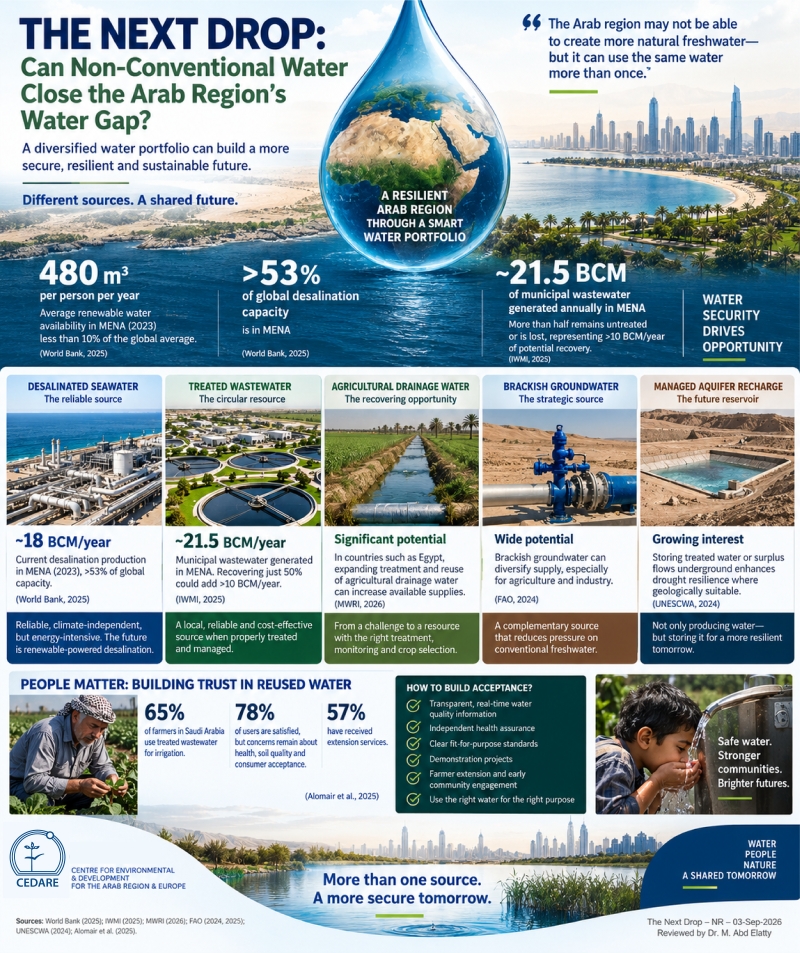
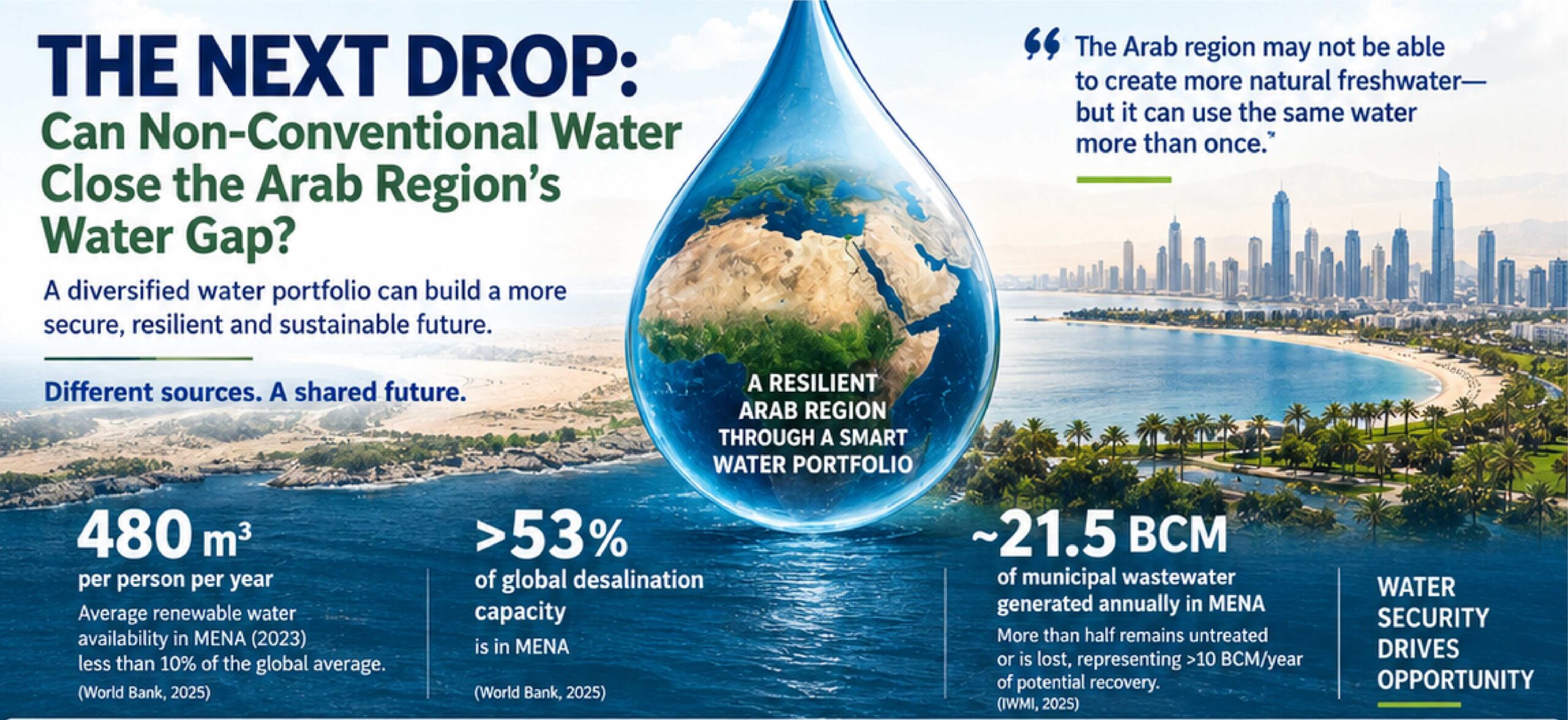
Across the Arab region, the water-security challenge is no longer simply how to develop more freshwater, but how to build the right portfolio of water sources. In the wider Middle East and North Africa (MENA), renewable water availability averaged only 480 m³ per person in 2023, less than one-tenth of the global average. At the same time, MENA already accounts for more than 53% of global desalination capacity, showing how strongly the region is turning toward non-conventional supply (World Bank, 2025).
Yet desalination alone cannot provide the whole answer. Treated wastewater may represent one of the region’s largest underused circular resources. MENA generates approximately 21.5 billion m³ of municipal wastewater each year, while more than half remains untreated or is lost through evaporation. In simple volumetric terms, recovering just half of this annual flow would represent more than 10 billion m³/year of additional water before accounting for technical, economic, environmental and quality constraints (IWMI, 2025).
This resource is particularly attractive because wastewater grows with urbanization and can often be reused close to cities, farms and industrial zones. The World Bank notes that reuse is most economically promising when treatment facilities and end users are geographically close, and estimates that potable and industrial reuse globally could increase eightfold by 2040 under supportive regulation and investment frameworks (World Bank, 2025).
But infrastructure alone will not unlock this potential. Public acceptance is a water-resource issue in its own right. A 2025 Saudi study of 391 farmers across five regions found that 65% already used treated wastewater and 78% of users were satisfied, yet concerns persisted over health risks, soil quality, pests and consumer acceptance. Only 57% had received extension services, suggesting that trust, knowledge and communication remain important constraints (Alomair et al., 2025).
The response should therefore go beyond awareness campaigns. Authorities can increase confidence through visible water-quality monitoring, independent health assurance, clear fit-for-purpose standards, demonstration sites, farmer extension and transparent communication about where reused water is suitable and where it is not. Tunisia’s 2025 Sanitation Safety Planning initiative provides a useful regional model, bringing water, agriculture, health and environmental authorities together to assess risks across the entire reuse chain.
For CEDARE, the policy message is clear: the future Arab water system should combine desalination, wastewater reuse, agricultural drainage reuse, brackish water and managed recharge, while matching each source to the appropriate use. The next drop must be not only produced and treated but trusted, affordable and fit for purpose.
References: World Bank (2025), In MENA, Make Every Drop of Water Count; World Bank Group (2025), Scaling Water Reuse: A Tipping Point for Municipal and Industrial Use; IWMI (2025), In MENA Water Reuse Holds Immense Potential, Yet Remains Largely Untapped; Alomair et al. (2025), Enhancing Treated Wastewater Reuse in Saudi Agriculture: Farmers’ Perspectives; FAO (2025), Advanced Sanitation Safety Planning for Treated Wastewater Reuse in Agriculture in Tunisia.