
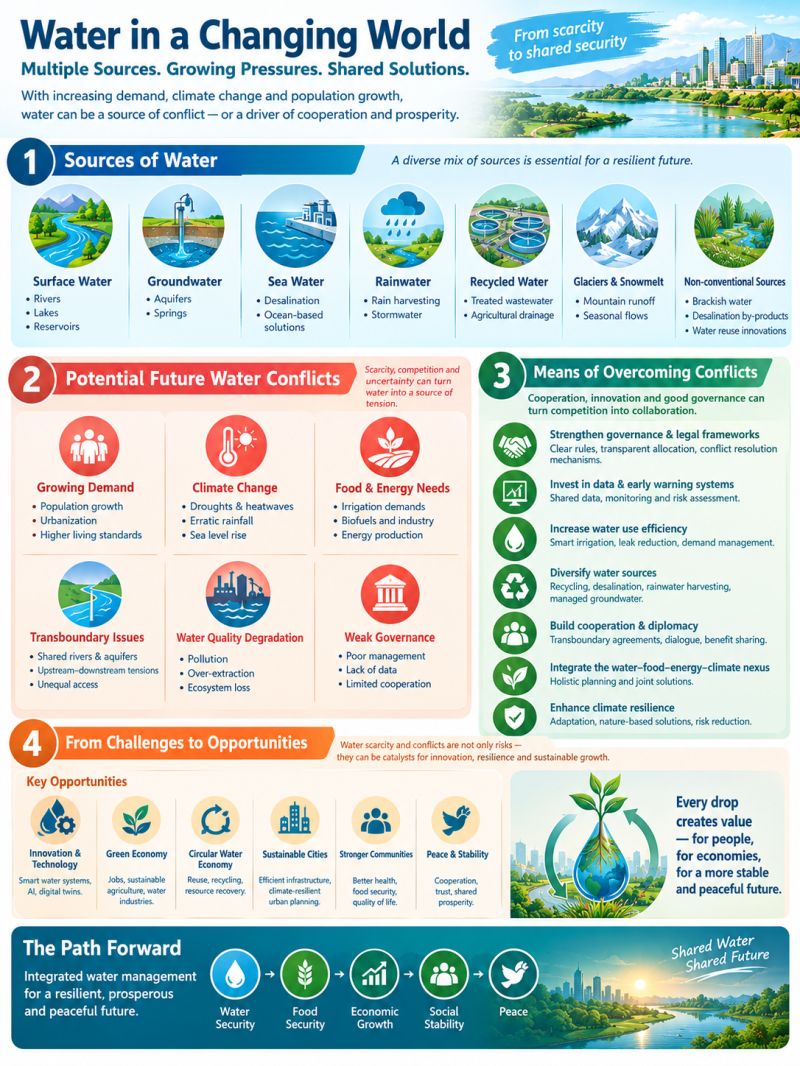
Environmental control engineering connects water with the environment, health, energy, and agriculture through water-quality monitoring, treatment and reuse, pollution control, risk management, and sustainability. The future of water management under conditions of scarcity and population growth involves the following.
Growing water demand
- Population growth and urbanization.
- Increasing agricultural, industrial, and domestic demand.
- Changing consumption patterns and rising living standards.
Increasing water scarcity
- Climate change and rising temperatures.
- More frequent droughts and irregular rainfall.
- Groundwater depletion and declining water quality.
- Greater competition among different water uses.
The shift in water management
- Moving from supply management to demand management and efficiency.
- Moving from one-time use toward a circular water economy.
- Diversifying water sources through desalination, reuse, rainwater harvesting, and groundwater protection.
- Using digital technologies and AI to forecast demand and risks.
- Moving from crisis management to anticipation, resilience, and adaptation.
Water and irregular migration
Water scarcity and drought → lower agricultural production.
Lower production → loss of income and jobs.
Deteriorating livelihoods → increased internal and international migration.
Weak services in receiving cities → additional pressure on water and infrastructure.
Economic and social pressures may increase the drivers of irregular migration. Water is not the sole cause of migration; it interacts with poverty, unemployment, conflict, and weak governance.
Water and armed conflict
- Greater competition over limited water resources.
- Interactions between water scarcity, poverty, unemployment, and food insecurity.
- Weak institutions and governance increase the risk of tensions.
- Conflicts may target dams, water treatment plants, and supply networks.
- Conflict can, in turn, destroy water infrastructure and deepen water insecurity.
Water is therefore often a risk multiplier rather than the sole cause of conflict.
The dangerous cycle:
Water scarcity → lower agricultural production → unemployment and poverty → migration → pressure on cities and services → social tensions → instability → conflict → destruction of water infrastructure → further water scarcity.
Future direction:
Water Security → Food Security → Economic Security → Social Stability → Peace
Priorities include strengthening water diplomacy and cooperation in shared basins; exchanging data and early warnings among countries; integrating water, food, energy, and climate management; investing in water efficiency, reuse, and desalination; and protecting water resources for future generations.
Conclusion:
The future of water management will involve more than managing a natural resource; it will require managing an interconnected system of risks, economic activity, livelihoods, migration, stability, and peace.