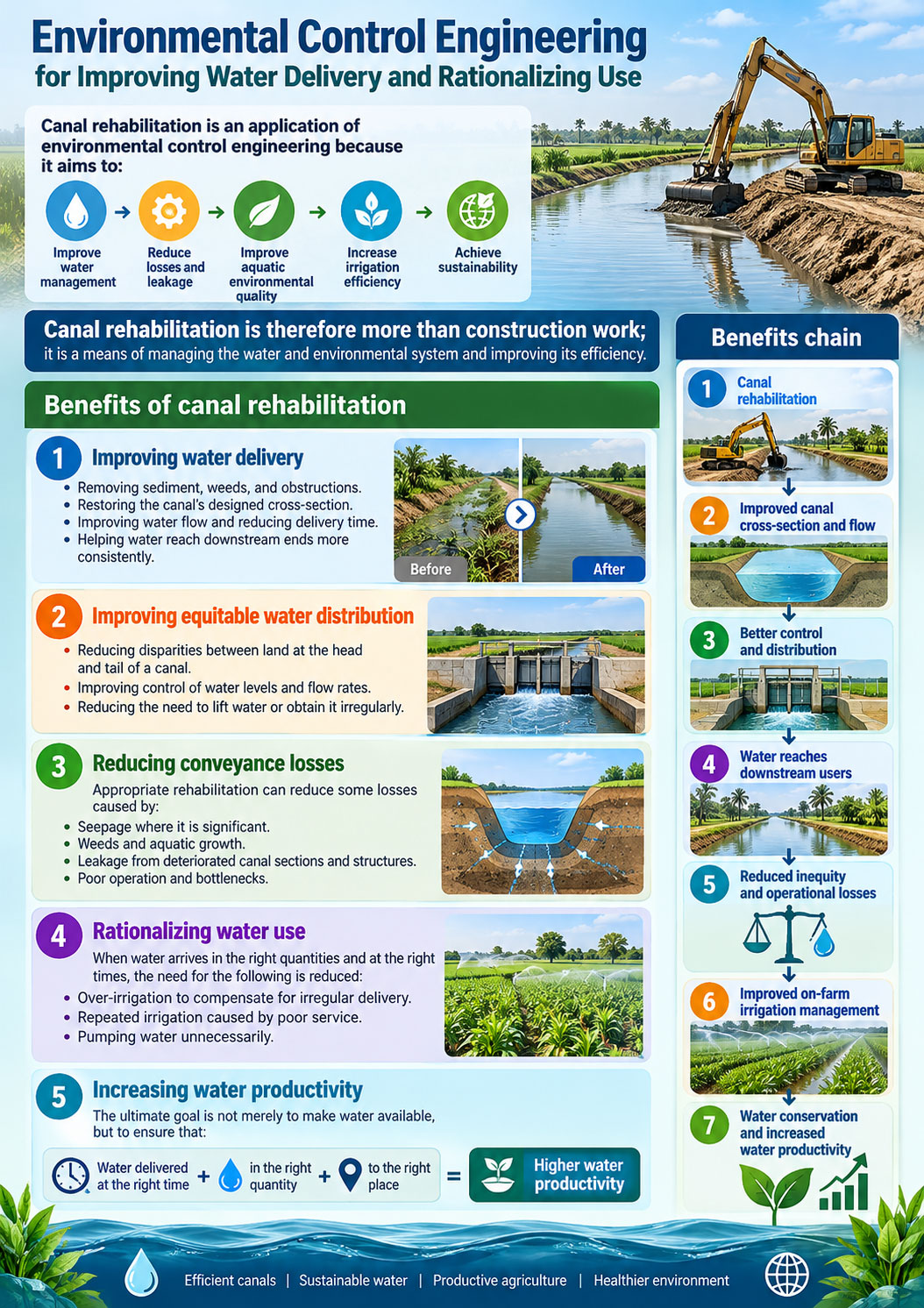
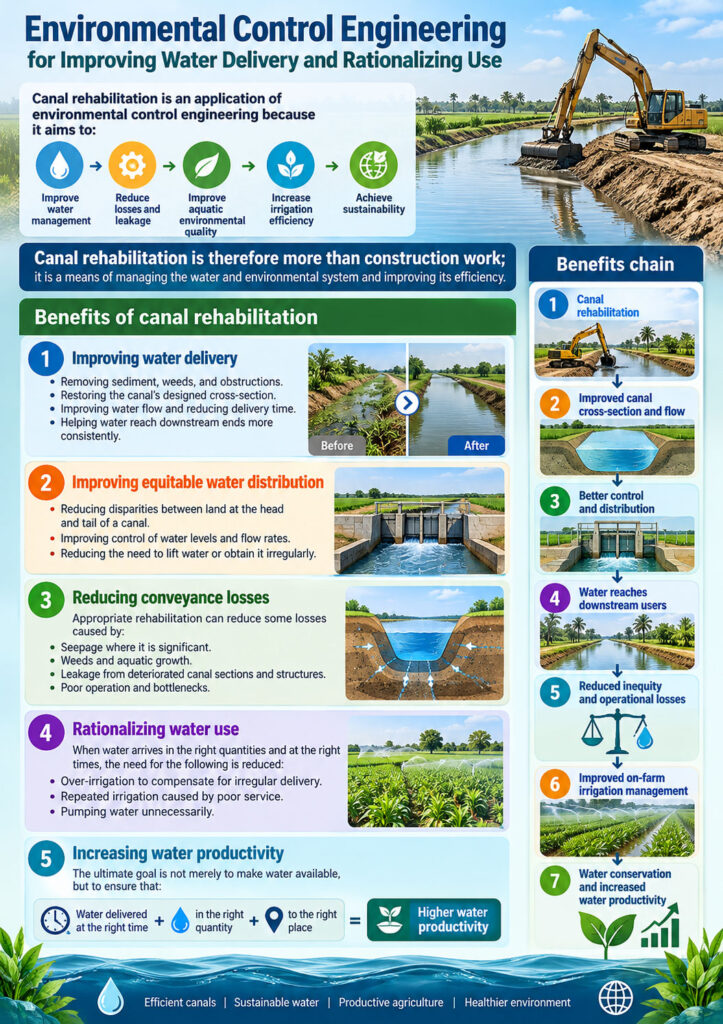
Canal rehabilitation is an application of environmental control engineering because it aims to: Improve water management → reduce losses and leakage → improve aquatic environmental quality → increase irrigation efficiency → achieve sustainability.
Benefits of canal rehabilitation:
Improving water delivery • Removing sediment, weeds, and obstructions. • Restoring the canal’s designed cross-section. • Improving water flow and reducing delivery time. • Helping water reach downstream ends more consistently.
Improving equitable water distribution • Reducing disparities between land at the head and tail of a canal. • Improving control of water levels and flow rates. • Reducing the need to lift water or obtain it irregularly.
Reducing conveyance losses Appropriate rehabilitation can reduce some losses caused by: • Seepage where it is significant. • Weeds and aquatic growth. • Leakage from deteriorated canal sections and structures. • Poor operation and bottlenecks.
Rationalizing water use When water arrives in the right quantities and at the right times, the need for the following is reduced: • Over-irrigation to compensate for irregular delivery. • Repeated irrigation caused by poor service. • Pumping water unnecessarily.
Increasing water productivity The ultimate goal is not merely to make water available, but to ensure that: Water delivered at the right time + in the right quantity + to the right place = higher water productivity.
Benefits chain: Canal rehabilitation ↓ Improved canal cross-section and flow ↓ Better control and distribution ↓ Water reaches downstream users ↓ Reduced inequity and operational losses ↓ Improved on-farm irrigation management ↓ Water conservation and increased water productivity