
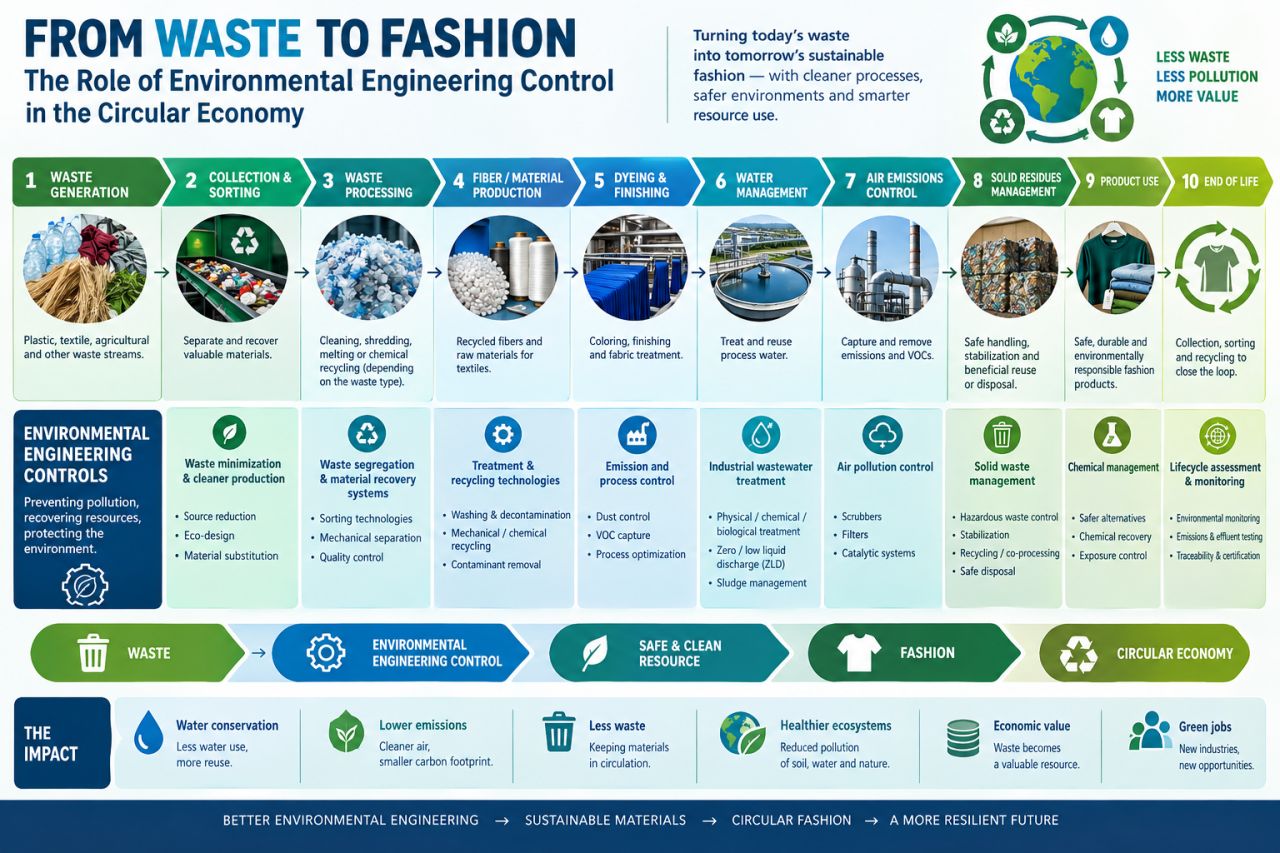
The term “Environmental Engineering Control” is more precise for this topic. Accordingly, the connection with “From Waste to Fashion” should be based on engineering-control systems rather than on the general concept of environmental sustainability alone.
Core concept:
Waste stream → Environmental engineering control → Resource recovery → Fashion product
Environmental engineering manages environmental risks and impacts at every stage of converting waste into materials suitable for fashion manufacturing.
Core engineering concept
Environmental engineering is the bridge between “waste” and a “safe resource.”
Example:
Used PET bottles
↓
Collection and sorting
↓
Washing and cleaning
↓
Shredding
↓
Melting and extrusion
↓
Recycled polyester fibres
↓
Fabrics
↓
Clothing
At every stage, environmental engineering asks:
• What pollutants are generated?
• How much water is consumed?
• What type of wastewater is produced?
• Which chemicals are used or released?
• What air emissions are generated?
• What solid waste remains?
• How can these impacts be prevented, treated, or used for resource recovery?
The strongest link: water
The connection can be strengthened through the perspectives of water and environmental engineering:
Waste
↓
Material recovery
↓
Water-efficient production processes
↓
Wastewater treatment
↓
Water reuse
↓
Sustainable fashion production
The environmental engineer’s role therefore extends beyond treating waste after a problem occurs. It includes designing the entire production process to reduce resource consumption and pollution from the outset.
Environmental engineering control in the circular economy
Prevention → Reduction → Recovery → Treatment → Reuse → Recycling
Better environmental engineering control → Sustainable materials → Circular fashion → A more resilient and sustainable future.
“From Waste to Fashion” is an excellent practical example of how environmental engineering can evolve from pollution control alone to resource recovery and the circular economy.
2