
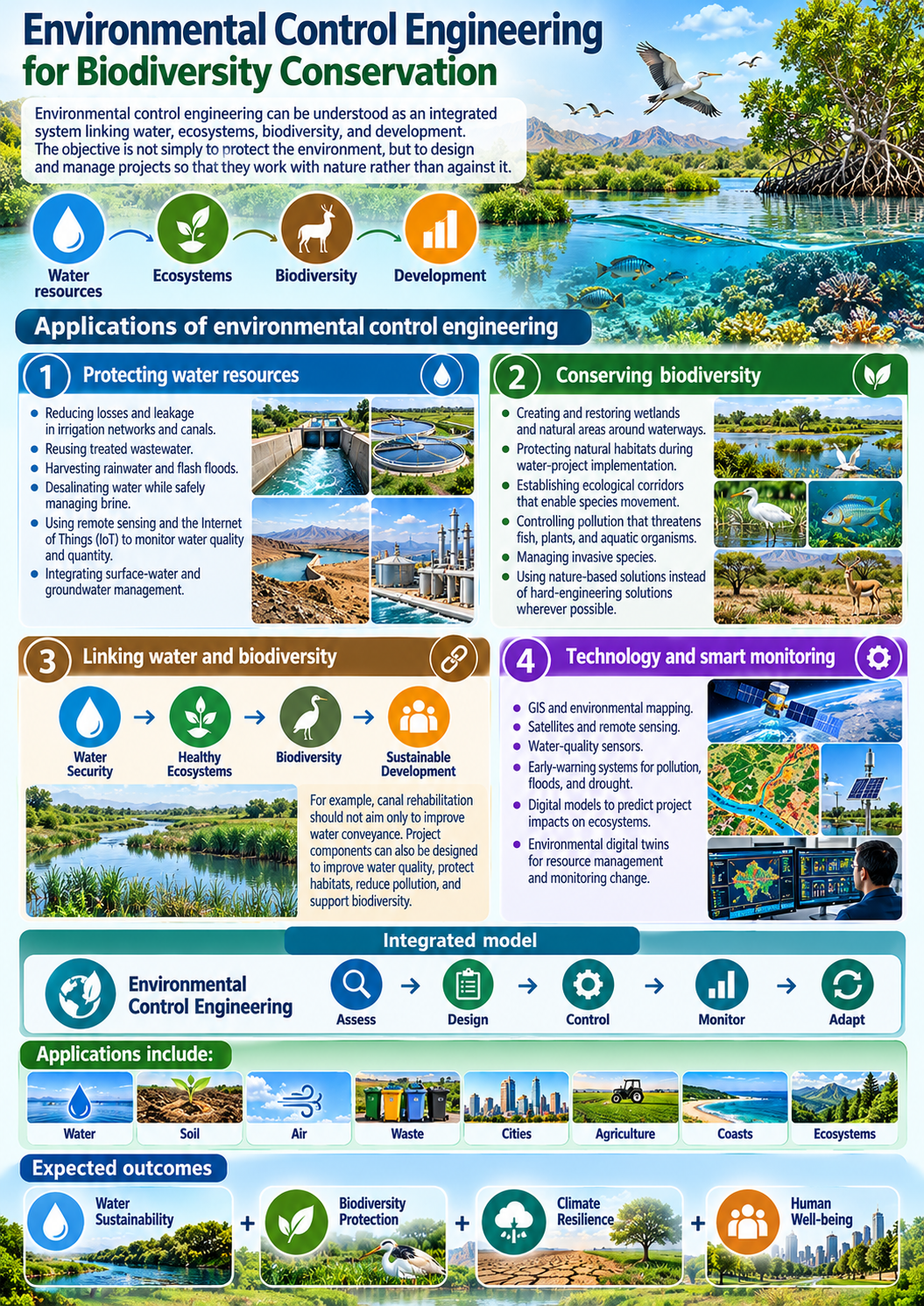
Environmental control engineering can be understood as an integrated system linking water, ecosystems, biodiversity, and development. The objective is not simply to protect the environment, but to design and manage projects so that they work with nature rather than against it.
Applications of environmental control engineering
1. Protecting water resources
• Reducing losses and leakage in irrigation networks and canals.
• Reusing treated wastewater.
• Harvesting rainwater and flash floods.
• Desalinating water while safely managing brine.
• Using remote sensing and the Internet of Things (IoT) to monitor water quality and quantity.
• Integrating surface-water and groundwater management.
2. Conserving biodiversity
• Creating and restoring wetlands and natural areas around waterways.
• Protecting natural habitats during water-project implementation.
• Establishing ecological corridors that enable species movement.
• Controlling pollution that threatens fish, plants, and aquatic organisms.
• Managing invasive species.
• Using nature-based solutions instead of hard-engineering solutions wherever possible.
3. Linking water and biodiversity
Water Security → Healthy Ecosystems → Biodiversity → Sustainable Development
For example, canal rehabilitation should not aim only to improve water conveyance. Project components can also be designed to improve water quality, protect habitats, reduce pollution, and support biodiversity.
4. Technology and smart monitoring
• GIS and environmental mapping.
• Satellites and remote sensing.
• Water-quality sensors.
• Early-warning systems for pollution, floods, and drought.
• Digital models to predict project impacts on ecosystems.
• Environmental digital twins for resource management and monitoring change.
Integrated model:
Environmental Control Engineering
↓
Assess → Design → Control → Monitor → Adapt
Applications include water, soil, air, waste, cities, agriculture, coasts, and ecosystems.
Expected outcomes:
Water Sustainability + Biodiversity Protection + Climate Resilience + Human Well-being.
2