
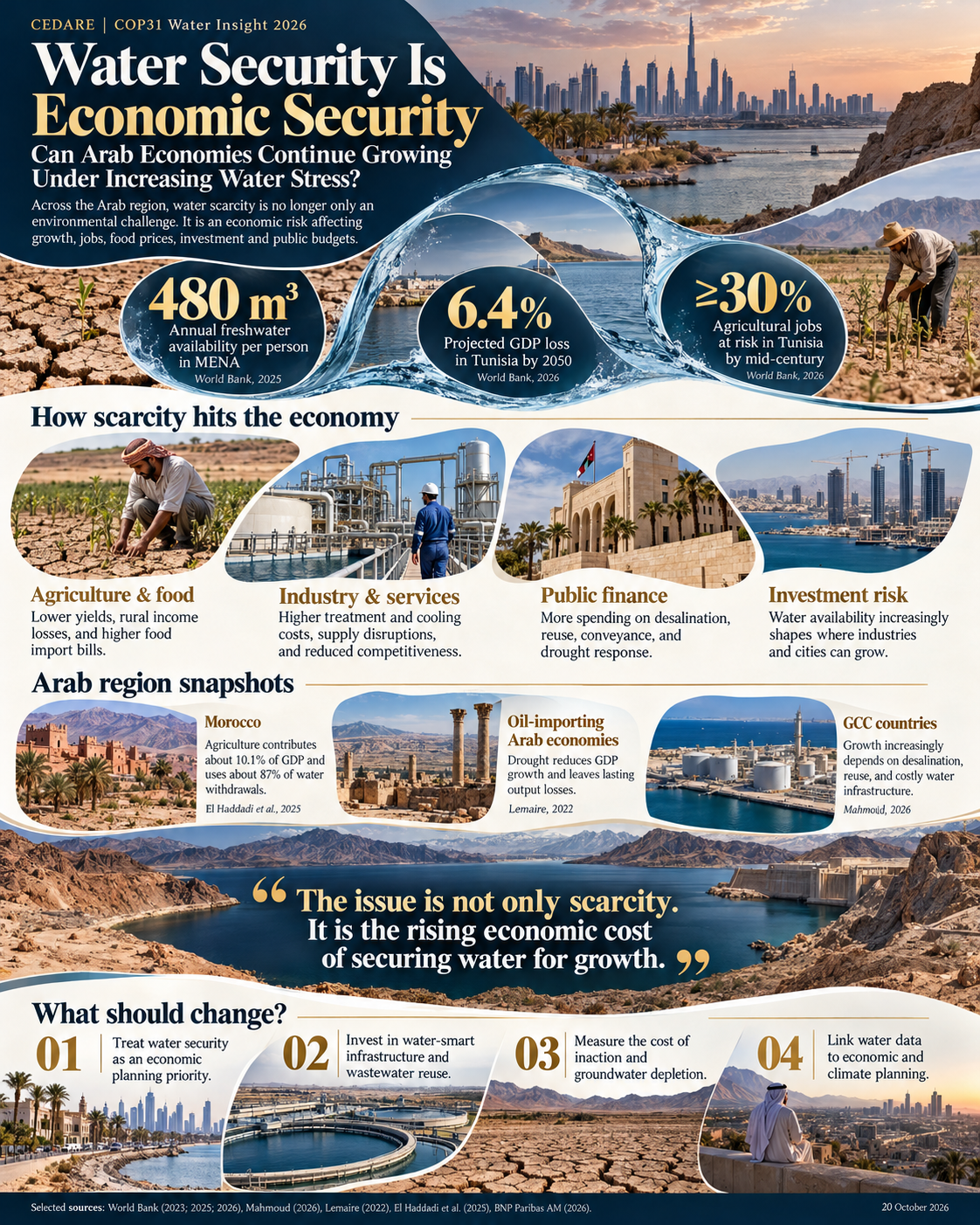
Can Arab Economies Continue Growing Under Increasing Water Stress?
For Arab economies, the price of water scarcity is increasingly reflected in food bills, industrial operating costs, jobs, public budgets and exposure to international trade shocks. The central challenge is not whether growth is possible under scarcity, but whether that growth remains affordable and resilient as domestic resources and global supply chains come under pressure.
The economic cost is larger than the water deficit
The Middle East and North Africa had an average of only 480 m³ of freshwater per person in 2023—less than one-tenth of the world average (Dione and Al Saad, World Bank, 2025). Drought can reduce crop output, lower rural incomes, disrupt agri-food industries and raise food-import needs. Lemaire (2022), examining 21 Arab League countries alongside Iran and Türkiye, found that drought episodes were associated with weaker GDP growth and lasting output-level losses in oil-importing economies. These results underscore the role of economic structure, rather than implying identical impacts across countries.
Egypt: water constraints become food, trade and fiscal risks
Egypt illustrates why water scarcity must be analysed beyond the water sector. In October 2026, the Ministry of Water Resources and Irrigation stated that national water requirements were around 120 billion m³ annually, while approximately 89 billion m³ were covered through a combination of available resources, reuse and food-related virtual water (Egypt State Information Service, 2026). These are broad planning categories and must not be equated with renewable freshwater availability.
The OECD’s May 2026 review reports that agriculture accounted for 76% of Egypt’s water use in 2023/24. Based on an earlier national water-balance assessment, it also cites roughly 30 billion m³ of virtual water embodied in imported commodities—including wheat, maize and soybeans (OECD, 2026). This is an estimated water footprint of imports, not water physically delivered to Egypt or an additional source available for withdrawal. The World Bank’s Egypt Country Climate and Development Report estimates that the combined effects of climate change on water, agriculture, air quality and tourism could reduce GDP by 2–6% by 2060 under its modelled scenarios (World Bank, 2022); this is not a water-scarcity-only estimate.
Virtual water: conserving domestic resources, importing external risk
Virtual water is the water consumed or used to produce traded goods, especially food and feed. Importing water-intensive commodities can relieve pressure on domestic irrigation and allow scarce water to support essential uses and productive sectors. Yet the same strategy links food security to harvests abroad, shipping routes, trade restrictions, exchange rates, commodity prices and supplier concentration. Disruption in an exporting country can therefore become a food-price or foreign-exchange shock in an importing Arab economy, even if its domestic water infrastructure remains operational (Elhadary, 2025; OECD, 2026).
The appropriate response is not blanket food self-sufficiency or unlimited imports. It is risk-adjusted virtual-water planning: diversify suppliers and trade corridors; maintain proportionate strategic reserves; compare imported products’ blue- and green-water footprints; and safeguard economically and socially important domestic production. Virtual-water accounting should inform, not replace, food-security, employment and environmental objectives (UNU-INWEH, 2025).
Different economies, different water-related financial exposure
Morocco demonstrates the agricultural growth channel: real GDP growth slowed to 3.2% in 2024 amid drought, while non-agricultural activity grew by an estimated 3.8% (World Bank, 2025). Tunisia’s September 2026 Economic Monitor projects that unaddressed water scarcity could lower its GDP level by 6.4% by 2050 and put at least 30% of agricultural jobs at risk by mid-century (World Bank, 2026). These are country-specific scenarios, not regional loss rates.
Jordan demonstrates the capital-investment challenge: its Aqaba–Amman project is designed to supply 300 million m³ of desalinated water annually through a 438-km conveyance system and a renewable-energy component; these are planned capacities, not current deliveries (AIIB, 2026). Gulf countries have sustained urban and industrial expansion through desalination and reuse, but this creates significant energy, financing, asset-reliability and operating-cost exposures (Mahmoud, 2026).
What would make Arab growth more water-secure?
First, embed water-availability, cost and reliability tests in agricultural, industrial, logistics and urban investment appraisal. Second, evaluate desalination, wastewater reuse and network rehabilitation against full life-cycle costs and avoided economic losses—not additional volumes alone. Third, treat virtual water and supply-chain concentration as part of national economic risk management, including scenario analysis of food-import prices and trade disruptions. Fourth, monitor GDP value added alongside actual consumptive water use, aquifer depletion, energy costs and environmental requirements; higher output per cubic metre withdrawn is not, by itself, proof of water savings.
The message for COP31
Economic growth can coexist with physical water scarcity, but it cannot remain secure if it depends on depleting natural capital, increasingly expensive water services or fragile food-import chains. For Arab countries, water security is therefore an investment, competitiveness and economic-resilience issue—not merely a water-supply target.
References
1. Asian Infrastructure Investment Bank (AIIB) (2026). Jordan: Aqaba–Amman Water Desalination and Conveyance Project. Approved 25 March 2026. [Source]
2. Dione, O. and Al Saad, B. (2025). In MENA, make every drop of water count. World Bank, 21 January. [Source]
3. Egypt State Information Service (2026). Irrigation Minister: Cooperation key to water management in Egypt, 25 October. [Source]
4. Elhadary, H. (2025). The virtual trades shaping global water distribution. Nature Middle East, 23 December. [Source]
5. Lemaire, T. (2022). Drought and Growth in Arab League Members, Iran and Turkey. February. Research paper supplied for this Insight.
6. Mahmoud, M. (2026). Water Security Under Pressure: Challenges and Strategies Across the Gulf. Anwar Gargash Diplomatic Academy, March. Supplied report.
7. OECD (2026). Policies for the Future of Farming and Food in Egypt. Paris: OECD Publishing, 4 May. [Source]
8. United Nations University Institute for Water, Environment and Health (UNU-INWEH) (2025). UN report warns: International food trade diverts the world’s water resources towards wealthier nations, 27 August. [Source]
9. World Bank (2022). Egypt Country Climate and Development Report. Washington, DC: World Bank. [Source]
10. World Bank (2025). Morocco Economic Monitor: Prioritizing Reforms to Boost the Business Environment. Winter 2025. [Source]
11. World Bank (2026). Tunisia Economic Monitor: Tunisia’s Water Challenge—From Scarcity to Resilience. September. [Source]