| Women use water. Women manage water. But do women decide about water? |
Across the Arab region, women are deeply involved in the everyday management of water—for households, agriculture, livestock, food production and family care. Yet the people who manage water most closely are not always equally represented in the institutions that decide how water is allocated, financed, regulated or prioritized.
This gap matters because water governance is not only about infrastructure. It determines who receives water, when, at what cost, for which uses, and whose needs are considered during scarcity, drought or crisis.
Women carry the burden—but not always the decision
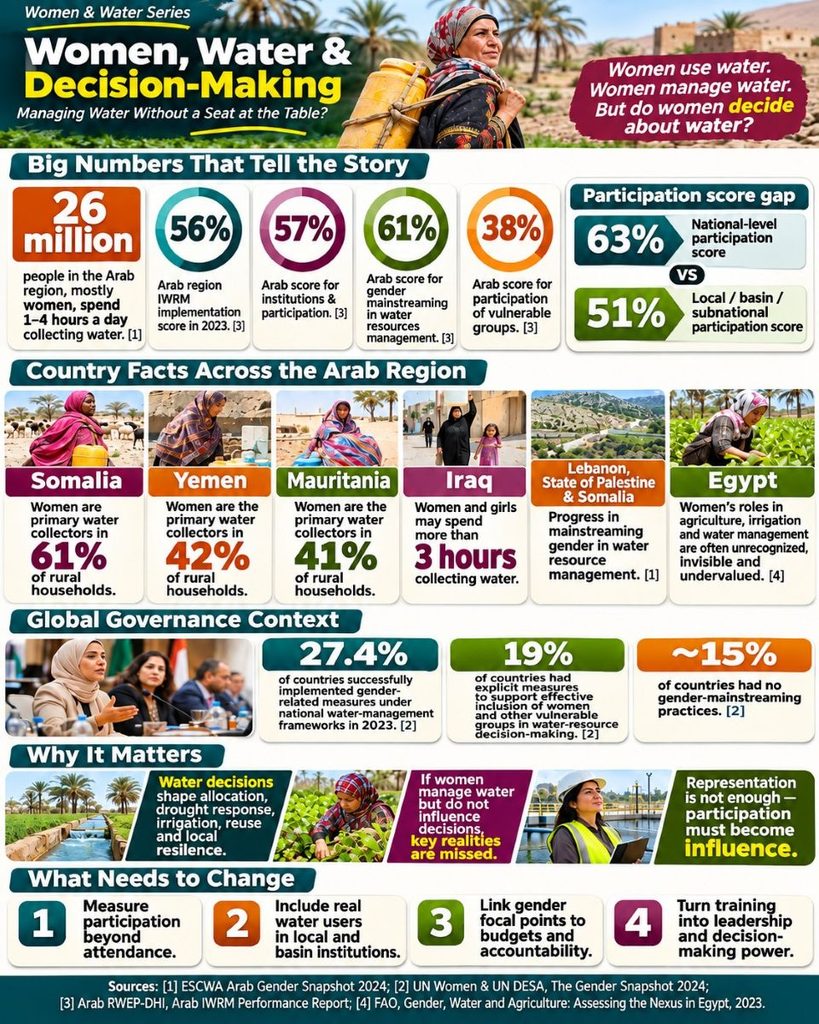
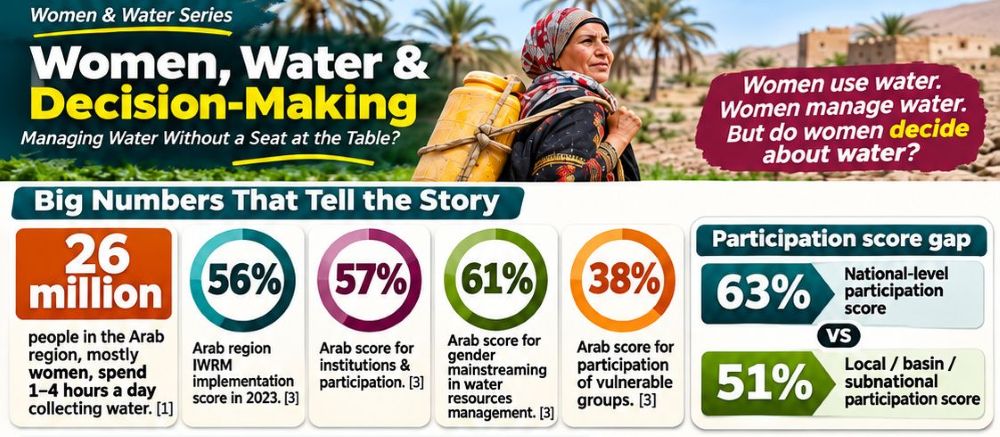
The imbalance is visible even before reaching formal water institutions. In the Arab region, around 26 million people—mostly women—spend between one and four hours each day collecting water. In Iraq, women and girls may spend more than three hours collecting water, while a single water-collection trip can take over an hour in Mauritania, Somalia, Tunisia and Yemen [1].
Recent rural data compiled for the Arab region also show women as the primary water collectors in 61% of households in Somalia, 42% in Yemen and 41% in Mauritania where such responsibility was reported [1].
Yet heavy involvement in securing and managing water does not automatically translate into influence over water decisions.
Globally, only 27.4% of countries reported in 2023 that gender-related measures were successfully implemented under national water-management frameworks. Around 15% had no gender-mainstreaming practices, while only 19% had explicit measures designed to support the effective participation of women and other vulnerable groups in water-resource decision-making [2].
The Arab region: progress in policy, but a gap in implementation
The latest regional assessment provides a more detailed picture. The Arab region achieved an overall Integrated Water Resources Management (IWRM) implementation score of 56% in 2023, close to the global average of 57%. However, the regional score for institutions and participation was 57%, compared with a global average of 61% [3].
More importantly, the average score for institutional participation at the national level was 63%, compared with only 51% at subnational, basin and other local levels. This suggests that improvements in national policies are not always reaching the institutions where local water allocation and management decisions are made [3].
Gender mainstreaming in water-resource management achieved a regional score of 61%, but participation of vulnerable groups scored only 38% [3]. The difference is significant: gender may increasingly appear in policies and strategies, yet meaningful participation can remain more difficult to institutionalize.
Different countries are taking different routes
Several Arab countries provide useful examples of how the gap between policy and participation is beginning to be addressed.
Morocco has incorporated gender provisions into water legislation, the National Water Plan and its institutional gender-mainstreaming strategy, supporting women’s participation in water councils and decision-making structures [3].
Algeria has integrated women into intersectoral commissions involved in national water planning, linking gender participation with broader national strategies for women’s advancement [3].
In Egypt, gender integration has appeared in national water planning for decades, and women increasingly participate in water-user associations and related decision-making processes [3]. At the same time, FAO’s 2023 assessment of gender, water and agriculture in Egypt found that women’s contributions to agriculture, irrigation and water management remain frequently unrecognized, invisible and undervalued, particularly their roles in fetching, preserving and managing both productive and domestic water [4].
The FAO assessment also stresses that women’s ability to exercise land and water rights is influenced by economic empowerment, income, access to credit and extension services, and participation in decision-making both inside and outside the household [4].
Iraq has established a department for women’s empowerment within the Ministry of Water Resources, supported by training and greater involvement of women in planning and decision-making [3].
In Lebanon, a gender focal point has been assigned within the Ministry of Energy and Water, contributing to stronger gender-mainstreaming practices. Across the Mashreq, gender mainstreaming recorded the largest improvement among subnational institutional and participation elements between reporting rounds [3].
Sudan has also reported examples of women moving beyond symbolic representation into technical, planning and leadership functions in water management [3].
Progress is also emerging in the Gulf. Saudi Arabia’s Water Act incorporates gender-mainstreaming objectives and recognizes women’s right to participate in water-management activities, while women participate in water-related councils and committees in Oman. However, ESCWA notes that leadership-level participation remains more limited in several countries. Bahrain has linked gender action to climate-resilience projects, while women’s presence in higher-level IWRM leadership remains less developed; in Qatar, women hold administrative positions in water-related ministries, although their role in senior IWRM leadership is less clear [3].
Why does a seat at the table matter?
Participation is not simply a question of representation.
Water decisions influence irrigation schedules, drought priorities, water-service design, groundwater management, wastewater reuse, tariffs, infrastructure location, climate adaptation and the allocation of scarce water among competing sectors.
If women are highly involved in agricultural production, household water management and community resilience but remain less involved in planning, potentially important information about how water is actually used can be absent from formal decisions.
The issue is therefore not simply:
| “How many women attend water meetings?” |
The more important questions are:
| Do they participate in decisions? Do they influence priorities? Do they control resources? And are their experiences reflected in water investments and policies? |
From participation to influence
The latest Arab evidence suggests that future progress could increasingly focus on moving from gender inclusion on paper to measurable influence in practice.
- Participation could be measured beyond attendance. Water institutions could track women’s membership, leadership roles, voting rights and actual participation in decisions at national, basin and local levels.
- Local governance mechanisms could better recognize actual water users. Participation in water-user associations and similar bodies should reflect who farms, manages water and depends on the resource, rather than relying exclusively on formal ownership or traditional perceptions of who constitutes a “water user.”
- Gender focal points need mandates, resources and accountability. International evidence shows that gender policies are more likely to move into implementation when institutions combine dedicated focal points, budgets, monitoring systems and actionable plans [2,3].
- Consider adopting gradual, time-bound targets to increase women’s representation in Water User Associations and relevant water councils and committees through fixed incremental shares, progressively moving towards balanced representation approaching 50%, while ensuring that participation is meaningful and influential in decision-making rather than merely numerical.
- Capacity development should be connected to authority. Training women in water management is valuable, but training alone does not guarantee influence. Skills development should be linked to opportunities for leadership, technical responsibility and participation in formal decision-making structures.
- Climate adaptation and water-security planning offer an important opportunity. As Arab countries strengthen drought management, reuse, non-conventional water, climate adaptation and IWRM, involving women from the design stage can help ensure that water policies better reflect the realities of households, farms and communities.
The real governance question
The Arab region is making measurable progress in integrating gender into water policies. The next step is more demanding: turning participation into influence.
Women should not be viewed only as beneficiaries of water projects or as those responsible for collecting and conserving water.
They are also farmers, water users, technical professionals, community actors and holders of practical knowledge about how water scarcity is experienced on the ground.
The policy question is therefore no longer simply:
| “Are women included?” |
It is:
| “When water decisions are made, do the people who manage water every day have a meaningful voice in deciding its future?” |
References
[1] United Nations Economic and Social Commission for Western Asia (ESCWA), UN Women and partners (2024). Progress on the Sustainable Development Goals: A Gender Snapshot of the Arab Region 2024. Beirut: United Nations ESCWA.
[2] UN Women and United Nations Department of Economic and Social Affairs (2024). Progress on the Sustainable Development Goals: The Gender Snapshot 2024. New York: United Nations.
[3] United Nations Economic and Social Commission for Western Asia (ESCWA) and UNEP-DHI (2025). 2024 Progress Report on the Implementation of Integrated Water Resources Management in the Arab Region: Midterm Status of Sustainable Development Goal Indicator 6.5.1. Beirut: United Nations ESCWA.
Official ESCWA report
[4] Food and Agriculture Organization of the United Nations (FAO) (2023). Gender, Water and Agriculture: Assessing the Nexus in Egypt. Cairo: FAO.
FAO DOI