
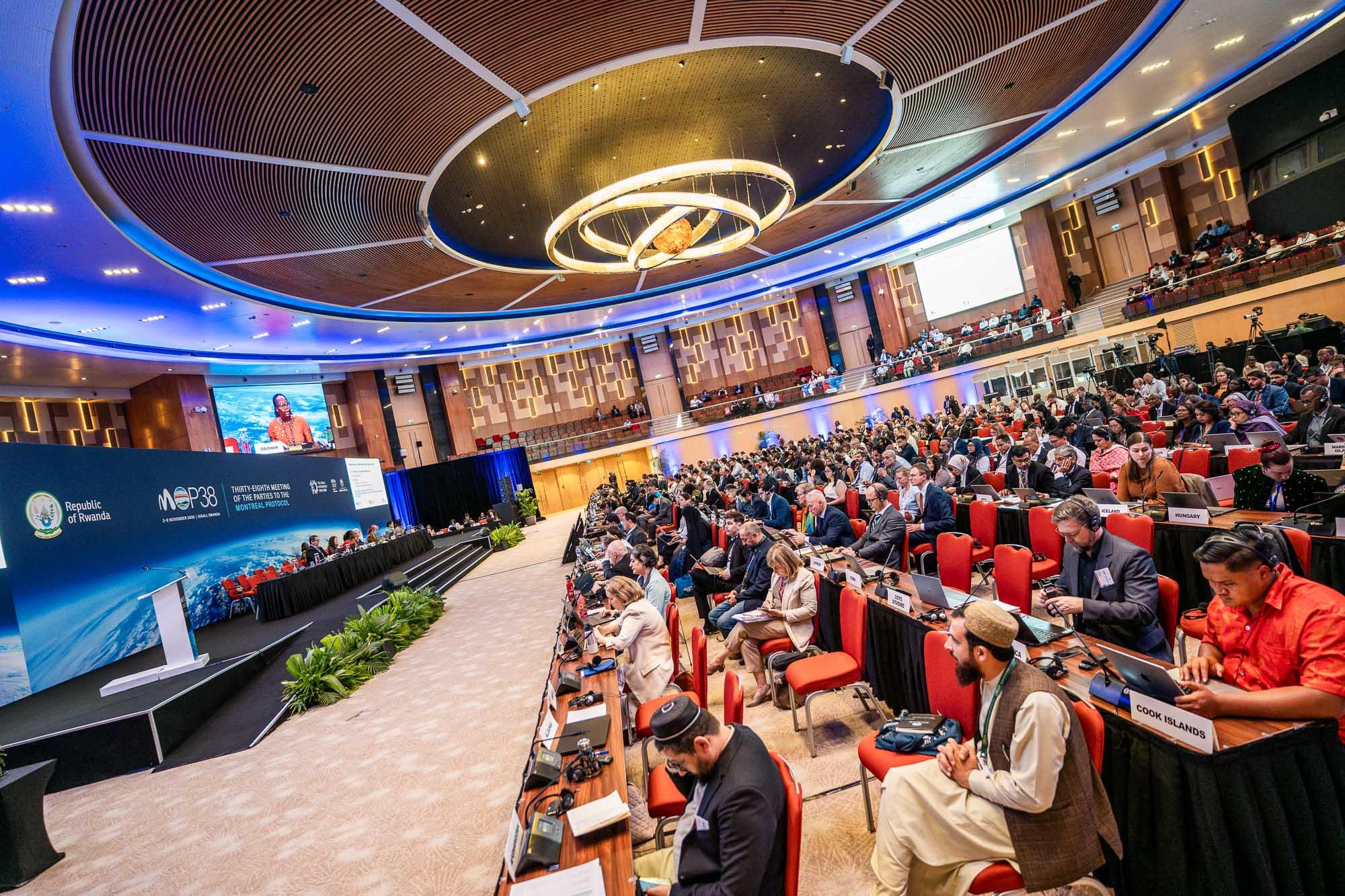
The 38th Meeting of the Parties of the Montreal Protocol on Substances that Deplete the Ozone Layer )MOP 38(, held in Kigali, Rwanda, 2–6 November 2026, marked the 10th anniversary of the Kigali Amendment and focused heavily on replenishing the Multilateral Fund (MLF) for 2027–2029, alongside administrative, budget, compliance and institutional issues. Parties adopted the 2027 Trust Fund budget and decisions on membership and compliance, but could not reach consensus on some atmospheric monitoring and controlled-substance tracking proposals. The replenishment debate was contentious, with estimate by the Replenishment Task Force challenged by some non-Article 5 Parties as overstating real demand, pointed to unspent funds.
For developing countries, Article 5 Parties, the main challenge is securing sufficient, stable and predictable funding for HFC phase-down under Kigali HFC implementation plans (KIPs), especially as obligations reach a critical juncture. Many Article 5 Parties stressed that HFC phase-down is a complex technical and socioeconomic transition, and that global economic uncertainty, supply-chain costs and high ambient temperature (HAT) conditions must be reflected in funding estimates. Opportunities include the MLF replenishment itself, a possible modular supplementary funding window for lifecycle refrigerant management (LRM), support for energy efficiency, and continued institutional strengthening. However, the dispute over methodology, unspent funds and the use of historical cost-effectiveness factors shows that Article 5 Parties must justify their needs with robust national data and engage early in replenishment negotiations.
For Arab countries, the strategic priority is to translate HAT and national-circumstance concerns into concrete funding methodologies and political coordination. Several Arab countries intervened on HAT conditions, national circumstances and the need for continued support, while Saudi Arabia and Lebanon sit on the Implementation Committee and Bahrain and Tunisia on the Executive Committee. Arab Parties should coordinate a common position that supports adequate, predictable MLF replenishment while insisting on HAT-specific cost factors, KIP funding certainty, LRM and energy-efficiency support, and protection for low-volume consuming countries. They should also prepare national cost data ahead of the 49th meeting of the Open-ended Working Group (OEWG 49)/MOP 39, use their committee representation to shape ExCom business-planning and compliance discussions, and engage constructively in the smaller replenishment formats to avoid isolation between Article 5 and non-Article 5 positions.
Cover Photo by IISD/ENB | Danny Skilton