
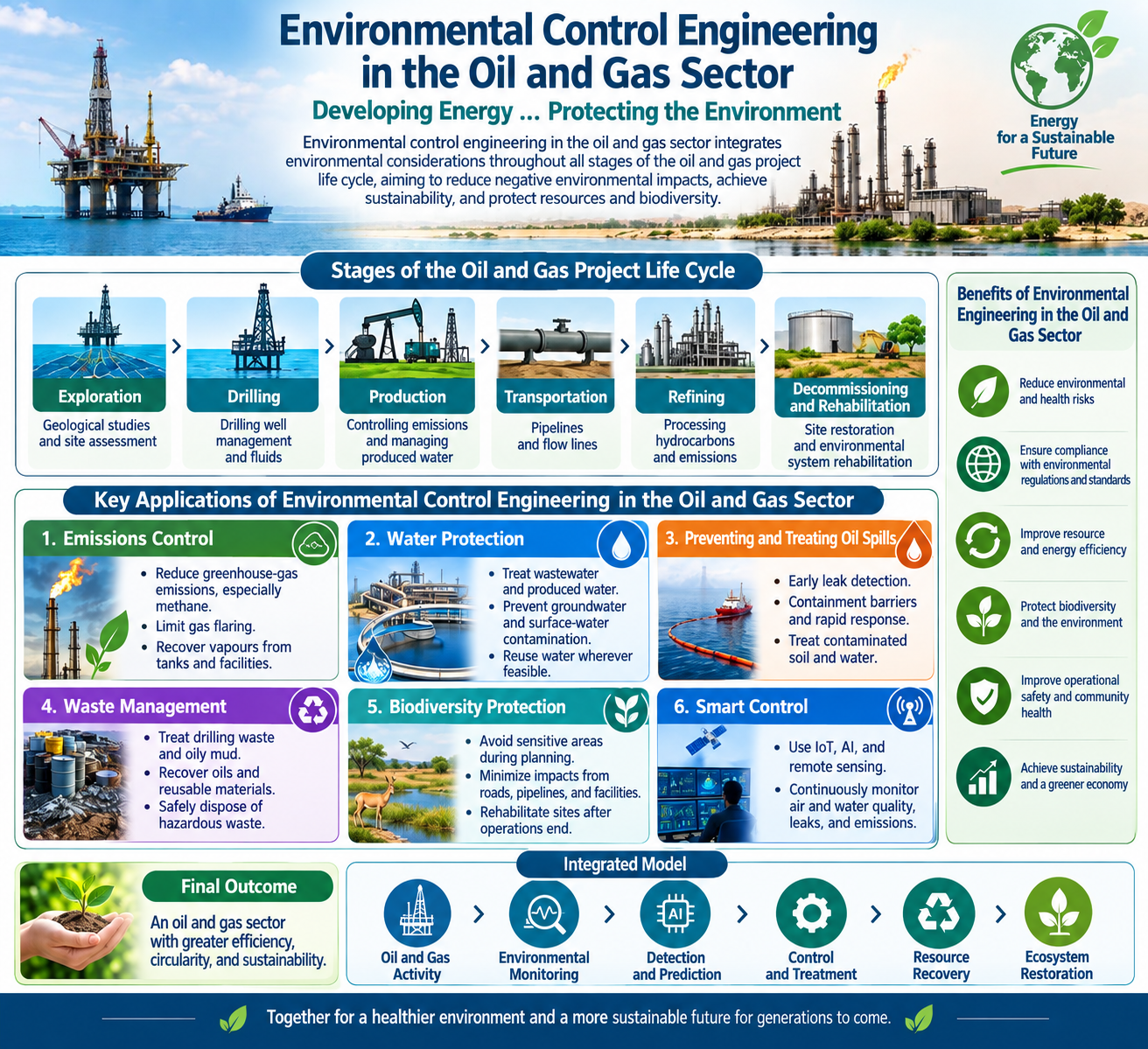
Environmental control engineering in the oil and gas sector integrates environmental considerations throughout the project life cycle: exploration → drilling → production → transportation → refining → storage → decommissioning and rehabilitation.
Key applications
Emissions control
- Reducing greenhouse-gas emissions, especially methane.
- Limiting gas flaring.
- Recovering vapours from tanks and facilities.
Water protection
- Treating wastewater and produced water.
- Preventing contamination of groundwater and surface water.
- Reusing water wherever feasible.
Oil-spill prevention and response
- Early leak-detection systems.
- Containment barriers and rapid response.
- Treating contaminated soil and water.
Waste management
- Treating drilling waste and oily mud.
- Recovering oils and reusable materials.
- Safely disposing of hazardous waste.
Biodiversity protection
- Avoiding environmentally sensitive areas during planning.
- Minimizing the impacts of roads, pipelines, and facilities.
- Rehabilitating sites after operations end.
Smart control
- Using the Internet of Things (IoT), artificial intelligence (AI), and remote sensing to continuously monitor air and water quality, leaks, and emissions.
Integrated model:
Oil and Gas Activity
↓
Environmental Monitoring
↓
Detection and Prediction
↓
Control and Treatment
↓
Resource Recovery
↓
Ecosystem Restoration
Environmental control engineering can therefore help transform the oil and gas sector from an “extraction–consumption–waste” model into a more efficient, circular, and sustainable model while reducing environmental risks and protecting resources and biodiversity.