
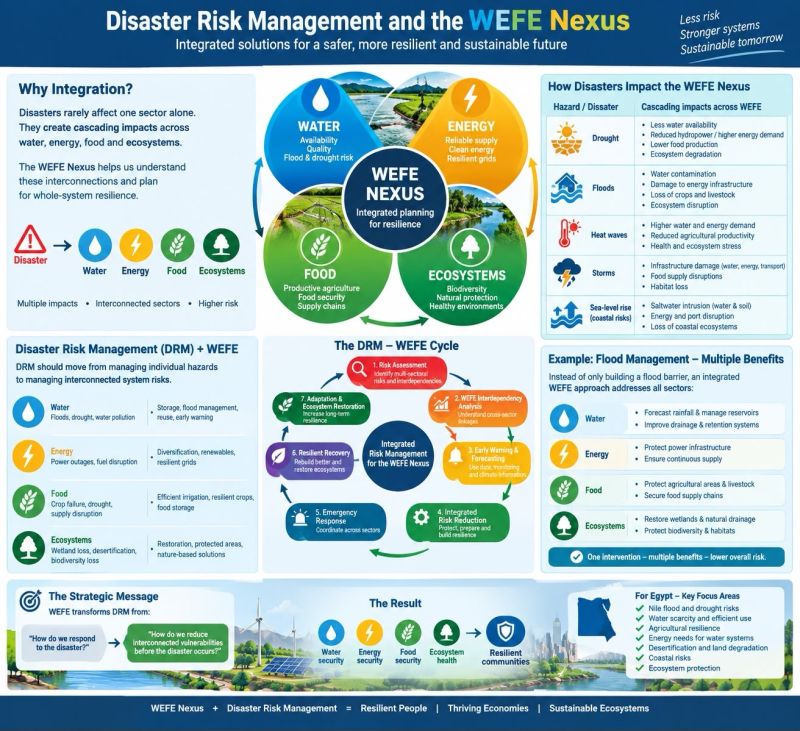
The WEFE Nexus—Water, Energy, Food and Ecosystems—provides a useful framework for Disaster Risk Management because disasters rarely affect one sector alone.
The core concept
Disaster → multiple cascading impacts → interconnected sectors
For example:
Drought
→ less Water
→ reduced hydropower / higher energy demand
→ lower Food production
→ ecosystem degradation
→ greater vulnerability to future droughts.
Therefore:
DRM should move from managing individual hazards to managing interconnected system risks.
WEFE + Disaster Risk Management
WEFE sector Disaster risks DRM response
💧 Water Drought, flood, water pollution Storage, flood management, reuse, early warning
⚡ Energy Power outages, fuel disruption Diversification, renewable energy, resilient grids
🌾 Food Crop failure, drought, supply disruption Efficient irrigation, resilient crops, food storage
🌿 Ecosystems Wetland loss, desertification, biodiversity loss Restoration, protected areas, nature-based solutions
A practical DRM–WEFE cycle
Risk Assessment
↓
WEFE Interdependency Analysis
↓
Early Warning & Forecasting
↓
Integrated Risk Reduction
↓
Emergency Response
↓
Resilient Recovery
↓
Adaptation & Ecosystem Restoration
Example: Flood management
Instead of only constructing a flood barrier:
Water: forecast rainfall and manage reservoirs
Energy: protect electricity infrastructure
Food: protect agricultural areas and livestock
Ecosystems: restore wetlands and natural drainage areas
This produces multiple benefits from one intervention.
The strategic message
WEFE transforms DRM from:
“How do we respond to the disaster?”
into:
“How do we reduce interconnected vulnerabilities before the disaster occurs?”
For Egypt, this approach is particularly relevant to Nile flood/drought risks, water scarcity, agricultural resilience, energy requirements for water systems, desertification, coastal risks, and ecosystem protection.
A powerful framework for a presentation is:
WEFE Nexus → Risk Reduction → Resilience → Sustainable Development
The ultimate objective is not simply disaster response, but building systems that can absorb shocks while maintaining Water, Energy, Food and Ecosystem security.
3
previous post