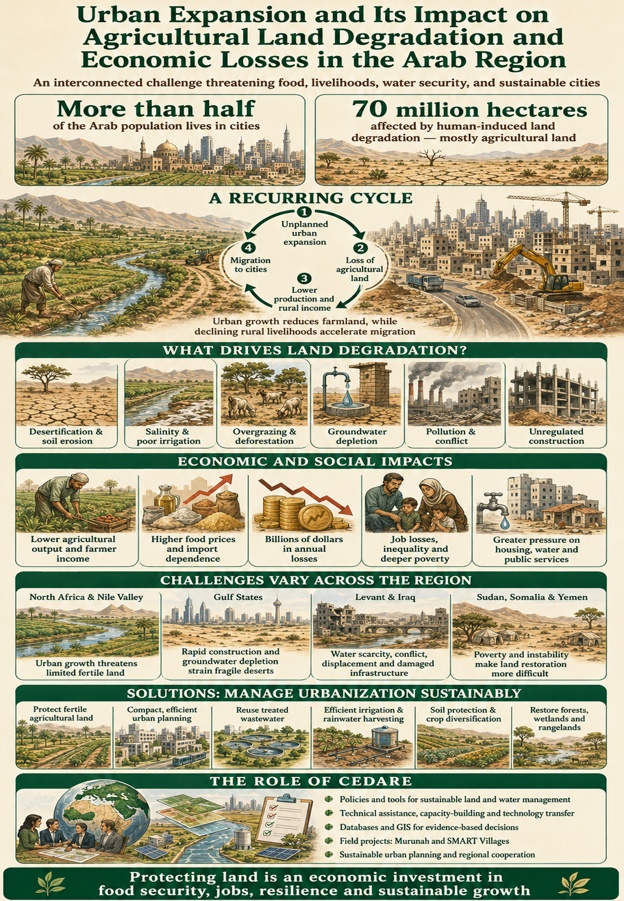
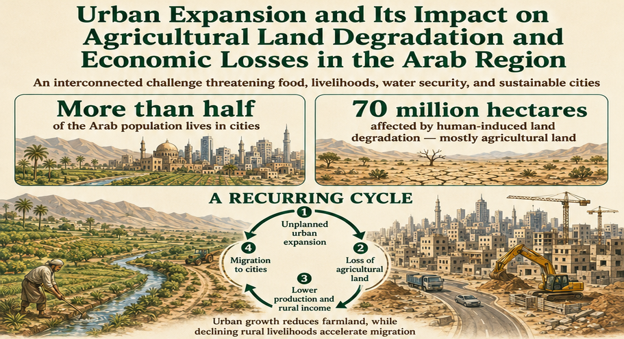
The Arab world is undergoing a major transformation as a result of urban expansion. Today, more than half of its population lives in cities, and the urban population is expected to continue growing. However, rapid and unplanned urban expansion places increasing pressure on land, water, agriculture, and public infrastructure. It also increases the demand for water due to population growth and the expansion of residential, industrial, and agricultural activities.
At the same time, the Arab region is experiencing severe agricultural land degradation. Land degradation refers to the loss of the biological and economic productive capacity of soil and ecosystems. It may result from desertification, soil erosion, salinity, overgrazing, deforestation, pollution, poor irrigation practices, excessive groundwater extraction, conflict, and unregulated construction. Estimates indicate that approximately 70 million hectares in the Arab region are affected by human-induced land degradation, most of which is agricultural land.
Urbanization and land degradation are closely interconnected. Cities often expand at the expense of the surrounding agricultural land because such land is flat, easily accessible, and close to existing infrastructure. Many major Arab cities developed near rivers, coastlines, oases, and fertile plains. As these cities grow, productive agricultural land is gradually replaced by housing, roads, commercial centers, and industrial zones. Once fertile soil is covered with concrete and asphalt, restoring it to agricultural use becomes extremely difficult.
Urban expansion also requires longer networks of roads, water pipelines, electricity lines, and sewage systems, increasing land consumption and the cost of public services. Unregulated construction can also damage ecosystems through the extraction of sand and stone and the depletion of groundwater. Pollution from industrial waste, construction debris, and untreated wastewater contaminates soil and water resources, affecting public health and contributing to the spread of disease.
The deterioration of irrigation canals presents an additional challenge, as it leads to substantial water losses, reduces the efficiency with which water reaches agricultural land, and increases irrigation and maintenance costs. This challenge becomes more serious with population growth, urban expansion, and rising water demand from farms, factories, and households. Effective water management, rational consumption, and improved water-use efficiency across different sectors are therefore essential for addressing water scarcity and protecting available resources.
The relationship between urbanization and land degradation also operates in the opposite direction, as land degradation can encourage migration from rural areas to cities. When agricultural land becomes less productive, farmers face lower crop yields and higher costs for irrigation, fertilizers, animal feed, and soil treatment. Eventually, some rural households may be forced to sell their livestock, abandon their farms, or seek employment in urban areas. This can create a recurring cycle in which urban expansion reduces agricultural land, while declining agricultural production weakens rural livelihoods and increases migration to cities.
One of the most significant economic consequences of land degradation is the decline in agricultural production. Degraded soil contains fewer nutrients, absorbs less water, and produces lower crop yields. As a result, farmers lose part of their income, while businesses involved in food processing, storage, packaging, transportation, and retail are also affected.
The Arab region already suffers from severe water scarcity and a shortage of arable land. Many Arab countries depend heavily on food imports, particularly grains and other staple products. When domestic agricultural production declines, countries become more dependent on global markets, increasing their exposure to rising international prices, supply-chain disruptions, currency depreciation, conflict, and transportation problems.
Consumers experience the effects through higher food prices and reduced food security. Governments may also be forced to increase expenditure on food imports and subsidy programs, leaving fewer funds available for education, healthcare, infrastructure, and other public services.
The economic cost of land degradation in the Arab region has been estimated at billions of dollars annually. These losses include declining agricultural production, infrastructure damage, higher food-import costs, reduced tourism, increased healthcare expenditure, and lower labor productivity. However, the actual costs are likely to be higher because many environmental and social losses are difficult to measure in monetary terms.
Land degradation also affects employment and wages, as agriculture remains an important source of income in many Arab countries. Small-scale farmers, livestock breeders, seasonal workers, and rural women are among the groups most vulnerable to declining land productivity.
Wealthier landowners and those with larger holdings may be able to invest in modern irrigation systems, soil improvement, new crops, or advanced agricultural technologies. Poor households with small landholdings, which constitute the majority, often lack the financial resources or technical knowledge required to adapt. When these families migrate to cities, they may encounter unstable employment, high housing costs, and limited access to services. Environmental degradation can therefore deepen poverty in both rural and urban areas.
These challenges vary across the Arab world. In North Africa and the Nile Valley, urban expansion threatens the limited amount of fertile agricultural land. In the Gulf states, rapid construction, coastal development, and groundwater depletion place pressure on fragile desert environments. In the Levant and Iraq, water scarcity, conflict, displacement, and damaged infrastructure intersect with land degradation. In countries such as Sudan, Somalia, and Yemen, poverty and political instability make the restoration of land and ecosystems particularly difficult.
Sound urban planning can protect agricultural land, reduce infrastructure costs, and prevent construction on fertile land. Cities can also reuse treated wastewater, expand green spaces, plant drought-resistant vegetation, and develop surfaces that allow rainwater to infiltrate the soil.
Agricultural and rural policies should support efficient irrigation, sustainable grazing, soil protection, crop diversification, rainwater harvesting, and the restoration of forests, wetlands, and rangelands. The cultivation of less water-intensive crops should also be encouraged, with priority given to drought- and salt-tolerant crops, short-duration crops, and crops with high economic value. These measures can support higher agricultural production while using less water and land.
Achieving this requires better water management, the promotion of rational consumption, and greater water-use efficiency in farms, factories, and households. Irrigation canals should also be maintained and modernized, water leakage should be reduced, and modern irrigation techniques, such as drip irrigation, should be introduced to ensure the optimal use of limited water resources.
Strengthening the interconnections among water, energy, and food security is also essential. Food production requires both water and energy, while energy is needed to extract and treat water. These sectors should therefore not be managed separately. Instead, integrated policies should be developed to achieve an appropriate balance among them.
Land protection should be viewed as an economic investment rather than merely an environmental cost. Healthy land supports food production, employment, tourism, biodiversity, and protection against flooding and erosion. The challenge facing the Arab region is not to stop urbanization but to manage it sustainably.
Without coordinated action, land degradation and unregulated urban growth will lead to higher food prices, the loss of livelihoods, overcrowded cities, and increased public expenditure. With effective planning and the sustainable management of land and water, however, urban growth can become more inclusive, resilient, and economically sustainable.
Several country examples illustrate the scale of land degradation and the variation in its effects across the Arab region:
- Saudi Arabia: It has the largest area of degraded land among these examples, amounting to approximately 20.09 million hectares.
- Mauritania: It has an exceptionally high national rate of land degradation, affecting approximately 60% of the country’s total area.
- Jordan: Approximately 25.62% of its land is degraded, while its urbanization rate has reached 93%.
- Iraq: Millions of people are simultaneously exposed to the effects of land degradation and drought.
- Egypt: The country faces a shortage of fertile land, while soil salinity affects more than one-quarter of its irrigated agricultural land.
- Lebanon: Land degradation causes measurable economic losses estimated at approximately USD 132 million annually.
These examples demonstrate that land degradation is not limited to the loss of agricultural areas. It is also associated with high urbanization rates, greater exposure to drought, soil salinization, and direct economic losses. They further confirm the need to adopt policies tailored to the specific environmental and economic conditions of each country.
The Centre for Environment and Development for the Arab Region and Europe (CEDARE) plays a pivotal role in addressing urbanization, land degradation, and the resulting economic losses in the Arab region through a range of integrated efforts. The Centre supports sustainable land management by developing policies and tools that help countries combat desertification, improve the management of natural resources, and promote the rational use of land and water.
CEDARE also provides technical assistance and contributes to capacity-building by training national professionals, facilitating the transfer of expertise and modern technologies in sustainable agriculture, and supporting integrated environmental planning. It also contributes to the development of databases and Geographic Information Systems (GIS) to monitor land degradation and analyze environmental data, thereby supporting decisions based on sound scientific evidence.
CEDARE also implements field projects, such as the Murunah and SMART Villages projects, which aim to improve soil and water management and strengthen adaptation to climate change. Through these projects, the Centre contributes to improving water-use efficiency, strengthening the ability of crops and rural communities to cope with drought and salinity, and achieving more sustainable urban and rural development.
CEDARE further supports sustainable urban policies and planning by integrating environmental considerations into urban development, limiting urban expansion at the expense of agricultural land, and promoting the concept of sustainable cities. In addition, the Centre supports regional and international cooperation with organizations such as the United Nations Environment Program, the United Nations Convention to Combat Desertification, and the World Bank. This cooperation contributes to reducing environmental and economic damage and achieving water and food security in the Arab region.
References
Food and Agriculture Organization of the United Nations. (2025, June 17). FAO study reveals alarming agricultural land degradation in the Arab region. The study reports that human-induced degradation affects about 70 million hectares in the Arab region, including more than 46 million hectares of agricultural land. (FAOHome)
International Labour Organization. (2024). Migration and climate change in the Arab region. The report examines how drought, declining agricultural livelihoods and other climate pressures contribute to internal and rural-to-urban migration. (International Labour Organization)
United Nations Development Programme. (2023). The water scarcity crisis in the Arab region: Examples and potential solutions. The source discusses regional water scarcity, declining agricultural productivity, land degradation and dependence on food imports. (UNDP)
United Nations Economic and Social Commission for Western Asia. (n.d.). Policy briefs on food security issues in the Arab region. ESCWA estimates that declining soil fertility and land degradation produce economic losses of approximately US$9 billion annually, including about US$1 billion in crop losses caused by salinity. (UNESCWA)
United Nations Economic and Social Commission for Western Asia. (n.d.). Agriculture and natural resources: Current status and characteristics of agriculture in the Arab region. The report links land degradation to losses of between 2 and 7 percent of GDP in individual Arab countries and discusses declining soil productivity. (UNESCWA Archive)
United Nations Environment Programme. (2017, June 13). Addressing land degradation is good for your health. The article explains how land degradation and dust storms affect agriculture, transportation, supply chains, schools, healthcare and worker productivity. (UNEP – UN Environment Programme)
United Nations Human Settlements Programme. (2022). The State of Arab Cities Report 2022. The report examines urbanization trends, urban expansion and the major environmental, social and infrastructure challenges facing Arab cities. (UN-Habitat)
World Bank. (2019). Sustainable land management and restoration in the Middle East and North Africa region: Issues, challenges and recommendations. The report examines the causes and economic consequences of land degradation and identifies sustainable land-management measures for the region. (Open Knowledge Bank)