The Climate Action Paradox: Rising Urgency, Divided Responsibilities
“This (climate action) work must be honest. It must be grounded in equity.”
Simon Stiell, UN Climate Change Executive Secretary (Second Global Stocktake launch, 18 November 2026)
Second Global Stocktake Opens as COP31 Confronts the Price of Climate Ambition
On Day 9 in Antalya, the formal launch of the Second Global Stocktake collided with tense ministerial negotiations over fossil fuels, electrification and finance. The stocktake offers a new opportunity to measure collective progress against the Paris Agreement, but also exposes a central political contradiction: calls for faster action are growing while the means of implementation remain contested. For Arab countries, the test is whether climate ambition will respect differentiated responsibilities, energy security and national development pathways, rather than shift the costs of transition onto developing economies.
Key Highlights of the Day:
• Second Global Stocktake Launched: Simon Stiell called for an honest, equity-grounded review. The two-year process will assess collective progress, with technical assessment beginning in 2027.
• Cover Decision Under Sustained Pressure: Negotiations President Chris Bowen sought convergence among nearly 200 Parties on disputed fossil fuel transition language, climate finance and Türkiye’s electrification agenda.
• Ocean and Carbon Removal Controversy: Advocates warned that draft references to scaling carbon dioxide removal could be interpreted as endorsing risky marine geoengineering without sufficient ecosystem safeguards.
• Carbon Border Costs: Discussions of the EU Carbon Border Adjustment Mechanism (CBAM) raised concerns over verification costs, administrative capacity and competitiveness, including concerns voiced by Türkiye.
• Carbon Markets and Implementation: Latin American discussions highlighted barriers to credible market operation, reinforcing the need for stronger measurement, reporting and verification, institutional capacity and safeguards.
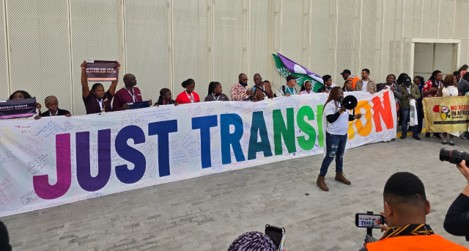
Fundamental Question for COP31: How can we agree on the climate transition, and who gets to decide what a just transition looks like?
Key Takeaway
A credible stocktake must measure not only emissions ambition but also the delivery of finance, technology and capacity-building support. Climate justice requires an orderly and equitable transition, safeguards against environmental harm, and fair trade rules that do not penalize developing countries for capacities they have not been supported to build.
Messages for Action
1. To Country Leaders and Decision-Makers: Make Ambition Fair and Financed
Coordinate Arab positions on differentiated responsibilities, climate finance, technology access, carbon border measures and nationally determined transition pathways. Demand measurable delivery alongside new targets.
2. To Climate Experts and Development Practitioners: Test Claims Against Evidence
Strengthen transparent MRV, assess the full ecological risks of carbon removal, and build credible project pipelines that link adaptation, mitigation and local development benefits.
3. To the Public: A Just Transition Must Protect People and Nature
Climate policies should safeguard livelihoods, ecosystems and affordability. Ask who benefits, who pays, and whether promised support actually reaches vulnerable communities.
Our Session of the day
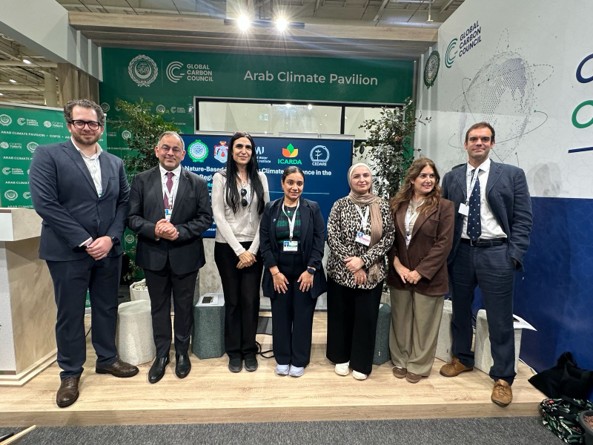
Arab Climate Pavilion
Nature-Based Solutions for Climate Resilience in the Arab Region: From Pilots to Scale
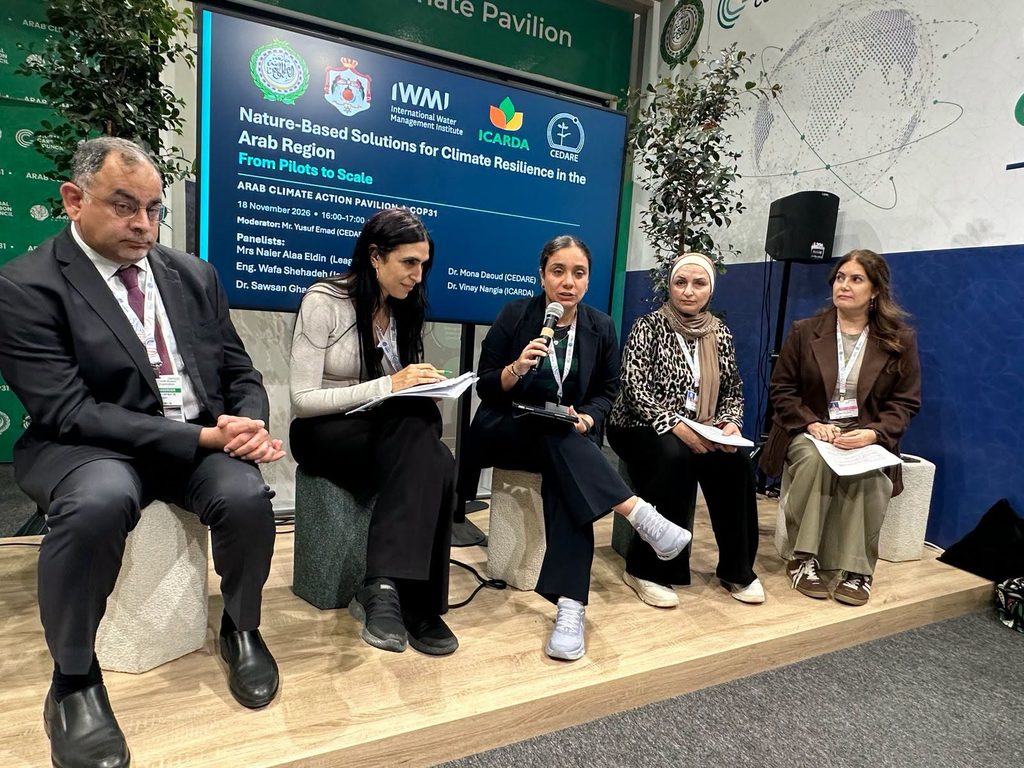
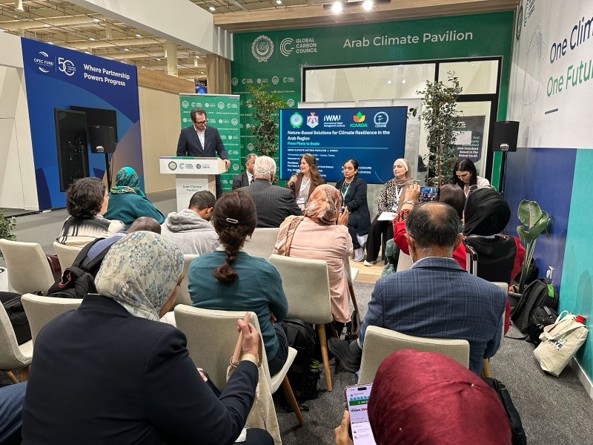
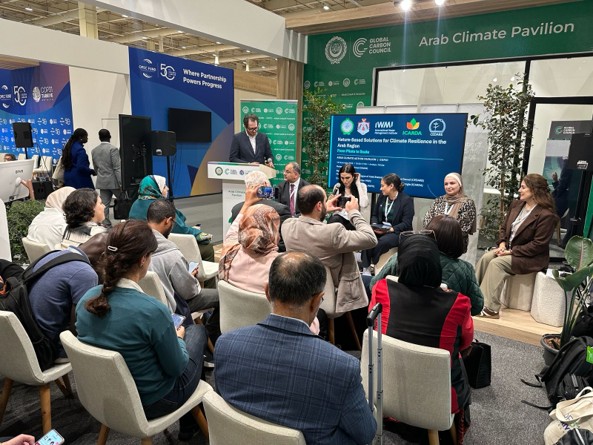
Organized by CEDARE in collaboration with regional partners, including the League of جامعة الدول العربية – League of Arab States (LAS), the International Water Management Institute (IWMI), Jordan’s Ministry of Water and Irrigation (MWI), and International Center for Agricultural Research in the Dry Areas – ICARDA, the session focused on a critical challenge facing the Arab region: How can successful nature-based solutions move beyond isolated pilot projects to become scalable, financially sustainable and nationally owned climate resilience programmes? Moderated by CEDARE’s Mr. Yusuf Emad, the session brought together Ms. Nair Alaa Eldin (LAS), Dr. Mona Daoud (CEDARE), Eng. Wafa Shehadeh (MWI, Jordan), Dr. Vinay Nangia (ICARDA), and Dr. Sawsan Gharaibeh (IWMI) to explore regional experiences and the policy, financing and institutional barriers to scaling.
Drawing on CEDARE’s Al Murunah and Al Murunah+ projects in Beheira Egypt, and ICARDA’s “Enhancing Food Security in Egypt” in Qena Egypt, the discussion highlighted the importance of integrating water security, sustainable agriculture, gender equality, community ownership and local governance into climate adaptation.
The key message was: NBSs for climate resilience cannot be scaled through projects alone; it requires transforming local evidence into lasting policies, investment and regional cooperation, with communities at the heart of implementation.